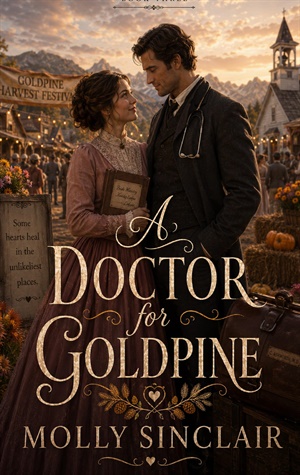
A Doctor for Goldpine (The Goldpine Brides #3)
CHAPTER 1
The Matchmaker's Quiet Ledger
Ruth Larson had matched eleven couples in four years of running her brother's bride ministry, a fact she knew with precision because she kept a small, private ledger in the bottom drawer of her writing desk recording each pairing, each wedding date, and, with particular satisfaction, each subsequent happy report that filtered back to her through the ordinary channels of a small town's affectionate gossip.
Amelia and Jed Thorne, entry number six, now blessed with a second child on the way.
Callie and Nathaniel Cross, entry number eleven, married not quite a year and evidently thriving, if the considerable warmth in Callie's last letter was any accurate measure.
Ruth read over these entries some evenings with the particular satisfaction of a woman who has built something worthwhile with her own two hands, and if she occasionally felt a small, unbidden ache turning the pages, wondering when precisely her own name might warrant an entry, she generally closed the ledger before the feeling could properly take hold.
She was not, she reminded herself frequently, an unhappy woman.
She had purpose in abundance — the ministry's correspondence to manage, the church's considerable needs to attend to alongside Josiah, a whole town's worth of families who had come, over the years, to rely on her steady presence at every birth, every illness, every ordinary crisis that required a capable, unmarried woman with time enough to lend a hand.
She had told herself, often enough that she had nearly convinced herself of it, that this full and useful life constituted its own genuine happiness, requiring no further romantic embellishment to be considered complete.
“You've got that look again,” Josiah observed, one warm August evening, finding her at the writing desk with the ledger open before her. “The one you get when you're totting up other people's happiness and wondering, real quiet-like, when your own turn's coming.”
“I don't know what you mean, Josiah.”
“You know precisely what I mean, Ruthie.
You've matched half this territory's lonely hearts these four years running, and I've watched you do it with genuine joy every single time, never once begrudging any of them their happiness.
But I've also watched you close that ledger with a particular sigh, more evenings than I expect you realize, and I'll ask you plain, sister, since nobody else seems inclined to ask it — when do you intend to consider your own prospects with even a fraction of the careful attention you give everyone else's?”
Ruth closed the ledger with rather more firmness than the question strictly warranted.
“My prospects, as you so delicately term them, are rather limited in a town this size, Josiah, as you well know.
I've turned down every eligible bachelor Goldpine's produced these four years, and not for lack of genuine effort on their part, only that none of them ever struck me as anything beyond perfectly adequate, and I confess I've grown rather particular, watching eleven couples find something considerably better than merely adequate.”
“Then perhaps Goldpine simply hasn't yet produced the right particular man,” Josiah said mildly, “which strikes me as an argument for patience rather than resignation.
You're only eight-and-twenty, Ruthie, not eighty.
I'd wager there's considerable time yet for the Lord's providence to deliver someone worth your particular standards.”
“I'm not resigned, Josiah, only realistic.
I've made my peace with the shape my life has taken, and I find it a good shape, full of purpose and genuine usefulness.
I'll not spend my remaining years pining after some imagined romance that may never arrive, when I've got considerable good work to occupy me exactly as I am.”
This declaration, offered with more conviction than her brother's gentle probing had quite managed to shake, closed the conversation for that particular evening, though Ruth found herself, retiring some hours later, turning the exchange over with rather more unsettled attention than she cared to admit.
She had built her whole adult identity, in the years since their parents' deaths had left her, at nineteen, the effective mistress of Josiah's household and the practical manager of his fledgling ministry, around the steady, reliable usefulness of a woman who put others' needs before her own.
It had never occurred to her, in all those years of careful service, to properly examine whether that usefulness had become, somewhere along the way, less a genuine calling and more a comfortable shield against the more frightening prospect of risking her own heart on uncertain romantic ground.
The town's more pressing difficulty, as it happened, had nothing whatsoever to do with Ruth's private romantic prospects and everything to do with the considerably more urgent matter of Goldpine's continued lack of a proper physician, old Doc Hansen having passed quietly in his sleep some three months past after four decades of faithful service to the district, leaving the whole territory dependent on the nearest doctor in Cheyenne, a full day's hard ride distant, for anything beyond the most basic first aid the town's collective folk wisdom could manage.
“We cannot continue indefinitely without proper medical care,” Josiah said, some days later, raising the matter over their shared supper with the particular gravity he reserved for genuine civic emergencies.
“I've written to three separate medical schools back east requesting they post notice of the position, but I confess I've had precious little response thus far, this territory's rough reputation apparently discouraging even considerable financial incentive from tempting many young physicians west.”
“Perhaps the notice wants a different approach,” Ruth suggested, her own considerable experience with the bride ministry's correspondence lending her a practical perspective on the matter.
“Rather than simply advertising the position's practical particulars, perhaps we ought to appeal to whatever physician might be seeking precisely the kind of fresh start this territory has proven so capable of offering others.”
“You're suggesting I run a physician through the same particular alchemy as your bride ministry.”
“I'm suggesting, Josiah, that this territory has a considerable gift for delivering exactly the difficult, worthwhile beginnings certain people most need, however unlikely the path that brings them here.
I've watched it happen eleven times now with brides fleeing unwanted circumstances.
I don't see why the same principle mightn't apply equally well to a physician seeking his own fresh start.”
Josiah considered this counsel with evident interest, and set about revising his notice that very evening along precisely the lines his sister had suggested, neither of them yet properly understanding how thoroughly that small editorial change would eventually reshape both their futures.
Ruth herself retired that night turning over the evening's conversation with rather more unsettled attention than the practical matter of a physician's notice generally warranted, finding her thoughts circling back, against her own better judgment, to Josiah's earlier gentle probing regarding her own romantic prospects.
She had spoken with genuine conviction, defending the full and useful shape her life had taken, and she believed, examining the conviction honestly, that she had not entirely lied in the defending of it.
And yet some small, persistent voice, one she generally managed to keep carefully quieted beneath the day's practical business, continued to ask what precisely she imagined her life might look like in another decade, still keeping the same careful ledger, still closing it each evening with the same small, unbidden ache.
She thought of her mother, briefly, dead these nine years now alongside her father in the same terrible winter fever that had claimed them both within a fortnight of each other, leaving nineteen-year-old Ruth suddenly responsible for a grieving younger brother barely embarked on his own ministry training and a household that required, overnight, the same steady competence her mother had once provided as a matter of unremarkable daily habit.
She had stepped into that role without any particular fanfare or self-pity, understanding it simply as the plain, necessary business of a family facing sudden hardship, and had built, from that necessary beginning, the whole considerable structure of purpose that presently defined her life.
She wondered, turning the matter over in the quiet of her own room, whether her mother might have counseled her differently than Josiah's gentle probing had managed, whether she might have recognized in Ruth's careful contentment something rather closer to a comfortable hiding place than a genuine calling freely chosen.
It was not a comfortable question, and Ruth found herself, drifting eventually toward sleep, deciding to set it aside for the present rather than examine it any further, the practical business of finding Goldpine a proper physician offering a considerably more manageable problem than the more elusive question of her own heart's genuine wants.
Morning brought its own considerable distraction from the previous night's unsettled reflection, a message arriving from the Cross ranch reporting that young Sam had taken a nasty fall from the hayloft and required whatever basic assessment Ruth's considerable practical experience could offer, the family being reluctant to undertake the full day's journey to Cheyenne for what might prove, upon closer examination, a minor injury not warranting such considerable trouble.