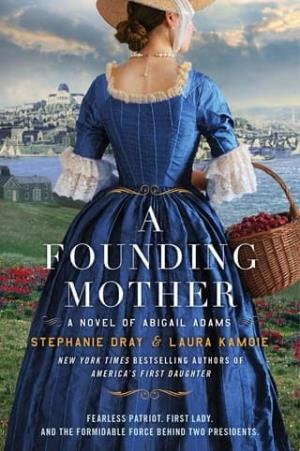
A Founding Mother
Prologue
QUINCY
Massachusetts
Was it all for naught?
Mine has been a life spent bleeding, starving, fighting, and straining to bring six children and a new nation into being.
At nearly seventy years of age, I am exhausted by the struggle. My hair is white, my back bent by time, my hands and knees
stiff with pain. And as I dig in the dirt to plant a rosemary bush of remembrance by the family tomb, I’m reminded by the
mocking song of the cicadas that four of my six children are dead. The other two are lost to me. And our nation’s capital
is under attack.
For more than four decades—long before we won our independence and long after—the British have menaced our cities, terrorized
our coastlines, seized our ships, kidnapped our sailors, and tried to stamp out the flame of our revolution.
Well, this time, they may finally do it.
So I’ve come to commune with my lost loved ones, fists full of the soil of my country for as long as I may still call it that.
I ignore the approaching carriage on the road—a simple chaise pulled by one horse. I don’t wish to be disturbed. I don’t wish
to put on a brave face as yet another person looks to me for reassurance that this hour is not as dark as it truly is.
But then I hear John call my name and look up with surprise to see my husband in the driver’s seat, his aged hands gripping
the reins.
At nearly eighty years old, John is still noble in profile. And he still looks the part of the president he once was. But his presidency was more than a decade ago. Now his sight is failing, his teeth are bad, and there is scarcely a hair still left atop his head.
Fortunately, his mind remains active, though that is presently a curse, for he knows that all we have done—and all we have
been—stands in peril.
Pulling the carriage to a stop, he motions to me with urgency. He is too frail to get up and down without assistance, so I
go to him, brushing dirt and dried grass from my black skirts. Of course, I am also frail, so it takes three tries before
I manage to haul my old bones up into the narrow seat beside him. “You have news?” I ask, my voice atremble.
He nods, tears glistening. Then his shoulders slump as he surveys the rolling hills. “Never did our country appear more beautiful
than amidst this catastrophe . . .”
I brace for the worst. “Washington has fallen, then? The British have taken it?”
John’s mouth flattens to a grim line. “Worse. It is conquered and set ablaze.”
I take a pained breath—then another—before I can speak again. “The president’s house?”
“Burned,” John replies.
I am sent reeling by this news, flooded with memories of those bygone days when I hosted dinners and a grand New Year’s party
in that lovely white manse as the president’s lady. I can still picture the oval room, the red upholstered furniture, the
sunny, picturesque view of the Potomac River. I cannot imagine it all devoured by flames at the hand of a tyrant . . .
Nevertheless, John catalogs the destruction. “Both chambers—House and Senate. The Treasury Building. The war department. The
naval yard. The Library of Congress. All burned to rubble and ash.”
Outrage heats my cheeks. Some would consider it wrong that I grieve more for the books—for all that knowledge lost—than for the mighty edifices so many years’ effort took to build.
But I do. John once wrote that liberty cannot be preserved without the people desiring and possessing a general knowledge.
More than anyone, I know he hasn’t been right about everything.
But about this, he was correct. “Barbarians,” I spit.
“This is no superior act of warfare. Just a haughty act of Gothic vandalism. And the British still think themselves our betters . . .”
John is silent.
I go silent, too, until I finally summon the courage to ask, “Is the war lost, then?”
My husband’s gnarled hands juggle the reins. “The United States has not yet fallen, but I see nothing to prevent the enemy
from victory. President Madison has fled and is in hiding. We have no regular army and cannot get one. The militia fight when
they please and run when they please. Our revenue is inadequate, our credit has fallen, our dignity lost.” He heaves a sigh.
“I’m afraid the English have guillotined us.”
My breath goes shallow, my hands and scalp prickle, and my heart thuds with despair.
This is the end, then. The end of the American experiment. The death knell of the United States. The destruction of everything we believed in,
everything we struggled to build, everything we sacrificed for. I look to the cemetery where my trowel and gardening gloves
still lie and imagine a new headstone standing among the others, this one for the United States of America. Perhaps we ought
to bury John’s copy of the rough draft of the Declaration of Independence. It would make as good a symbolic corpse as anything
else, and burying it might safeguard it against British destruction besides.
John senses the tenor of my thoughts and offers one slim hope. “How many states the British will conquer, I know not: but
they will not subdue them all.”
Will it matter? With Massachusetts threatening to break away and make a separate peace with Britain, my husband—who has gone
from traitor, to patriot hero, to president—would likely be deemed traitor again. And he wouldn’t be alone.
All the surviving founders of the Union could face the same fate. Dear God, the fathers who fought and bled, risking life and property to obtain independence and secure a democratic form of government,
are surely asking themselves if they fought and bled in vain.
But what of the mothers of this country?
Fathers might drive the ploughs that till the fields of our future, but mothers provide the water, pull the weeds, and nurture
the buds. Because men oversee the harvest, they take the credit for the crop. But without mothers, not one sprout would grow—whether
the fruit be a child or a nation. It is mothers who nourish and guide each shoot toward the light without knowing what may
blossom and what may wither on the vine. Without knowing which children will live or die. And as one of those mothers, I cannot
help now but think back upon the acts of my life that may have brought us to this place.