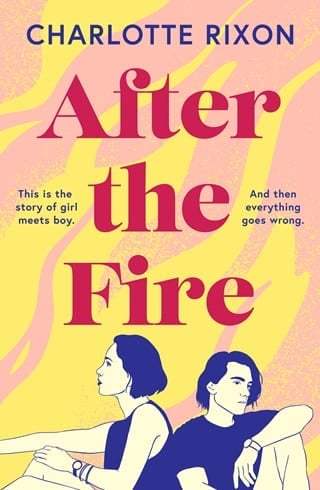
After the Fire
Beth
Beth
Fourteen years after
The final tech run is over. Opening night is tomorrow. Press night is just around the corner.
And for the first time, the doubts have started to creep in.
Why on earth did she think that doing a one-woman show was a good idea?
It was a foolish thought, thrown out over lunch with her agent, who seized on it and ran further and faster with it than she could have imagined.
But of course, she knew why she’d suggested it. She’d wanted to do it because it would mean the best part of a year locked away in her little mews cottage, writing and hiding from the world.
She thought it would be cathartic. A way of getting back to her : the girl she once was. Who now often seems entirely swallowed up by the woman the world believes her to be.
After The Fire .
That’s the name of the play. A monologue, a memoir, therapy borne out on stage, in front of strangers. Masochistic narcissism too then, really. But once she shared the script, everyone was surprisingly excited about it, and it felt good to be doing something people were energised by, and she does so like to please.
For a while, she was sure the decision had been the right one. The experience of writing it was exactly what she’d hoped it would be. A way of getting out all that she’d bottled up for so long. At one point, midway through the writing process, she realised that she was actually enjoying it.
But she knows, after three weeks of intensive rehearsals, that although she enjoyed the journey here, she won’t enjoy the final destination: performing her life in front of an audience.
She doesn’t enjoy playing herself. After all, she became an actress precisely so she could pretend to be other people.
Aside from anything else, it’s lonely. She misses the buzz of having a cast around her. Those heady days at university, and early on in her career, when she was performing in the chorus of so many productions – not just West End ones but cheap-as-chips fringe shows too.
Somehow, they were even better. You could practically taste the hunger and ambition in those dressing rooms.
It’s been three days since her fight with Nick and she’s barely slept since. She can’t remember feeling this exhausted. This emotionally disordered.
Last night, she had another nightmare, the worst for a long time.
Everything feels wrong. She’s trying to tell herself that things are the way they should be, that in the long run this will be a good thing, bringing everything to a head so that they can move on. But it doesn’t feel good. It doesn’t feel right. Nothing about any of this feels right.
She’s packing up her things when the theatre manager, Penny, knocks lightly on her dressing room door.
‘Come in!’ she calls.
‘All set for tomorrow?’ Penny asks. ‘How are you feeling?’
Beth gives her the smile everyone loves. Gap-toothed, wide.
And this time: inauthentic.
‘Good, thank you. Excited.’
‘Not nervous?’
‘Oh, only a little,’ she laughs.
She’s not being truthful. But what other answer could she possibly give? She can’t burden Penny with her neuroses.
Penny nods and presents her with a bouquet, placing it down carefully on her dressing table. Ornamental cabbages. Beautiful from a distance. Ugly up-close.
‘Very striking aren’t they? Someone wanted to get in early,’ Penny says, raising her eyebrows. ‘Or perhaps they got the date muddled up.’
‘Thanks, Pen. Wow, they’re… different.’
Penny grins at her. She has that look in her eyes – the one most people have now when they look at Beth. Admiration. Devotion. As though she’s some delicate, rare treasure that must be protected.
It makes her uncomfortable. After she won her Olivier Award, even her mother started doing it. Even though her mother had never even heard of the Olivier Awards before then.
Nick was the only one who looked at her like she was just a normal person. The girl he’s known for fourteen years.
And now he won’t want to look at her at all.
But perhaps… are these flowers from him?
Beth holds her breath as she plucks out the small card that’s nestled in between the cabbages. She can tell they are expensive. Someone is trying to impress her, to catch her attention and hold it – because people have been fooled into thinking her attention is valuable.
People love you more when you’re successful. More people love you when you’re successful, too. As though success somehow proves that you matter more than everyone else.
She hates that idea. And yet she has pursued it, relentlessly, for as long as she can remember. It’s an addiction, the same as all the others. Just less honest, perhaps.
She’s always claimed the moral high ground, no more so than during her fight with Nick. But now, she wonders, is she as guiltless as she likes to think she is?
She lifts the flap of the tiny envelope, pulling out the cream card inside.
The words written on it stop the breath in her throat.
Congratulations! I’m happy you got everything you wanted out of life. Hope the show goes really well.
Rosa x
She closes her eyes briefly, squeezing the card in her closed fist. Her mind is a buzz of noise, sweat immediately rising to the skin under her armpits.
A memory resurfaces. A picture she had buried so deeply that now she can’t be sure if it’s a memory at all, or a torment of her imagination: Rosa standing opposite her in the union building afterwards, her face white with fear, asking her with hard eyes if she had seen Anna.
It was Rosa’s story too. Not just hers. Not just Nick’s.
Should she have checked with Rosa before she decided to share it?
The marketing for the show is more salacious than she’d wanted. She’d fought against the description they’d used, but the producer was adamant, said they had to pull in the crowds.
You may know Beth Millen as one of the UK’s best-loved and most successful actresses, famous for her trademark smile and shape-shifting talents. But behind the scenes lies a story of resilience and a lifelong struggle to recover from a horror in her past. A horror that still haunts her to this day.
After The Fire charts one woman’s honest determination to rise from the ashes, and asks if we can ever truly move on from the things we’ve lost…
On one level, it was all true, of course, but the way they’d written it felt seedy. Exploitative.
‘We’ve got to get people intrigued,’ her agent had said, taking the producer’s side after she’d protested. ‘It’s difficult to get people to turn up for what might be seen as a vanity project, without knowing there’s going to be some serious payoff.’
Her agent was right. But she should have made more of a fuss. She’s betrayed the others.
She looks at Rosa’s card again. Tries to read between the lines. Is it a note of congratulation, or a note of disgust?
She can’t be sure, but the regret swells in her stomach.
More than anything else, it is a stupid card with stupid words on it because of course she doesn’t have everything she wants. She doesn’t have Nick.
She doesn’t even know if he’ll be coming tomorrow. She sent him an invite ages ago, before they fell out, but he never responded, and she was too cowardly to bring it up.
Now, it seems obvious why he hadn’t got back to her: he wanted to support her as he always has done, but he didn’t understand why she would want to talk about this publicly. He didn’t want to relive it all.
She grips the edge of her seat, nausea rising. Why would Rosa get in touch now, after all these years?
She should have argued more against the way they marketed the show. The way they made it sound so dramatic and sensationalised. It was misleading, inaccurate, unfair.
After all, the whole point of it was that it wasn’t about the horror in her past. It wasn’t about that incident at all.
It was about something more long-lasting.
Something more fundamental but just as devastating…
The aftermath.