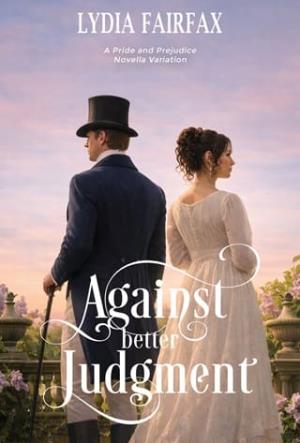
Against Better Judgment
PROLOGUE
Elizabeth
ELIZABETH BENNET left for her morning walk before the household awoke, restless and unquiet in both mind and heart.
The wind caught at the hem of her pelisse and slipped beneath her bonnet, biting at her cheeks with a chill that belonged more to March than to April.
The air felt sharper than it ought, or perhaps it was only that she could not be still.
Sleep had eluded her. Each time she closed her eyes, Mr. Darcy's voice returned—steady and proud, trembling only when she refused him.
The disbelief in his tone, the warmth that had broken through his reserve, and the pride that had coloured every sentence played again and again in her thoughts until she could bear it no longer.
Her thoughts wandered to the events of the previous day. The proposal had been unlike anything she could have conceived; it was astonishing, ardent, and offensive all at once, and her heart still beat more swiftly whenever she recalled it.
A few months earlier, her cousin, Mr. Collins, had offered her his hand.
She had refused him, and he was now married to her dearest friend.
Elizabeth’s mind drifted to that ridiculous morning when Mr. Collins, looking as limp as a wilted lettuce in his ill-fitting coat, had declared his affection in the Longbourn drawing room.
She laughed softly as she stepped over a small stone in her path.
Even now, she could hardly believe that any proposal might rival Mr. Collins’s absurd declaration, yet Mr. Darcy’s had been far worse.
Where Mr. Collins was ridiculous, Mr. Darcy was wounding.
His pride had turned what might have been a compliment into an insult, his affection offered as though it were a favour she ought to accept with gratitude.
She had come to Kent expecting nothing beyond Charlotte’s good sense, Mr. Collins’s pompous attentions, and Lady Catherine’s ceaseless instruction.
Never had she imagined she would be obliged to endure Mr. Darcy’s company, still less to be offered, and compelled to refuse, his hand.
Yet here she was, restless and ashamed that her thoughts would not leave him, determined with every step to think of him no more.
Her feet followed the narrow path behind the parsonage, though she scarcely noticed where it led.
The quiet brought no peace. Every sound seemed to echo her thoughts, every turn to recall the look upon his face when she had spoken the words that must have wounded him deeply.
She told herself he deserved it, yet the recollection troubled her all the same.
She rounded a bend in the grove and caught her breath.
Looking in the distance, her eyes caught a figure moving ahead among the trees, tall and unmistakably familiar in form.
For a moment, she thought her imagination deceived her.
Then the first light of morning shifted through the branches, and she saw him clearly.
Mr. Darcy.
He was pacing the path, his steps quick and uneven, his head bent as though contending with some inward struggle. The sight held her fast. Her heart beat so violently she feared he might hear it. A sudden warmth rose to her cheeks, half from alarm, half from a feeling she could not name.
He had not yet noticed her. She stood motionless, unwilling and perhaps unable to withdraw, her eyes fixed upon the restless motion of his hands, the rigid set of his shoulders. There was unease in every line of his frame, the very air about him charged with agitation.
When at last he turned and their eyes met, he stopped abruptly. The flush that spread across his face, and the way he removed his hat in haste, spoke of surprise and an instant effort at composure.
Unwilling to give him the satisfaction of seeing her discomposed, Elizabeth continued along the path as though quite unaware of his presence.
He came forward with measured composure, his hat in his hand, his expression grave.
The effort of control was evident in the firm line of his mouth and the slight tremor of his fingers upon the brim of his hat.
Elizabeth offered a brief curtsy as their paths crossed. "Good morning, Mr. Darcy." Civility, at least, required that much of her.
“Good morning, Miss Elizabeth,” he replied. His voice was low, his manner constrained. “I have been walking here for some time in the hope of meeting you. May I beg a few minutes of your attention?”
Elizabeth caught her breath. “You wish to speak with me, sir?”
She had not been willing to stop before, yet now she found she must.
“Only to deliver this.” He drew a folded letter from his coat and held it out to her. “Will you do me the honour of reading this letter?”
The paper gleamed faintly in the morning light.
Elizabeth regarded it, then raised her eyes to his.
His countenance met hers with steady earnestness, and for a moment her resentment faltered.
There was something in his aspect—fatigue perhaps, or perhaps even sincerity. She could not determine which.
“I think it unnecessary, Mr. Darcy,” she said quietly. “Nothing you could write would alter my opinion.”
He paused, as if considering his next words. Then he inclined his head. "You must allow that there are matters which could not be spoken of yesterday. This letter contains only the truth. You may read it or not, as you wish."
Elizabeth could scarcely believe what she was hearing. The sheer presumption of it—to stand there offering explanations as though she were obliged to hear them, as though his version of truth must naturally supersede her own judgment.
You may read it or not, as you wish.
How magnanimous. How like him to frame even this as a choice he was granting her, when the very act of presenting the letter presumed she would care to know his thoughts at all.
Her tone grew sharper. “I cannot accept it, sir. The subject is too painful. What you did to my sister and to my friend, Mr. Wickham, cannot be justified. And, as propriety dictates, any written communication between us would be improper. Pray let this be the end.”
He hesitated, his eyes searching her face as though weighing the force of her refusal.
Then, without a word, he crossed to a nearby stone bench and laid the letter upon it with deliberate care.
"I will respect your wishes," he said quietly.
"Should you reconsider, it will remain here until I quit Rosings.
ssHe bowed, his manner composed yet subdued, and turned away. His steps soon faded down the shaded path, leaving only the soft crunch of leaves above.
Elizabeth did not move. Her gaze fell upon the letter resting on the bench, the seal bright against the worn stone. For a moment, curiosity stirred, swift and unwelcome.
What could he have written? What truth could possibly excuse such arrogance? Her fingers twitched at her side, but she refused to yield.
To take it would be to question her own judgment. She would not.
Drawing a steady breath, she turned and continued along the path. Behind her, the letter lay untouched, its edges stirring faintly in the breeze, waiting for a hand that would never come.