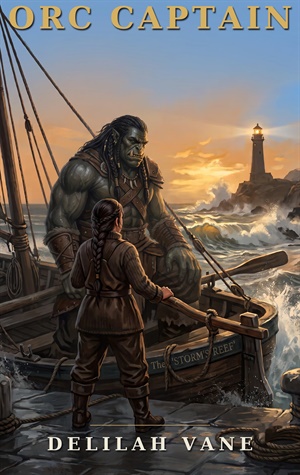
Anchored to the Orc Captain (Orc Warlord Brides #5)
One Soundings
Wind backing northeast. Sea building on the bar. A warship where no ship should be, dismasted, black hull down at the head, swinging her broken bones across the only channel out of Saltgate.
And me, rowing at her.
Quill is screaming something from the harbormast. Can’t hear it.
Don’t need to. There is one fact in the world right now and it is under my keel: four fathoms shoaling to two, the bank moving the way it moves after three days of northeast blow, and a window of slack water you could spit across.
The Petrel takes the first breaker on her shoulder like she’s done it four hundred times, because she has.
Sixty heartbeats to the wreck. I count them in strokes.
Orcs in the water. Three clinging to the rail of what used to be a fighting ship, one of them roaring orders at the sea itself, as if the bar has ever once in its life taken an order.
I put the Petrel alongside on the lee quarter, where the hull makes a wall of the worst of it. “Rope!” I shout, and throw it. “Not there. There. Two of you, wounded first. You, big one: you’re last, and if you swamp my boat I’ll put you back.”
The big one turns in the water. Half-drowned, bleeding over one eye, his ship dying under his hands, the bar hammering the hull a boat-length away and reaching for all of us.
He grins at me.
Gold caps on both tusks, seawater in his teeth, a grin like the sun coming up wrong, and he calls across the water, cheerful as a man at his own wedding: “Whose boat?”
“Mine. Get in it.”
“Sound bottom,” says the orc, to nobody, to the storm, approving, and takes the rope.
That is the whole of how I met him. And no: I did not fish him out because of the grin.
I fished him out because it is my water, my bar, my job, and nothing drowns in my channel while I have a hull under me.
The grin I noticed the way a pilot notes a new wreck: a hazard to shipping, marked for avoidance.
I got them in over the transom, two bleeding and one gold-toothed and delighted, and I read the bank once more, and took the window when it opened.
Following sea. Bad one under the quarter at the turn.
The Petrel shook it off. “Good girl,” I told her, quiet, and put us through the gate of the breakwater into flat water and the whole crowded quay shouting, and that was that.
Ashore, later, it stopped being simple. Ashore is where things stop being simple; it’s why I like the water.
I’m Nell Pryor. Twenty-eight. Pilot of Saltgate bar, licensed the day I turned twenty-one, taking boats over that bank since I was tall enough to see the leadline marks, daughter of the best pilot this coast ever had and the proof, if you want it, that the sea doesn’t pay its debts either.
I live at the pilot station on the point with my father and a kettle that has never once boiled fast enough, and until the autumn the fleet came home early, I had a life so plainly arranged you could have read it off a chart.
Work the bar. Mind the soundings. Owe nothing. Nothing, to anybody, ever.
Notice that I did not say and no one owes me. I hadn’t thought that part through. Nobody ever thinks that part through.
They came up to the station at dusk, once the wounded were stitched: the harbormaster, two dripping orc officers, and the big one, patched over the eye, wrapped in somebody’s spare sailcloth like the world’s least repentant ghost, still — I could not help noticing, and resented it — wearing the grin.
“Salvage,” said Quill, apologetic, hat in his hands. He’s been harbormaster thirty years; apology is his weather. “It’s the law of the coast, Nell. Lives and hull both, taken off the bar in storm. The claim’s yours. I have to enter it.”
“Waive it,” I said. Kettle on. Not looking at any of them. “They were in my channel. It’s rowing, not commerce.”
And a voice like the whole cheerful ruin of the day said: “No.”
I turned around. The big one had come in under my lintel, bent nearly double to do it, and straightened up into the rafters, and the room got smaller in a way I declined to acknowledge.
Up close, out of the water: thirty-one, I’d learn — young for what the wreck said he was — deep-chested, built long and quick where the mountain orcs I’d seen at market were built like retaining walls.
Skin the green-black of deep water over sand.
The gold-capped tusks. One eye covered; the other amber-bright — no.
I’ve heard about the mountain warlord’s amber.
This was yellower, harder. Lamp-oil. Wrecker’s light.
“Skarn,” he said, as if the name were a coin he enjoyed spending.
“Captain of the Reefbreaker, first of the war-chief’s southern squadron, and I’ll tell you the whole of it: youngest fleet-captain the Tidehold has ever cut loose, seven actions, never lost a ship.
” A pause you could have moored in. “Until the one currently sitting on your bar. So. The claim stands. Enter it, harbormaster.”
“You’re refusing my waiver,” I said. “In my own kitchen.”
“I’m refusing charity,” said Skarn, and the gold-capped brightness banked down to something with keel to it.
“A Tidehold captain does not float off on forgiven. You took three of mine and my hull off a killing bank in a following sea with a boat I could wear as a boot. That has a price, and I pay what I owe. Every copper. Every hour.” The grin came back up the way the sun comes up, wrong, wonderful.
“Besides. I’ve just watched the best boat-handling of my life and I hear the pilot’s shorthanded. ”
That is how, by the coast’s own law, in front of witnesses, with my kettle boiling behind me like an omen, I came to hold a salvage claim on an orc war-captain. Him. His hull. His hours. Mine, on paper, until the debt was worked to zero.
“You’ll regret it,” I told him. “I get up before the gulls.”
“Pilot,” said Skarn of the Tidehold, settling into my father’s second chair as though it had been carved for him, “I have regretted nothing since the year I learned to swim, and I don’t propose to start with you.”
He was wrong about that, as it happens. But it took the whole winter, and I’m telling this in order.