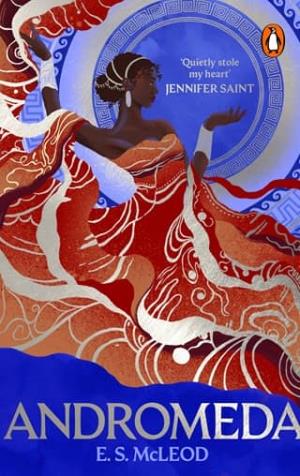
Andromeda
Chapter 1 Aethiopia
Aethiopia
Having come to stare at my face, the fish dies gasping above water, and this is how I first see death in my beauty.
That I am beautiful is fact and it is fact because no one would ever say differently.
It is the first thing that I know about myself.
Such things are normally opinion, but this is not because the gods will it.
This is what my mother says, what everyone says.
I am six. My grandmother is teaching me to catch my next meal with my bare hands.
I do not know happiness like the wriggle of mulch between my toes.
I strip and immerse myself, taste the liquid sun and the cool beneath.
I swim beside my grandmother, who I suppose taught me, though I did not need to be taught. I am made of rivers.
She says, ‘You must be faster than the sparkle!’ Then her eyes widen as I reach, snatch, catch.
The fish is a juicy, twitching trophy. I catch another.
Then another. I am delighted. I believe myself talented, the world’s best fisher.
But the shoal does not stop, more and more fish appear.
They stare at me with their bulbous eyes, unable to look away until they are drowned in the warm air.
I am naiad enough to speak to them as they gape, and I learn the truth.
Their friends whisper of me and they want to see for themselves.
I am not so sure I am worth it, but my basket is full.
Phineus, my father’s younger brother but only ten years my senior, is sitting on the banks beside us, and he grins down into my face, crowing, ‘Faster than the sparkle, Ma? Why, our Andromeda is the sparkle!’ before tossing me easily into the air.
I am pleased. I am giddy. I am the sparkle.
But later, as I fall asleep, I see their unblinking gaze, bloated and bulging, as though their eyes are stuck to my lids, as though they have misted over mine like tears.
After this, I become aware of how my entire world is eyes.
They linger like the light on the glittering pieces at my neck and ears; they are quicker and even less forgiving than the whispers of my father’s court.
These at least are drowned out by the rushing of my river nearby and the sound of the brush moving through my hair under my mother’s ministrations.
I feel the eyes here too, judging it as scandalous, the way she dresses and brushes me herself.
But my mother trusts me with no one else.
Perhaps this is because anything less than perfect is unacceptable, and it is Queen Cassiopeia alone who may judge perfection.
Or perhaps it is because my grandmother will secret me away when my mother’s back is turned, and the servants are too scared to stop her.
She appears from the river, dark and shining like the pebbles on its banks, scales and reeds clinging to her, and they shrink away from Achiroe, naiad daughter of Nilus.
They eye her nervously, weighing their options.
Their queen, famed for her fierce tongue and fiercer temper, who will surely rage at them when I return, muddy and smelling of earth?
Or a daughter of the River himself, rapids made flesh?
They look from my grandmother’s unyielding face to my eager one.
Well, they think, King Cepheus won’t be so very angry.
The River Goddess is his mother, after all.
Who are we to keep a child from her grandmother? And so I am gleefully swept away.
My mother often asks me if I would not prefer the company of other girls to that of my grandmother, for in our palace there are daughters of nobles and advisors in their plenty that I could have as friends.
But I would not. They do not look at me as they do each other.
They are at once too keen and too wary; my face is too full of meaning and I cannot be at ease.
I cannot meet their stares with scowls of my own without risking my mother’s admonition, which I fear as much as I crave her approval.
There is no consequence to their looking, not for them.
Little children are told by their elders that such open appraisal is impolite, but I am the princess, their princess, I belong to them and so they stare as they would at some fine statue erected and unveiled to honour Aphrodite.
Blessed by her though I am, the goddess of beauty scares me. I pray I avoid her notice.
It is during my ninth winter that I come to understand that my beauty is not exceptional in its inspiring of violence.
My grandmother is telling me a story. We drift idly downstream, her voice in harmony with the warm, damp world that hums around us.
Here I feel large, as though I stretch beyond the bony protrusions and ranginess of a body my mother assures me will fill out soon.
It is my favourite way to spend a day. I am rocked and cradled by currents, listening to my grandmother’s tales of our kin, so very high up and far away.
Others who are so connected might boast gleefully of their third cousin’s wife who is related to a dryad, but my grandmother’s tales often feel like warnings.
She says, ‘This is not the story that will be told. It is not that which will be spun into immortal tune by bearded bards. That is an inescapable truth that cages us like flesh, but this—’ she tips her head back so that it is half submerged in the water, ‘I am giving you a key, a door opened to understanding.’
My grandmother’s words weave the tale and my mind makes the music, animal and raw, the cawing notes of the gulls that witnessed it all:
There was once a priestess, and she was beautiful.
And, like all beautiful creatures, she was coveted, desired.
There are some who will merely look upon beauty and wish for it, but there are some who would take it, try to possess it themselves, try to hold it tightly and care little if, in their crushing grip, it breaks.
This is what happened to the priestess.
For there is no hold so tight, no grip so crushing, as that of a god, and it was a god that wanted her.
Afterwards, the priestess lay in her temple’s shadows as the light began to fade. She watched Astraeus throw spears at the sky and pierce it like skin, until it bled mottled blue and purple. She was cold. Her lips were bruised and split, and yet – she said her prayers.
She prayed and prayed until the deep blue above was sapped of its saturation.
I am told, in this moment, she wondered if she and the sky were one; if she were bleeding it dry.
It looked wan and sickly and she pitied it, rather than pity herself.
For a long time, she was met with silence, her prayers unanswered, and this, to her credit, enraged her.
And so she screamed, ‘Hear me, O Wise One! Hear me, my most beloved Lady! I have cleaned the floors of your temple, I have loved you well! All I had I gave to you! How can you turn from me now?’
And – to Athena’s credit – she appeared.
She was ire and ore, cool grey at the end of the day dyed orange as died the sun.
‘Forgive me, Wise One.’ The priestess’s voice was hoarse, raw. ‘The Lord Poseidon took what I did not willingly give.’
‘Hush. You do not need my forgiveness,’ Athena replied.
‘Avenge me, Wise One. Have I not served you well?’ the priestess pleaded.
‘You have,’ Athena agreed, ‘and if I could tear him apart I would do so gladly. But I have not the weight to balance the scales against him. He is the colonizer of primordial waters – he claimed each drop of embryonic fluid as his own. To provoke Poseidon is to turn existence on its head; my father would not allow it.’
‘Then I beg you, leave me, for I am lost.’ The priestess clawed at her face, dug her fingers into her thighs, which were immediately stained, as if by a sacrifice.
Athena said, ‘You cannot be lost where wisdom is found, and here I stand. Come, child, do not despair.’
But the priestess sobbed still. ‘If you are just and wise then help me find sense here. I always did as I was bidden. My mother promised me a prince for a husband. It is why she gave me my name. A prince or a king for my Medusa, for my little ruler, she said. I was not named for this.’ The priestess wept and wept for her mother.
Athena reached for her.
Here my grandmother opens her eyes and looks at me.
She says, ‘They do not tell of the goddess reaching. But she finds injustice vexing. We know this. And this is more than hubris and mortal collateral damage – the assault of her priestess, the defiling of her temple – this is a slight against her.’
‘Names are a kind of prophecy and prophecy is a kind of burden,’ the goddess said.
‘Your queendom is as it must be, but it was never yours to choose.’ Then – as the scales shone silver, so brightly came an idea.
‘I cannot retrieve what has been taken but I can assure you that no man will ever so take again.’ Athena paused, and then said, ‘They will come for you still, one day. And when they do, it will be for your head.’
‘Better that, than this,’ said the priestess.
‘And by then you’ll have tasted such sweet retribution that you shall die full and satisfied.’
The priestess’s eyes grew wide. ‘My mother always said that to take revenge is to poison oneself and expect another to sicken.’
Athena threw her head back and laughed. ‘Your mother is a fool. Vengeance and justice are fiery bedfellows. Make this rock your empire. Turn back the eyes that have looked too long upon you, make them your sentry, little ruler.’
The goddess bestowed her parting gift then and gave the priestess, named to rule and born to protect, the face of one who rages back.
Twisting serpents crowned her head and indeed it was a kind of coronation; Medusa the Gorgon blazed before her.
And from that day forward, Medusa no longer suffered the consequences of dangerous looks.