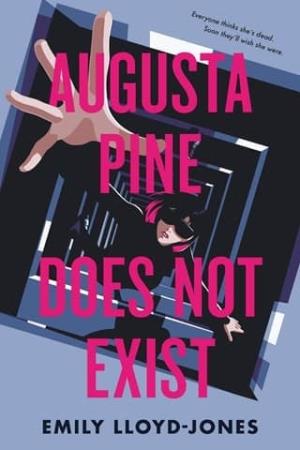
Augusta Pine Does Not Exist
Augusta Pine Does Not Exist
This is how you kill someone.
You don’t need a gun or a knife. You don’t even need to want it. All it takes is one bad decision.
I was fifteen when I became a murderer.
There was a boy. A beautiful boy. He had a way of looking at things—like the world brimmed with unseen wonder.
And if he couldn’t find the beauty, he would make it.
His nail beds were smudged with charcoal from art class.
In sketchbooks, he captured the softness of apple blossoms, the forest of shadows cast by classroom desks when morning sunlight poured through the windows, and the outlines of students carrying transparent umbrellas in the rain.
One time, I caught him drawing me—and I barely recognized myself.
The curve of my lips held a thousand secrets and my sweep of brown hair seemed artistic instead of unruly.
He came to school in a small red car, bought by his parents so he wouldn’t have to rely on buses.
The car’s autopilot was programmed for school and home and nothing else.
I was nothing like him. My knees jounced with unspent energy, my fingers playing with a cheap smart-ring I’d managed to buy secondhand.
I wrote computer code in the air, my fingers tracing invisible hacks.
I did not create beautiful things—I picked apart existing programs, finding back doors and slipping inside like a thief in the night. I took what I wanted.
And I wanted that boy.
He wanted a day off from school.
The wanting was our undoing.
Because when I hacked his car’s navigation system, I accidentally turned off the program that made us visible to the other driverless cars.
I sat in the driver’s seat, using my smart-ring to upload the hack.
And then I set the autopilot to take us across the city to a local zoo.
We laughed at our own cleverness as we zoomed away from school and onto a bridge.
The sun shone through golden dust motes, and the thrum of music rattled through the seats. It was a moment of triumph, of freedom.
The difference between murder and manslaughter is intent—but that doesn’t matter to the victims.
Let me tell you what does matter: velocity and momentum. Rubber and steel. An SUV trying to merge into a lane that its sensors said was empty. The railing of a bridge, crumpled outward as the boy’s red car was pushed over the edge and into the water below.
I remember the world jerking sideways. I felt my neck snap to one side, fire in my spine. And then there was nothing but weightlessness. Adrenaline surged through my body, sharpened every sense and pulled time to a standstill.
We spent an eternity in free fall.
Hitting the water below was like slamming into concrete. The car crumpled inward, the steering wheel crushing most of my heart.
I was conscious for only a handful of moments.
But it was long enough to see the spiderweb of cracks in the windshield, the lights in the dashboard winking out, and the spatter of blood across the ceiling.
It was long enough to know. To understand.
To feel that bone-deep wrench of guilt. No no no no, oh please no, let me go back, just five seconds, let me fix this, let me not have—
When death took me, I welcomed it.
And then it spat me back out again.
I awoke in an unfamiliar place, in an unfamiliar body, to an unfamiliar man sitting at my bedside.
He had dark hair, a light complexion, and eyes that could have been gray or green.
He wore a crisp white shirt with the sleeves rolled up and a suit jacket draped over the back of his chair.
A tattoo of golden clocks was etched into his left arm and a holographic chessboard sat before him.
When he saw me awaken, he flicked the chessboard away and leaned closer.
The harsh hospital light illuminated the delicate lines at the corners of his eyes.
Countless wires and tubes connected me to machines. To my bleary eyes, they looked like threads tying me to this new reality.
I was a tapestry still on the loom—something yet unfinished.
I licked my dry lips. “W-who are you? Where’s my family?”
The man said, “You aren’t going to know my name, but you may call me Prefect.”
I stared at him blankly, uncomprehending.
He said, “When you hacked that car, you overrode the identity of the owner and hijacked the vehicle’s autopilot. A federal felony, these days. The passenger also died—which leaves you on the hook for felony murder.”
A howl of unspoken grief welled up in my chest. Perhaps it would have eased the pain to scream, to wrench myself from the bed and claw at the floor.
I wanted to close my eyes; I wanted to be away from all of this.
To pretend that I hadn’t done something unforgivable.
I wanted to go back to that morning, to return to the girl who’d offered to help a boy skip school.
I’d killed him. He was gone because of me.
And in that moment, I despised myself with an intensity I hadn’t known was possible.
“Why are you here?” I rasped out. Even my voice sounded unfamiliar. Later, I would learn I’d been intubated for the better part of a week.
“Because it was a very good hack,” said Prefect. “Exploiting a security flaw in the sound system and then uploading a fake update? Quite creative.”
“I killed someone,” I said flatly.
“I never said it was perfect,” he replied.
Prefect reached into his pocket and withdrew two square slips of plastic.
The harsh light gleamed on silver ink. They were tattoo templates, I realized.
For biometric identity tattoos. The electron-ink was special—powered by one’s pulse and rigidly controlled by the government to prevent identity theft.
“Your heart stopped in the ambulance,” said Prefect. “Your rescuers performed CPR on you most of the way to the hospital. Your tattoo went dark.”
I looked down at my left hand. Sure enough, the skin was … empty. It looked strange without the barcode of silver lines. I’d been inked since elementary school. “So?” I said.
“You get a choice,” said Prefect. He held up his right hand, gesturing with the first plastic square.
“This is you. Your name, your social security number, your school records, your vaccinations, your family history. You choose this square and you’ll be reinked.
I’ll leave and your family will be brought in.
Then, you’ll be arrested. You’ll go through arraignment, a trial, or a decent plea deal if your family can afford better than Lawyerbot.
” He cleared his throat. “But make no mistake—you are guilty. And in this state, you’re old enough to be tried as an adult.
You’ll get twenty years at the minimum.”
I blinked slowly, fighting through the haze of drugs and pain. “Not really hearing a choice yet.”
He gave the second square a flick with his left hand. “This is a different name. A different life. If you take it, your family will be informed that you are dead. You will have absolutely no contact with them. You cannot say goodbye. And then you will come and work for me.”
I tilted my head, trying to get a better look at him. “You’re offering me a job?”
“Not a job,” he said. “More like … accelerated community service. Ten years of it.”
Even at fifteen, I wasn’t wholly ignorant of the world. One didn’t recruit criminals to sell cookies. “I’ll be doing bad things, won’t I?”
“Not bad,” said Prefect. “Morally questionable, perhaps.”
“Dangerous?”
“Undoubtedly.”
I snorted—and a flare of agony went through my throat. Everything about me felt raw as an exposed nerve.
“You’ll be working for the Identity Security Division,” he said. “We investigate identity theft, fraud, and other assorted crimes. We hunt criminals with criminals. Sometimes we walk the line of legality. If you ever get caught, we’ll disavow any knowledge of you.”
This could not be happening. Some childish part of me wanted to roll over, to pull the pillow over my head and wait for my mom to wake me in the morning.
“So it’s twenty years in prison or ten years with you?” I said. “That’s not much of a choice.”
Prefect leaned forward. There was a fierce intensity to his eyes, even as his voice was carefully uninflected. “I’m offering you something that a court and a judge and a prison sentence can’t.”
I made no effort to hide my skepticism. “And what’s that?”
The corners of Prefect’s mouth curved into a thin smile.
“A second chance.”