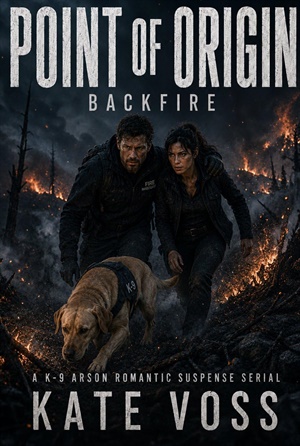
Backfire (Point of Origin #6)
The Set
The dirt was dry to the depth of his knuckle, and that was the first good thing.
He crouched at the corner of the porch and worked a pinch of it between two fingers in the dark.
The one rain of the season had slid down the valley and missed the bench clean.
The grass had gone to straw. The old boards of the house were cured down to kindling.
A careful man knew the ground before he knew anything else, and this ground kept no secrets and picked no sides. He'd built a life on that.
He stood. The house sat quiet above him, black against a blacker sky, no moon. Off the bench somewhere a dog he didn't own barked once at nothing and quit.
He'd been up here twice already. Once to walk the inside, once to leave things where they wanted to be.
Both times the place had held its silence for him.
The old woman was six months gone to her son down in the flat country, and nobody had come up the gravel since but him.
He liked a house that had already been let go of.
It made the work feel less like taking and more like tending.
Inside, in the dark, he knew the rooms by heart now.
The smoke detector was off the hall ceiling and sitting out on the porch rail, the two screws laid beside it in a neat row.
The back door stood unlatched from the inside.
The front would open to a hand and no more.
He'd done all of that on the second trip, slow and gloved.
The small clean steps that made a fire look like weather instead of a decision. Tonight was only the pour and the wait.
Behind him the younger one came up the drive with the first can, walking soft, watching his own feet.
"Down here," the lead said. "Slow. Mind the boards."
"They're loud."
"Then step where I stepped."
The younger one set the can by the porch steps and stood looking at the shape of the thing they'd come to build. Even green, he could see it wasn't the usual.
"This isn't like the others," he said.
"No."
"We always pour to take the house."
"We're still taking the house." The lead popped the cap and let the smell come up, sharp and clean and known to him. Dyed farm gas, forty gallons of it split across the truck bed, bought in a co-op lot that would never remember a face. "We're taking a few other things with it this time."
"What things."
"Come lay the front with me and I'll show you the difference."
He moved along the front of the house with the can held low, laying a thin bright trail down the boards. Back toward the drive. Then out along the two paths a man on foot would take up to the door.
"Watch the lines," he said. "Most nights you pour to close the exits. Doors, windows. You seal the box and let the box do its work. The house takes itself. Tonight we do that too. But tonight we also pour the ways in."
The younger one turned that over. "The ways in."
"A man comes up that drive, he's got two routes to the porch.
The gravel, or the grass along the fence.
We lay both. Thin. Low. Nothing he'd catch by flashlight.
" The lead straightened and looked back down the dark drive, seeing how it would run once it ran.
"He comes up. The house is already going.
And behind him, quiet, the ground he crossed catches too.
He turns to go back down the drive, and the drive behind him is a wall of it. "
"So he goes the other way."
"The other way's laid the same. Both routes fold in behind. Whatever room the two of them are standing in when it takes, that's the room they've got." He capped the can and shifted it to his other hand. "That's the difference. A house pour takes a house. This one takes whoever we point it at."
He crouched at the base of the front wall where two loads met.
He let the gas pool there, a slow careful puddle against the seam.
The deepest char would sit right there when it was over, if anyone ever came to look.
Someone always came to look at this one.
Let them find a clean corner pool and a poured hall and a detector with its screws set out in a row.
Let them find good work. He took a small cold pride in that, the pride a man takes in a weld that will hold long after he's walked away from it.
"You build it clean even for the ones who'll come pick it apart," the younger one said, watching him. "Even knowing they'll walk every inch of it."
"Especially then." He capped the can. "Sloppy work is what gets a careful man caught. I'd rather they know a professional was here and never once be able to put a face to him. That's the whole trade."
The younger one was quiet a moment. "He," he said.
"They."
"How many?"
"Two. And a dog."
The lead handed him the second can and nodded him toward the far corner. He watched the boy carry it, watched the caution in his shoulders, and thought that the caution was worth teaching. Fear made a man sloppy. Caution made him useful.
"A dog," the younger one said, from the corner. Not liking it.
"A working dog. Trained to gas. He'll come off that truck and walk straight to the porch before either of them says a word, because to him this whole hill smells like the one thing he was raised to find.
" The lead almost smiled. "He's the surest of the three.
He'll bring them right in and never know he did it. "
"That's not a parcel, though." It came out careful, not quite an argument. "A parcel's an empty house."
"It's still an empty house. Owner's gone. Nobody in it, nobody near it. The house burns like any other tonight, and that part's clean."
"And the two."
"The two made themselves part of the job.
" He said it flat, without heat. It was true, and he'd squared it with himself weeks back, the first night he'd been handed this one.
"You get told to leave a thing alone. You get told twice, in writing, by men who can end you.
And you keep coming anyway, up roads at three in the morning that you were warned off of.
A man who does that isn't a bystander. He walked in. The paper will say he walked in."
"You ever done one like this. People who'll be standing in it."
"No." The lead let that sit, honest, because a lie to a green man was a crack you'd feel later. "Not one aimed at somebody who'd walk up on their own feet. This is the first."
"And it doesn't."
"It's the same fire either way. Same gas, same hall, same wind.
I don't build it any different because of who comes to it.
" He looked at the boy across the dark yard.
"The order came down. The money cleared.
I do clean work in a dirty trade, or I do dirty work in it.
I made that call a long time before tonight, and so did you, the day you took the first envelope. "
The younger one didn't answer, which was answer enough, and the lead let it lie. A green man came around or he didn't. This one would. They mostly did, once the money was already spent.
"What if only one comes," the younger one said. "Just her. Or just him."
"Then we take the one and hold for the other, and the other stops being a problem in a day or two on his own.
" The lead shook his head once. "But they'll both come.
He doesn't let her go alone anymore. She doesn't ask him to.
That's the thing they got wrong, wanting to be in it together.
It's a good thing in a person. It's a bad thing to hand a man like me. "
He worked the front while the boy worked the back, and the work steadied him.
Good work always had. He checked the wind again, a habit older than this trade.
It came thin off the ridge and turned along the bench, out of the northwest, the quarter he'd wanted.
In an hour it would stiffen. Fire wanted air, and the bench would give it air.
He respected that about fire. It didn't lie and it didn't hurry, and it did exactly what its conditions asked.
A man who understood the conditions could set it down like a tool and come back for the result.
The two he'd never met understood it the same way.
He knew that much about them. It was the whole reason they'd come close enough to stand in it.
A person who didn't respect a fire kept clear of one.
These two walked toward them, into them, hunting the seam where a fire had been told what to do.
That was why the seam he'd laid tonight would hold them.
He'd built it for people who'd come looking.
He didn't think of himself as a man who burned people.
He'd have told you, if you were someone he could tell, that he had never once lit a house with a soul inside it.
That was still true. It would still be true when this one was ash, because the house would be empty when it went, and the two would bring themselves.
There was a line in that a man could stand on.
He did clean work in a dirty trade, or he did dirty work in it.
He'd decided a long time ago which of those he'd be.
He knew the shape above him only in pieces.
A fund that showed up at every fire with white vans and relief checks and a banner over the fairgrounds.
A string of houses up the county, old people gone to their children, the ground under them wanted for a reason he was never told.
His part was the ground. He cleared it. Someone far up a chain he would never see turned cleared ground into money.
A share of that money came back down the chain to him.
He took it and asked nothing. Asking was the habit that got careful men uncareful.
The phone in his coat buzzed twice against his chest. He stepped off from the house before he answered, out to where the drive met the grass, the can hanging quiet at his side.
"Set," he said.
"Good." The voice was flat and unhurried and belonged to no name he'd ever been given. "The file's handled. They'll have the date by four."
"They come tonight, then."
"They come. The address goes where she watches. She sees it. It fits the pattern she proved, and she can't leave it alone. He won't let her walk up here without him." A pause, no hurry in it. "You'll have both of them and the animal by the time the wind's up."
"And after."
"After, it's a fire that got ahead of two trespassers.
" The voice stayed even. "Nothing else. No struggle.
No marks. Nothing a coroner leans in at.
Two people went up a road they'd been told to stay off, in the dark, near a fire somebody set careless, and it moved faster than they did. That's the whole story."
"You'll get the one story. It's the only kind I lay."
"I know it. That's why it's yours." Something near warm, then gone. "Give me any other, and you and I have a problem neither of us wants."
"You won't."
The line went dead. He put the phone away and stood a moment with the cold coming up out of the ground and into his boots.
Then he went back and walked his lines a second time, because a careful man walked his lines twice, and found them good.
The trails lay where he'd set them, thin and bright and patient.
Everything the house needed was on it. Everything the drive needed was on it.
It would hold like this as long as a set fire ever held, which was no time at all once a hand gave it what it wanted.
"We're clear," he told the younger one. "Cans in the truck. Wipe the caps."
They pulled the truck off the drive and up under the black line of pines at the top of the bench. Nose out. Engine off. Then they sat. The boy's knee kept jumping against the door. The lead laid two fingers on the dash and it stopped.
"Now what?" the younger one said.
"Now we wait for them to do the one thing they can't help." The lead settled back into the seat. "And we watch the road."
The boy's eyes went down the bench to the black house. "And once they're up here, do we stay till we know it took?"
"We're gone before it's a foot tall." The lead didn't look over.
"A careful man is never standing next to his own fire when the first siren comes over the hill.
We light the ways in behind them and we drive.
The fire's a better witness than we are, and it doesn't need us watching to finish.
You stay to be sure, you're the face somebody remembers. "
To the east, low over the flat country, the black had started to thin. Not light. The idea of it. A gray seam along the bottom of the sky. In an hour the sun would come over the edge of the world and find all of this already done.
The wind came up off the ridge and moved through the pines above the truck, cool and steady and turning, out of the northwest. Right on the hour he'd wanted.
He'd asked for it, and here it was. Somewhere down the dark county a hand was filling a date into a file, and a woman who couldn't let a pattern lie was going to see that date, and she was going to come, and she was going to bring the man and the dog up a road that only ran one way now.
He checked the wind a last time and found it good, and waited for the gray.