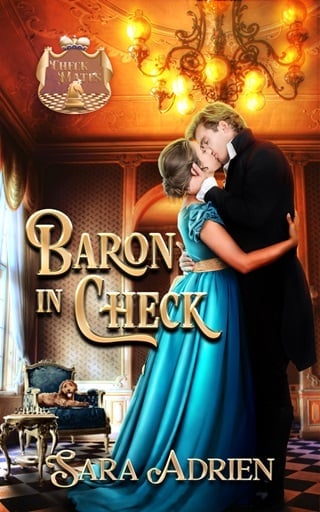
Baron in Check: In Love and Chess, Every Move Counts. (Check Mates Book 1)
Preface
Dear Readers,
Before you read this fictional story, let me tell you a real one.
I grew up hiding that I’m Jewish, like the Pearlers in my Infiltrating the Ton series. When I came to America, I stopped hiding, so I lived like the Klonimus family in my Diamond Dynasty series. But every step of the way, I had friends who were not Jewish. Some of my closest friends are of mixed heritage and identify as people of color or of Asian descent—none of it matters because they are people first, and they are my friends.
I was raised to think in a color-blind way of sorts. I’ve learned many languages (now, my eighth language is Mandarin). I’ve been to almost every country in Europe at least once and to many, many places in the Americas and Asia. Sometimes, I’ve had the pleasure of making new friends there, practicing my language skills (or lack thereof), and seeing how Jews lived around the world. There’s a word for that in Hebrew: the diaspora. It holds a lot of meaning for Jews outside the land of Israel. In some ways, it considers us, non-Israeli Jews, uprooted individuals who may return someday. On the flip side of this complex notion is that Jews welcome other Jews no matter where they live.
As an author, this is where I see friction and, thus, the potential for a whole series. You are about to read the first of these books.
Welcoming your friends is a good deed. Being hospitable and kind is a pillar of my Jewish education, but I think it’s just part of being human. Accepting other Jews in our homes for shelter is a must because we may be wandering in the diaspora, uprooted, with no country where we feel safe. Although Israel is a country and has been for all of my life, it was not there for all of my grandparents’ lives. As Holocaust and World War II survivors, they warned me of a world without Israel. And it scares me to death to watch the news at the time this book was written.
This brings me back, dear readers, to the notion of friends. Forgive my tangent. This is a long thought: We need friends and allies to stay with us, and we will stay with them. When I say “we,” I include anyone with the goodness in their hearts who can do the right thing and find the strength to do so. That’s why I’m dedicating this book to our friends who stay with us, Jewish or not. Friends are friends.
One year, when I was in law school, I had nowhere to go for a Seder dinner on the first night of Passover. I was told about a Seder that was taking place in the common room at an apartment building, an urban high rise, where I could go for a small contribution toward the cost of the food. I did.
And the people I met there inspired my hero in this book, Gregory Stone.
At that Seder dinner, there were so many kind people, but none who were technically Jewish (except for me). There were daughters of Jewish fathers whose mothers were not Jewish, so their families didn’t celebrate Passover. A few interfaith couples had nowhere to go because they weren’t Jewish “enough.” Then, there were sons and daughters of interfaith parents who had lost their traditions. If this had been a children’s book, they would have been The Lost Boys from Peter Pan. They were uprooted. I was lonely, and we found each other.
Whether or not they were “Jewish enough” isn’t for me to judge, but they were all so friendly toward my traditions that they squeezed into a relatively tight space and put on a full-blown Seder with everything required. I was moved to tears several times that evening, and my memory of it has influenced me so much that I’m writing books about it now.
Like the Lost Boys and all the attendants of that lovely Seder several years ago, Gregory Stone, a friend of the Pearlers and Klonimuses, is a bit of a lost boy. He’s wandering and uncertain about which direction to choose. From his perspective, his parents caused him all this trouble by converting and leading him to a career without the hold of his faith. From his parents’ perspective, it was a way to pave the way for him to find success despite his heritage because he faced antisemitism in many ways, even before the word was coined. Again, I’m not the judge but the author, so I’m exploring the dilemma, the feelings, and the potential conflicts of such situations with friction. It is my intention to touch on truth in fiction, a slippery slope that even the Boston Herald once wrote shows that I have “great courage and a big heart”—now you’ll be the judge of that in the story.
Just promise me that while you read, you don’t forget that actions have consequences far beyond whether something was politically correct. It doesn’t end there. And wars don’t end there, either. It is where my story begins, and I hope you’ll approve of the depth I tried to give my characters.
Let me check in with you: Are you still reading? Good!
I wrote this book at a time when my relatives weathered an existential war in Israel, and the world saw an upswing of antisemitism we hadn’t seen since the Third Reich. It is during times like these that we must thank those people who support us, stand with us, and lend their hearts and friendship to us Jews. That’s why this book is dedicated to all those who dare to stand up against ignorance, bigotry, antisemitism, antizionism, and any discrimination.
That is also why, dear readers, this book is not for the faint of heart. I’m calling matters what they are—hatred, ignorance, and all the ugly truths that the antagonists in this series stand for. The villains are wrong, evil, and misguided, and I spared no effort to use the literary devices at my disposal to show the stark contrast between them and my hero and his friends. Thus, this book deals with a converted Christian who doesn’t know where he belongs and a shunned woman who cannot claim her place in the world on her own accord. They are lost in the traditional sense and need to redefine what it means to find one another. If this is not romantic, I don’t know what is.
Although I took every precaution to phrase the social criticism carefully, the period in which this story is set was not known for its mellow approach to hate speech. I hope you, as my readers, will appreciate the dangerous line I embarked on and that you’ll find the courage to accompany me on a journey that’s not just taken out of history books, but out of my own life. Like a chess board’s squares, I tried to make the good and evil as clear cut as the black and white, but the contrast is stark and may sometimes be jarring. It is intentionally so, dear readers, because I wouldn’t write a good story without high stakes.
The stakes for this story were set high as soon as Gregory Stone appeared as a character in The Pearl of All Brides (Infiltrating the Ton, book 2), then again in A Kiss After Tea (Infiltrating the Ton, book 3), and most recently in In Just A Year (Diamond Dynasty book 4). He’s been part of the Pearlers’ and Klonimuses’ lives, has opposed Richard Nagy, the villain from the Diamond Dynasty series, and has had an altercation with the villain of this series, Baron von List. I’ve met many Nagy’s and List’s in my lifetime, and their worst traits morphed into the antagonists. None of the people in this book are real, and even when Prinny, who existed, appears in a scene it is fictional.
Similarly, some of the chess tactics, rules, and game strategies I mention were not documented when this story took place. That doesn’t mean, however, that they weren’t played. I’m taking artistic license to set our current chess rules and knowledge into the Regency-era setting to explain some of the tactics better and also so that you, dear reader, can follow the story more easily.
If you’d like to refer to the chess glossary at the end of the book, I summarized some of the terminology for you and included Author’s Notes about the historical research that drove this book.
I hope you’ll enjoy Greg’s story and cheer for him on the difficult moral journey he’s about to embark upon because, in chess and in love, every move counts.
Sara Adrien
Boston, 2024