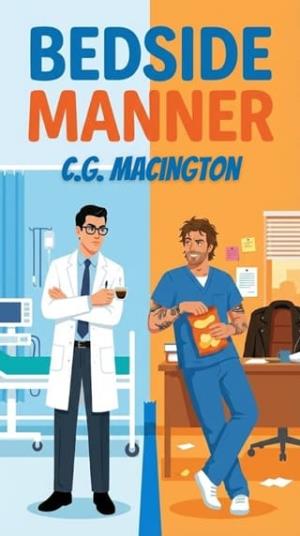
Bedside Manner
Chapter 1
The Sterile Field
Maxwell
The heart is a dramatic organ.
It is a fist of muscle, a battery of electrical impulses, a fragile vessel that decides, sixty to one hundred times a minute, whether a human being continues to exist or becomes a memory.
I prefer it when the heart is silent.
"Clamp."
The word is barely a breath, but in the hyper-pressurized silence of Operating Room 3, it sounds like a gavel strike.
A scrub nurse, her eyes visible only above a tightly fitted mask, slaps the hemostat into my outstretched gloved hand.
She doesn't speak. In my OR, nobody speaks unless the patient is dying, and my patients do not die.
I adjust my grip. I look down into the open chest cavity of the fifty-five-year-old senator lying on the table. The bypass is complete. The sutures are microscopic works of art, the kind of stitching that should be hung in a gallery, not buried under layers of fascia and skin.
"Releasing cross-clamp," I announce.
This is the moment. The terrifying, suspended second where the heart, cold and still for the last two hours, has to remember its purpose.
I wait. I don't pray—God has nothing to do with the precision of a vascular anastomosis—but I do hum. It’s a subconscious tick, a low, vibrating thrum in the back of my throat. Bach. Cello Suite No. 1 in G Major. The prelude.
Thump.
A single, sluggish contraction.
"Sinus rhythm returning," Dr. Sato drones from the head of the table. He sounds bored, which is the highest compliment an anesthesiologist can pay a surgeon.
Thump-thump.
The monitor picks up the beat, transforming the silence into a rhythmic, reassuring whoosh-hiss. The blood begins to flow, pink and oxygenated, surging through the new vessels I have constructed. It is perfect. It is mechanical poetry.
"Flow is excellent," I say, keeping my voice flat. "Closing."
I don't smile. A York doesn't smile for doing the job he was bred to do. I step back from the table, peeling off my bloody outer gloves with a snap, leaving the closing to my senior resident.
"Dr. York?" Indira asks, her voice trembling slightly. "Do you want to check the drain placement?"
"If you can't place a drain by your fifth year, Dr. Singh, you should consider a career in dermatology," I say. I don't look at her. I walk to the scrub sink, the adrenaline of the surgery already receding, replaced by the familiar, cold hollowness that lives in my chest.
I scrub out, the ritualistic washing of hands that strips away the blood and the responsibility.
I check my reflection in the steel mirror.
Not a hair out of place. My black hair is slicked back, immobile.
My pale blue eyes are clear behind my rimless glasses.
I look exactly like my father. I look exactly like the statue of my grandfather in the lobby.
I look like a machine.
I dry my hands and check my watch. 11:45 AM. I have a department meeting at noon, followed by rounds, followed by a donor dinner my mother is forcing me to attend.
I push through the double doors of the surgical wing, expecting the hushed, carpeted serenity of the Cardiothoracic Department.
Instead, I walk into a construction site.
A plastic tarp hangs from the ceiling, flapping in the draft of the ventilation system.
The smell of drywall dust overpowers the scent of antiseptic.
The waiting area—usually a sanctuary of beige leather and muted abstract art—is gone.
In its place is a gaping hole in the wall and two men in hard hats eating sandwiches on a stack of drywall.
I stop dead. A piece of tinsel, cheap and silver, has been taped to the plastic tarp. Merry Christmas, it mocks.
"Dr. York!"
I turn to see my administrative assistant, a woman who usually possesses the calm demeanour of a bomb disposal expert, looking frantic. She is holding a cardboard box.
"What is this?" I gesture to the destruction with a hand that is worth five million dollars a year to this hospital.
"The renovation timeline was moved up," she says, breathless. "Dr. Sterling sent the memo this morning. The East Wing foundation needs reinforcing before the blizzard hits next week. They’re condemning the offices."
"Condemning?" I repeat. "I have consults. I have charts. I have a succulent that requires a specific amount of indirect sunlight."
"We packed it," she says, shoving the box into my hands. It contains my diploma, my Newton’s cradle, and my succulent. "Dr. Sterling said it’s temporary. Until the New Year."
"Where?" I ask, my voice dropping to a dangerous register. "Where am I supposed to work, if my office is currently a pile of rubble?"
She grimaces. It’s the look one gives a patient before telling them the tumour is inoperable.
"The Trauma floor," she whispers. "Ground level."
I stare at her. "Trauma is a zoo. It’s a bacterial petri dish. It’s loud."
"It’s the only floor with spare desk space. You’ve been assigned to Office 104." She takes a step back, as if fearing I might bite. "It’s a shared space."
"Shared," I say, testing the word like it’s a piece of rotten fruit. "With whom?"
She doesn't answer. She just points toward the elevators.
The elevator ride down feels like a descent into hell.
St. Jude’s Medical centre is shaped like a hierarchy. The top floor is Cardio and Neuro—the gods, the intellects, the clean specialties. As you go down, things get messier. Orthopedics. General Surgery. And at the very bottom, the basement level, is The Pit.
Trauma.
The elevator doors ping and slide open.
The noise hits me first. It isn't the hum of machinery; it’s the roar of humanity. People are shouting. A gurney rattles past at full speed. Somewhere, a child is screaming.
I step out, clutching my box of possessions like a shield. The air here is different. It is humid, smelling of wet wool, floor wax, and the distinct, coppery tang of fresh blood.
And the music.
Thunderstruck by AC/DC is blasting from the nurses' station. Not playing—blasting. The opening guitar riff reverberates off the linoleum floors.
I clench my jaw. I navigate through the chaos, dodging a nurse carrying a tray of urine samples and a police officer taking a statement from a man with a knife wound. This isn't medicine; this is air traffic control during a crash.
I find Office 104. It’s located directly across from the main Trauma Bay, separated only by a wall of glass. A fishbowl.
I open the door.
The office is small. It was clearly designed for one junior administrator, but two desks have been jammed together in the centre, creating a battlefield of territory.
The desk on the left is empty, save for a layer of dust.
The desk on the right looks like it was hit by a mortar shell. Stacks of paper charts lean precariously like the Tower of Pisa. Empty cans of 'Red Bull' form a pyramid. A stethoscope is tangled with a phone charger. A bag of spicy corn chips lies open, spilling orange crumbs onto a medical journal.
I feel a twitch develop in my left eye.
"You must be the squatter."
The voice comes from behind me. It is deep, scratchy, and amused.
I turn.
Standing in the doorway is a man who looks less like a doctor and more like someone who has been dishonourably discharged from a pirate ship.
He is tall—broader than me, with the kind of functional muscle that comes from lifting heavy things, not a gym membership.
He wears ceil blue scrubs that are wrinkled and stained with something dark that I desperately hope is iodine.
Under the scrub top, he wears a faded black t-shirt with a white skull logo.
His hair is a disaster of dark brown curls, pushed back from his forehead by a hand that is currently holding a half-eaten bagel. He hasn't shaved in at least three days.
"Dr. York," I say, drawing myself up to my full height. "I assume you are responsible for the noise pollution in the hallway?"
The man takes a bite of the bagel. "If by noise pollution you mean the sweet, sweet sounds of Brian Johnson, then yes. Helps the rhythm. Keeps the blood pumping." He extends a hand. "Jax O’Connell. Trauma."
I look at the hand. There is a smear of dried blood on the cuticle of the thumb.
"Maxwell York. Cardio," I say, keeping my hands firmly on my box.
Jax grins. It’s a lopsided, boyish grin that displays a chipped canine tooth. It is infuriatingly charming. "I know who you are, Princess. Everyone knows the Ice King. Didn't know you came down to the dungeons."
"Princess?" My voice drops fifty degrees.
"Figure of speech." Jax walks into the room—struts, actually—and tosses the bagel onto his disaster of a desk. "So, Sterling said I had to make room. I cleared off the left side for you."
"You call this cleared?" I walk to the empty desk. I run a finger along the surface and hold it up, showing the grey smudge of dust.
"I’m a surgeon, not a maid," Jax says, dropping into his chair.
The springs squeak in protest. He kicks his feet up onto the desk—right next to the open bag of chips.
"Look, we just stay out of each other's way. You do your... whatever it is you do. Knitting arteries? And I’ll handle the meat and potatoes. "
"Meat and potatoes," I repeat, horrified. "You are referring to human beings."
"I’m referring to the guy who just came in with a fence post through his abdomen," Jax says. He gestures to the glass wall.
I look. Through the fishbowl window, I can see into Trauma Bay 1. A patient has just been wheeled in, thrashing and screaming. The paramedics are shouting vitals. The monitor is alarming.
The casual slouch vanishes from Jax’s body instantly.
He is up and out the door before I can blink.
I shouldn't watch. I should unpack my succulent and set up my computer. But I can't look away.
I watch Jax O’Connell enter the chaos.
The change is instantaneous. The pirate is gone; the soldier appears. Jax doesn't shout, but the room orients around him. He moves with a brutal, efficient economy. He cuts the patient's shirt away with shears, his hands moving so fast they blur.
Through the glass, I see the problem. Tension pneumothorax. The patient is suffocating, his chest cavity filling with air.
Standard protocol requires a sterile field, a scalpel, a chest tube kit, and anesthesia.
Jax doesn't wait for any of that.
I watch, my breath catching, as Jax grabs a massive needle from a crash cart, pours a bottle of Betadine over the man’s chest—splashing it everywhere—and stabs the needle between the patient’s ribs.
A hiss of escaping air is audible even through the glass.
The patient’s thrashing stops. The vitals on the monitor stabilize.
Jax pats the man on the shoulder, says something that makes the terrified patient nod, and then turns around.
He looks through the glass, straight at me.
Jax winks.
Then he wipes his bloody hands on the front of his scrubs and walks back toward the office.
I feel a strange, uncomfortable sensation in my chest. It is a flutter. An arrhythmia.
Jax kicks the office door open. The smell of copper follows him in.
"See?" Jax says, sitting back down and grabbing the bag of chips. He crunches one loudly. "Meat and potatoes."
I set my box down on the dusty desk. I take a deep breath, inhaling the scent of dust, floor wax, and this infuriating, chaotic man.
"Dr. O'Connell," I say, pulling a container of disinfectant wipes from my box.
"Yeah, Dr. York?"
I snap the lid of the wipes open.
"Stay on your side of the room."