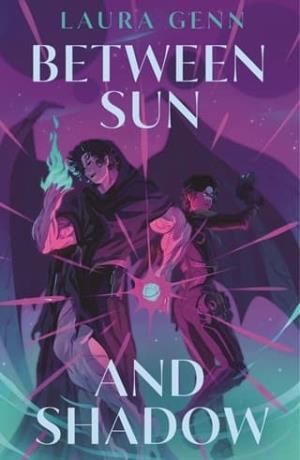
Between Sun and Shadow
PROLOGUE
Once upon a time, the planet Pagomènos stopped spinning.
An asteroid—massive, merciless, over a mile in all directions, gleaming with a distant galaxy’s heretofore unknown power—lurched free of its belt.
Whether by idle fate or by the thoughtless hand of a cruel god, the rogue rock struck Pagomènos, rapidly pursued by the tongues of its sun.
All at once and forevermore, the planet’s spin lurched to a near halt.
Tidally locked, Pagomènos’s rotation synced with its solar orbit, and the planet was split into light and unrelenting dark. Days, nights, seasons, and a lifetime tracked in seconds and minutes and hours became confined to a distant past.
This cosmic change bore natural disasters: vicious wind storms at the intersection of night and day, and unwavering pressure from either extreme heat or cold on the the planet’s far sides.
In time—though it would become impossible to track how long—the people would find that the meteorite, which had embedded itself in the planet’s surface,
bled power and poison. Their world had been irrevocably changed, and with it, their bodies.
Preternatural energy warped every living thing it touched, transforming it to be as fierce as the increasingly hostile planet.
Even before the physical changes revealed themselves, the Pagonians were terrified.
While core memories—identity, recent events, simple tasks like food and sleep—remained untouched, the people found their broader understanding slipping through their fingers like so much sunbaked sand.
Where had they come from, before they settled Pagomènos?
How had the technology that enabled such interstellar travel been built?
History crumbled to ash in their minds with every passing moment.
They feared their very senses of self would soon dissolve alongside it.
In the daylight, the people fled belowground.
They gathered their wisest inventors, their most advanced technological prodigies, and constructed a memory-storage device for every survivor: a simple microchip, surgically installed as a ward against eventually forgetting all they had ever been.
Aboveground, where the remaining animals achieved ever more alarming new forms—evolving at an impossible rate, fueled by the asteroid’s unimaginable power—the daylight people never dared to tread without armor.
Apocalypse be damned, they would not join the ranks of Pagonian mutations.
And they would not forget what it was to be merely human.
In the darkness, the people scraped and clawed for purchase, but they simply could not prioritize invention when utter sightlessness loomed supreme as a challenge.
Cut off from Pagomènos’s sun, they sought the gleaming asteroid itself, and their exposure to it accelerated their mutation beyond even the planet’s animals.
Soon there were people who could move objects with a thought, others bearing wings to carry them through the frigid wind currents.
There were even those who could produce azure energy, like the asteroid’s own, from their hands—with which they would build a looming torch for their shadowed home.
The people of the light had worried that, absent microchip installations, they would forget even their own names, deteriorated by the asteroid’s energy, becoming ever less and less.
But the people of the night, embracing their invader as one might a godlike visitation, found instead that in fully giving themselves to its power, they became much more.
Their knowledge of extended history, former technology, and the like were laid like sacrifices before their intergalactic interloper.
Of events yet to unfold, they would keep meticulous records.
And unlike what the daylight people had feared, they never forgot themselves entirely.
After the cataclysmic impact, Pagomènos should have been a graveyard for human life, sentience erased from its surface as surely as if an Earthside starship had never landed.
Instead, as the asteroid’s energies permeated everything, the dead planet became undead, its people walking monuments to purgatory.
In the daylight, there were armored, sheltered beings, still clinging to technology, constructing ever more advanced methods of living somewhat as they always had; but in the nighttime, wings and claws and teeth overtook the land, lit by impossible fire conjured by hulking, powerful creatures who hardly recalled what their bodies had once been.
Once upon a time, half of Pagomènos descended into eternal night. Once upon a time, half of Pagomènos ascended into eternal day.
Once upon a time, a whole world slipped and fell out of time as they had known it.