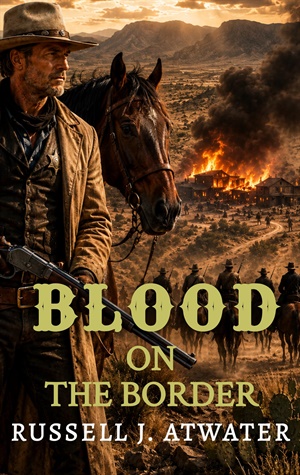
BLOOD ON THE BORDER
Chapter 1
Chapter One
The stagecoach had stopped in the worst possible place.
Clay Maddox saw it from three hundred yards out. The coach was listing sideways from a left rear wheel that had dropped into a rut. The team of four horses was stamping and blowing, and three riders were blocking the road ahead.
One rider held a rifle across his saddle. The other two had dismounted and were working their way toward the coach doors on foot.
Not highway robbers caught in the act; they had been waiting.
The heat pressed down like a wool blanket, thick and close, even this late in the day.
Sweat ran between Maddox’s shoulder blades and soaked the back of his shirt.
The scrub cedar and mesquite threw thin shadows across hardpan that had not seen rain in weeks, and the air tasted of alkali and dry grass.
Maddox drew his Colt without slowing his horse. The bay gelding knew gunfire and did not flinch when he cocked the hammer. The distance closed fast at a full gallop, his horse’s hooves tearing through dry scrub.
The nearest dismounted bandit turned at the sound. The man had just enough time to raise his rifle before Maddox put a round through his chest at forty yards.
The second man on foot spun and fired wildly. The shot whizzed past Maddox’s ear. He leaned low in the saddle, steadying his arm against his horse’s rhythm, and squeezed the trigger. The bullet caught the bandit in the shoulder and drove him backward into the dirt. He did not get up.
The mounted rider wheeled his horse around and raised his rifle. Maddox was already between the gunman and the coach, his body blocking the line of fire to the passengers. The rider hesitated. That hesitation cost him. Maddox’s third shot knocked him out of the saddle.
The scrubland fell quiet. Dust drifted in a slow copper haze.
Gunsmoke hung in the still air, acrid and sharp, mixing with the iron smell of blood already baking into the sand.
One of the coach horses screamed and pulled against the traces, but the others held still, their ears flat and trembling. Inside the coach, someone was crying.
Three shots were fired; three men down. The whole thing had taken less than ten seconds.
Maddox’s pulse was steady. Twenty years of this work had burned the shaking out of him long ago, and what was left was just the quiet arithmetic of survival: threats identified, threats dealt with, civilians alive.
Maddox reined in and dismounted before the dust settled. He holstered his pistol and walked to the coach door with his hands visible, moving with the steady, unhurried pace of a man who had done this before.
“You’re safe,” he said. His voice carried without him having to raise it. “Stay inside until I tell you otherwise.”
The door cracked open. A woman in a blue travelling dress stared out at him with wide, red-rimmed eyes. Behind her, a thin man in spectacles clutched a leather case to his chest like a shield.
“Is it over?” the woman asked.
“It’s over.”
She let out a sharp, ragged breath that turned into a sob. The thin man started talking fast, something about the schedule and a meeting in El Paso, his voice climbing toward panic. Maddox put a hand on the coach door frame and looked the man in the eyes.
“Sir. You’re alive. That’s what matters right now. There’ll be time for the rest.”
The man stopped talking. He swallowed hard and nodded.
Maddox checked the driver. He was an old fellow with a white moustache and blood running from a graze across his temple. He sat hunched on the box seat, gripping the reins with both hands, even though the team had gone still.
“Nicked me,” the driver said, his voice rough and thin. “First shot. I pulled up and they came right at us.”
“How many?”
“Three. Just the three.”
Maddox pulled a bandana from his pocket and pressed it to the graze. The cloth was damp with his own sweat, but the old man gripped it and held it to his temple without complaint. His hands trembled, but his eyes were clear.
“You did right,” Maddox told him. “Running would’ve gotten everyone killed.”
The driver nodded once, a short jerk of his chin, and continued to stare straight ahead at the road.
Maddox walked back to the fallen men.
The first bandit lay face-down in the scrub, arms thrown wide, fingers still curled around empty air where his rifle had been. Flies had already found the wound.
The second had rolled onto his side, his shoulder wound dark and leaking into the sand. His chest rose once, shallow and wet, and then stopped. He was dead, or close enough that the distinction was academic.
The third sprawled on his back ten feet from his horse, hat blown off in the fall, eyes open to the white sky above. A young man. Younger than Maddox had expected. Barely twenty, with a thin beard that could not hide the boyish line of his jaw.
Maddox crouched beside the first body and turned it over.
He checked the man’s gun belt. New cartridges, factory-loaded, all the same caliber.
He moved to the second man. Same ammunition.
Same make of rifle, a Winchester ‘73, cleaned and oiled.
The third carried identical rounds and a matching weapon.
He stood and looked at the positions where each man had been standing when he’d arrived. One on the road ahead. Two flanking the coach doors, approaching from opposite sides. A crescent formation.
These men had not stumbled onto a stagecoach and decided to try their luck. They had known the route, picked a spot where the road narrowed and the rut would slow the wheel, before spreading out with coordinated fields of fire.
Someone had given them those rifles, loaded the cartridges, and told them where to wait. Someone with money, planning, and no shortage of men willing to die on a dusty road for wages or loyalty, or fear.
Not a robbery. A statement.
Maddox wiped sweat from his forehead with the back of his wrist and went back to the third body, the mounted man who had been covering the road. He crouched again, ignoring the stiffness in his knees that came from too many years in the saddle.
The bandit’s shirt was dark with blood, but his hand had fallen open near his hip, and beside his fingers lay something that did not belong on a West Texas road.
A crown. Small, polished gold, no bigger than a man’s fist. It sat in the dust without a mark on it, no scuff, no film of grit. The metal caught the late afternoon sun and threw it back in a hard yellow flash.
Maddox picked it up. The weight told him it was real. Not painted tin, not brass. Gold, or something close enough that a jeweler would need to test it. The edges were smooth, and the points of the crown were sharp, each one filed to a precise tip.
He turned it in his hand. There was no dirt in the grooves. No blood. While three men had been positioning themselves to kill everyone on that stagecoach, someone had set this on the road with deliberate care.
A calling card.
Maddox had spent twenty years in the Rangers.
He had tracked Comancheros, horse thieves, murderers, and men who killed for no reason anyone could name.
He had never seen anyone leave a gold crown on the ground.
Whoever was behind this wanted it to be found.
The crown was not a trophy. It was a signature, and signatures were written for readers.
He stood and walked to his horse, slipping the crown into his saddlebag. The metal clinked against the leather, and even muffled it carried a strange, clean sound, out of place among the flies gathering on the dead.
The woman in the blue dress watched him from the coach window. Her face was pale and streaked with tears, but her eyes tracked his movements with the sharp attention of someone cataloguing what she’d just survived. Maddox gave her a short nod. She did not look away.
A rifle cracked from the east. The sound rolled across the scrubland, flat and hard, and a puff of dust kicked up fifteen yards to Maddox’s left. Not a miss. A deliberate shot placed to get his attention.
His hand was on his Winchester before the echo faded. He dropped to one knee and brought the rifle to his shoulder, scanning the eastern ridge. There. A quarter mile out, maybe more. The ridge ran along the horizon like a jagged spine, broken rock and scrub juniper dark against the pale sky.
A figure on horseback was silhouetted against the fading light. Heat haze rippled the air between them.
It was too far for a clear shot, too far to make out their features. The rider sat motionless, watching. Not fleeing. Not attacking. Just watching.
Maddox held the Winchester steady, the stock firm against his shoulder, his breathing slow. The crosshairs drifted across empty air. At this distance, in this light, a shot would be a prayer, not marksmanship. He waited.
The rider didn’t move. The horse stood still as carved stone, and the figure’s posture was loose, unhurried. Not a man fleeing the scene. A man surveying it.
Then the figure turned its horse south and disappeared below the ridgeline.
Maddox lowered his rifle. The rider had moved south. Toward the border.
He stayed where he was, one knee in the dirt, Winchester across his thigh, watching the ridge. The sun dropped another degree toward the horizon, painting the scrubland in shades of rust and copper.
A hot wind moved through the mesquite, carrying the smell of sage and something older, the mineral scent of land that had been baking since before anyone put a name to it.
Whoever had left the crown had men willing to die in coordinated ambushes. Had gold to spare as a prop. Had the discipline to arm three killers with identical weapons and the arrogance to watch from a ridge.
This was not the end of something. It was the beginning. And beginnings, in Maddox’s experience, only came in two kinds: the ones you walked toward, and the ones that walked toward you whether you liked it or not.
Maddox turned back to the coach. There were survivors to tend to, a driver who needed stitching, and a long ride to the nearest Ranger outpost. The woman in blue still watched from the window, and the thin man had stopped shaking enough to open the coach door and step down from it on unsteady legs.
“Who are you?” the woman asked.
“Texas Ranger, ma’am. Captain Maddox.”
She looked past him to the bodies, to the blood drying black in the sand, to the road stretching empty in both directions. “Are there more of them?”
He met her eyes and did not lie. “Likely so.”
She pressed her lips into a thin line and nodded once; the kind of nod that said she had already known the answer and had asked only to hear it spoken aloud.
Maddox slid his Winchester back into its scabbard and led his horse forward. The bay’s hooves crunched steadily on gravel and dry scrub, and the fading heat of the day rose from the ground in shimmering waves that warped the southern horizon.
The sun burned low and red behind him, and dust settled slowly over three dead men and the road south.