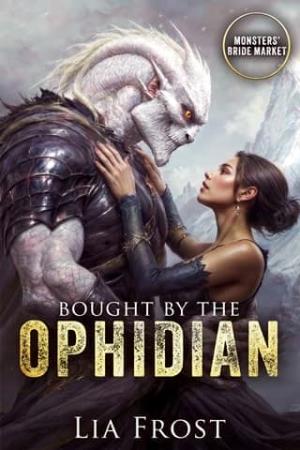
Bought By the Ophidian (Monsters’ Bride Market #13)
Ruelle
The auction hall smells like wool and sweat and the metallic bite of whatever they use to clean the floors between sales. The tile is still damp underfoot.
Livestock in the morning, women in the evening.
Somebody decided that was fine.
I’m not in the holding pen. I paid the auctioneer’s entry fee two hours ago, told his assistant I needed the privy, and didn’t come back.
Nobody noticed. Nobody tracks the last lot of the night.
I’ve been in the crowd since then. Three of tonight’s buyers are creatures I could name on sight.
Two are things I’ve never seen before, my brain already turning them over: the color shift along one’s mandible, the question of whether that outer layer is skin or something I’d need a sample to understand.
The rest are humans with more gold than sense, bidding on women the way they’d bid on horses, checking teeth and hips and whatever else they think predicts value.
One of them squeezes a woman’s arm to test the muscle tone. She doesn’t flinch.
I would have bitten him, but I have a professional reputation to consider.
Had. I had a professional reputation.
Now I have the kind that doesn’t open gates, a pack with four small boxes of vials, a notebook, nineteen sealed samples I couldn’t bring myself to abandon, an assay stone, and the clothes I’m standing in.
The bride market isn’t the worst thing that’s happened to me this year.
It’s not even close.
Lot twelve goes, then lot thirteen. The crowd thins as buyers leave with their purchases and the torches burn lower. The auctioneer is tired, and his assistant has started stacking bid paddles.
And then I see him.
He’s against the far column, alone, and I realize he’s been there all night. I didn’t notice him because he wasn’t bidding and I was watching the bidders. Now the crowd has thinned enough that his outline is clear, and I go still.
An Ophidian.
I’ve studied shed specimens and preserved tissue, one set of extracted fangs mounted in a display case at the guild hall, a few pages of notes that read like guesswork.
I have never seen a living one.
He’s tall, broad across the shoulders, narrowing into something the crowd hides. Pale scales, pearl-white, overlap his arms and collarbone, thick at the shoulders and thinning at the neck, the kind of natural defense that makes steel redundant.
It makes me want to know whether each scale moves independently or locks against its neighbors when he flexes.
His gold eyes catch the torchlight. The skull above them is angular and elongated, the back of the head swept into a crest of bony ridges. The snout is pronounced, the jaw heavier than a human’s.
He’s wearing a leather vest over the scales, functional, no ornamentation. Most apex predators I’ve met decorate themselves; this one hasn’t.
His fangs are long enough to show past his lips, the tips resting against his lower jaw. Everyone else in this room would see the fangs first.
I see the dull patches.
Ash where there should be pearl, three that I can count from here, the torchlight catching them wrong. Up close there’ll be more. I know what that looks like even in bad light, the surface reading flat where it should refract.
It’s deterioration. I’ve seen it in samples and once in a live subject years ago, a desert viper brought to the guild hall in a cage, already too far gone.
I’ve been looking at him for thirty seconds, and I already want to get closer.
Then I see the tremor in his hands. Both of them, the right worse than the left. He’s pressing them flat against his thighs because he can’t control what they’re doing and doesn’t want anyone to notice.
I know what that looks like too.
Venom sickness. Self-toxicity. Scales die first, then the nerves.
He’ll be dead in months. Maybe less.
I leave the crowd.
He watches me approach, his gold eyes flat and guarded, the vertical slits of his pupils contracting as I get closer. I stop two feet away and look up; he’s tall enough that I have to crane my neck.
Up close the deterioration is worse, five or six dull patches with two more starting along his jaw. The tremor isn’t just in his hands. His whole body carries a fine vibration, a system that’s run too hot for too long.
“You’re dying,” I say.
The scales along his throat shift, tightening against each other.
“Without intervention, I’d guess you have four to six months.”
He stares at me. I stare back.
“Who are you?” His voice is low and rough, a vibration that sits in the chest.
“Ruelle. Formerly of the Arrenval guild.” He doesn’t react. “Poisoner.”
He waits for more. I don’t give it to him.
“I’ve read what there is to read about your species. You need someone who understands what’s killing you.”
He doesn’t respond for a long time. His eyes move over me, the road-worn boots, the thin jacket, the pack on the floor that holds everything I own.
“What do you want?”
“Somewhere to go. A door that stays open. And access to the most interesting venom I’ve ever seen in a living specimen.”
I look at his throat, where the deterioration is creeping along the gland line. I catch myself staring. I look back at his eyes, and I don’t apologize.
“Buy me at the auction. I’ll address the venom problem. You provide shelter.”
“You’re offering to fix me?”
“I’m offering to try. Nobody else in this room can.”
Something shifts in his face. Not a smile; Ophidian facial structure doesn’t lend itself to smiling. Something close to it.
“How much?” he says.
“However much it takes. Though I’ll be honest, the bidding probably won’t be competitive.”
I pick up my pack, turn, and walk back toward the holding pen. Behind me I hear him make a sound. Not a laugh. Something close to it, broken at the edges.
The auctioneer’s assistant looks up when I reappear. “Long privy break,” she says.
“Digestive issues. Don’t ask.” I look toward the block. “Am I last?”
“You’re it.” She waves me toward the block.
“Lot fifteen.” The auctioneer checks his sheet and yawns. “Poisoner. Specialized knowledge in toxicology. No dependents. Sound health. Some scarring.”
Some scarring.
I step onto the block. The wood is rough under my boots, and I don’t take them off. The girl before me went barefoot, ankles showing, and the bidding went fast.
I’m not performing. I’m up here because the market has rules: stand on the block, let people bid, then choose. The rules don’t say I have to look hopeful about it.
“Do I hear an opening bid?”
Silence. The room is nearly empty, most of the serious buyers gone after lot twelve. What’s left is a few stragglers nursing drinks and the Ophidian at the back wall, eyes flat, hands trembling at his sides.
Nobody bids. The auctioneer clears his throat. His assistant examines her nails.
I stand on the block and nobody wants me. The word poisoner is doing what it always does, clearing the room like a bad smell.
“Do I hear any bid at all?” The auctioneer looks at me like a man who wants to go home. “Starting at, let’s say, two hundred. Anyone?”
Nothing.
“One hundred?”
A drunk in the corner laughs. Someone whispers the word poisoner to someone else. I hear it, like something you’d scrape off your boot.
The Ophidian steps forward. One step.
What’s left of the crowd notices, because he’s hard not to notice, the scales and the fangs and the size of him, the way the torchlight comes off his eyes brighter than it arrived.
“Two thousand gold,” he says.
The silence changes. Not disinterest now; a room recalibrating. Two thousand for a lot nobody wanted. The auctioneer’s eyebrows go up. His assistant stops examining her nails.
“Two thousand gold from the Ophidian,” he says, new energy in his voice. “Do I hear twenty-one hundred?”
Nobody moves. Nobody was going to bid at one hundred, and nobody’s going to bid at twenty-one hundred.
“Going once.”
I look at him. He looks at me.
“Going twice.”
The almost-smile is there again. A dying monster and a disgraced poisoner, finding each other at the bottom of the lot list.
“Sold.”
I walk off the block, down the steps and across the floor, straight to him. Two feet away.
“That was dramatic,” I say. “Two thousand. You could have bid two hundred. Nobody was competing.”
“I know what you’re worth.”
His meaning is plain. It reaches something I keep shut, and I do what I do with things like that. File it. Don’t look at it. Move on.
“Good,” I say, because that’s what I can manage. “Take your shirt off when we get somewhere private. I need to see the scale deterioration across your back.”
The auctioneer’s assistant meets us at the side table, quick and tired at the end of the night.
He counts out the gold while she records the amount, tears out a receipt, and slides a small leather pouch across the table.
My lot share, per market rules: the bride keeps a portion.
I take it without counting and put it in my pack.
He watches me do it, his head tilting a fraction. Then I turn toward the door and walk out into the cold.
He follows me out of the building, his footsteps heavy on the stone, clawed, the sound echoing off the settlement walls so that the few people still on the street step aside without being asked. Behind us the auction hall doors close, and the torches go out one by one.
I don’t look back.