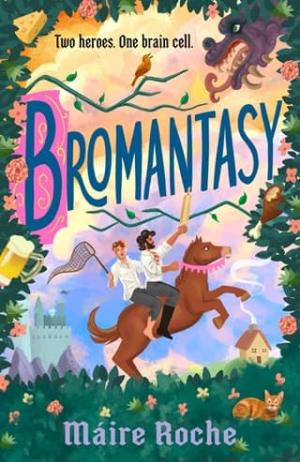
Bromantasy
Chapter One
One
It was all Juniper O’Reilly’s fault, really, no matter who you asked.
The good citizens of every village within a dozen leagues thought so.
The king certainly agreed. All of it was Juniper’s fault: the fire ale cocktail explosion, the trousers mishap, and, worst of all, the great loss of specialty hand-crafted cheeses.
Oh, and the decimated village and the incident with the prince’s missing toe.
But we are getting ahead of ourselves.
The end of the harvest season, just as it was about to tilt into the cooler autumn months, was so gloriously perfect: The reaping was very nearly done, the shelves were brimming with newly preserved delights and dried plums to last the winter, and the nights came with just an apple-sweet bite of cold that made Juniper’s blankets feel so deliciously warm in the morning.
Sunflower heads were hung upside down, still vibrantly yellow, garlic was braided into ropes across the kitchen ceiling with an array of drying herbs, and the potato barrels were full to the brim.
Soups and mashes all winter, Juniper predicted.
And, most important, this year Juniper hadn’t accidentally called his roommate, Mo, Daddy in front of the farmer who supplied their cheese.
It was a reasonably common mishap that occurred between two cordial roommates who shared a deep bond of friendship and brotherhood, they had both agreed, and Juniper was just ruminating on whether Farmer Abernathy remembered the incident when Mo poked his head into their small kitchen from outside.
It was nearing the end of the afternoon, the early-autumn sun leaning lazily through the windows and filling their cottage with a particularly soft golden glow.
Mumford, the sleek orange cat who had been hanging around since early spring—and had recently moved into Juniper’s bedroom—bounded toward Mo, rubbing against the leg of Mo’s trousers.
“Juniper,” Mo said with a little grin that was almost hidden in his beard (he always had just the smallest smile on his face when he was talking to Juniper). “The bruggane family down the road brought up a basket of apples to share with us.”
The bruggane, of course, rarely ate anything but meat as a rule, so apples were of little use to them, but it was a thoughtful gesture regardless.
“We’ve got extra duck we could share with them,” Juniper suggested.
Not his ducks, of course; they’d traded pears for duck meat from another farmer who’d had an abundance. If anybody touched Juniper’s ducks, Matilda, H. Harumpus, or Big Jack, Juniper would have lost his mind.
“Maybe their family would like that?”
Juniper could make Mo a pie with the apples, maybe a few. He made Mo his favorite pie every autumn, sometime in the weeks leading up to Samhain—a spiced apple with cardamom and sage and a flaky golden crust made with copious amounts of the rich yellow butter from the fuzzy brown cow they kept.
“We can bring them some herbs, too.” Mo ducked under the doorframe, carrying the basket of apples. He was strikingly handsome—all the local villagers agreed with Juniper on this—and the calm to Juniper’s storm.
Juniper was a head shorter than Mo—not that this ever stopped him from picking fights with people quite a bit bigger than Mo—and his fair, freckled skin always seemed to be a little splotchy from the sun, no matter how much tallow he applied.
Mo’s warm brown skin, on the other hand, was always perfectly smooth, except for that little freckle he had just to the left of his nose.
Not that Juniper paid particular, extended attention to Mo’s face, of course. He cleared his throat rapidly, reaching for Mumford, who wound between Mo’s legs when Juniper tried to pick him up.
“Shall I make you a pie tonight?” Juniper asked, putting aside thoughts of freckles and shoving some stray curls out of his face.
Juniper’s hair was a wheat field speckled with strawberries, if you asked Mo, or “wildfire disaster,” if you asked Juniper’s deceased father, gods curse his departed soul.
“Ah, Mumfy.” Mo shook his head down at their cat—he was their cat now, even if they hadn’t meant to let him stay. “He insists on standing exactly where I’m trying to walk.”
Juniper returned to his work (sorting through a basket of herbs that had yet to be hung with the ropes of garlic and cut sunflowers, while thinking in detail about apple pies and sitting on the front porch to eat them with his best friend).
“I had to be very firm with him this morning,” Juniper said, “when he tried to steal that lovely Burren cheese I made, right off the table.”
“Were you firm?” Mo set the apples down at their kitchen table, a roughly hewn square slab of wood they’d cut themselves from the fallen oak at the edge of their property. He looked up at Juniper with a grin on his face. “Or did you look into his soft little face and just sigh a bit?”
“I sighed firmly,” Juniper told Mo with a shake of his head.
Of course he hadn’t scolded Mumford. But he had called him Dumbford when the cat had jumped into a water pail willingly and then hissed at Juniper about it.
Mo ran a hand through his dark brown hair, ruffling it up, and then sat down with a deep sigh that cut Juniper a bit too sharply.
The sound made Juniper’s hands still.
Mo’s eyes were distant, their deep brown far from Juniper and the cottage they had called home since they were barely out of school.
Nearly ten winters of living with his best friend, and Juniper could read this mood: The Winter Wandering Woes were about to capture Mo.
Juniper, for his part, was going to grow old in this little cottage, with their two bedrooms and two hooks for their cloaks, and a kitchen they’d built just for them.
He was going to cozy up by the fire every winter, sleep in on cold, dark winter mornings, and just generally be warm and well-fed and content with nothing ever changing.
But each year, once the harvest was up, Mo… well, he grew restless.
As soon as the last pepper was pickled and the last parsnip stowed in a bin and the pumpkins lined up cheerfully along the windowsill like tiny orange and gray-green guardians, Mo settled into a chair, heaved that sigh, and began dreaming of other worlds and adventures to be had.
“Mo?” Juniper asked carefully.
“Mmm,” Mo said.
Mmm could mean almost anything, depending on the tone: It could mean Tell me more when Juniper was telling a fantastical story, or it could mean I hear your frustration when Juniper was complaining about Farmer Abernathy’s grain stand outcompeting theirs at the local fair, or even It’ll be all right, Junebug, when the fire had died down low and Juniper had drank all his mead and was talking about things like fathers or how cold sleeping on floorboards was or even about places that couldn’t really be called home.
But this time, this mmm meant that Mo was tired and restless and, Juniper thought, considering leaving the way he talked about every winter. The way Mo had left that very first year, when Juniper had been young enough and stupid enough to think that Mo would be the one person who would never leave.
“Let’s go into town,” Juniper said hopefully. “We can walk down to the brugganes’ home together—what did they say their name was again? The—” He tried, hopelessly, to imitate the unique grunting noise that constituted family names for bruggane families.
Mo grunted in response, though whether that was just a Mo noise or he was repeating the name of the bruggane neighbors, Juniper could not tell.
“Anyway, we’ll bring them the duck and tell them thank you and then stop by the pub and see the newest quest list for the fall.”
Mo’s gaze snapped to Juniper’s, sharper than Juniper had expected, the distance in his look evaporating into a careful, focused expression. “You want to see the quest list?”
Juniper always wanted to see the quest lists.
Whether any of them were worth leaving his very cozy bed behind? Another story altogether.
“Of course I want to see the quest list,” Juniper said breezily, plucking a bright little sprig of basil from the basket. “Do the bruggane like thyme? Is it offensive to ask if they season the meat they eat?”
Not all species used the same foods—the bruggane, like Juniper’s ancestors, had mostly lived in the mountains in the north of their island country, while Mo’s people had lived on the coast to the south.
So Juniper had been raised to cook with wild thyme and mountain garlic and crow sorrel, and Mo lived for sea spice and prairie onion and the salt marsh burdock that grew at the very edge of the land.
Mo didn’t answer Juniper now. Just looked at him with that steady, too-knowing look that made Juniper want to take his herbs and retreat to his bedroom, where the heavy oaken door meant he could have any unpleasant emotions or too-obvious thoughts in private, where no perceptive roommates could see them.
Best to do that sort of thing in private, his father had always told him.
It was the one thing the old bastard had been right about. That, and the benefits of mead over light beer.
“Anyway,” Juniper said when it became clear that Mo was waiting for more about the quests, and Juniper’s newfound interest in knowing about them, and that the thyme question was one that he alone must answer.
“We can stop at the tavern and have a pint or two, celebrate the harvest. And talk to those silly little recruiters about what the king’s newest projects are. ”
Every month or so, but especially around harvest time or near the old solstice and equinoxes people still celebrated, the king of their land sent recruiters all around the kingdom, to cities big and small, with a list of quests he needed done: ridding a land of silver sea wolves that were eating the crops or the locals or— Juniper didn’t actually know what they were eating; or ousting a particularly gnarly bridge troll who was fond of gobbling sheep that were due to be imported to the capital city; or even, once, a quest to drive out an abnormally large spider.
Juniper, of course, would stay right here in the nice cozy village he and Mo had chosen, thank you very much.
But a trip into town would get Mo out of the house and put that spark back into his eyes, and if Mo got too drunk and staggered up to sign up for a quest—well, Juniper could just take him home before things got out of hand.
Mo cleared his throat, eyes cutting away from Juniper’s again. “There’s more to do here,” he said finally. “To prepare for winter.”
“Not much. We’ve got the harvest up, and enough cheese to last from Samhain until Yule.
Maybe even Imbolc if I don’t have too many cheese-and-mead evenings.
” Juniper dropped an apple directly on his toe in his effort to grab one without looking at Mo.
If he looked at Mo, he would see it all there right in Morn Elmthorn’s eyes, the same thing he saw every time they sat by the fire and told stories:
While Juniper’s stories were cozy little adventures, sparks that had barely escaped the hearth fire, Mo’s stories were full of faraway places that left home burning in their wake.
It was the way of things with adventures and quests and heroes, really.
There was a gorgeous and heroic person—broad-shouldered and bright-eyed and beautiful like Mo—and there were often many Junipers.
Roommates, friends, people better at making a spiced plum pie than saving the realm.
People who would, if Mo ever went out and lived those faraway stories, be left behind entirely.