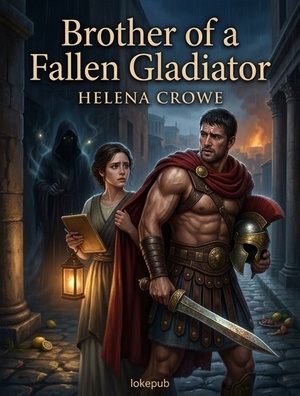
Brother of a Fallen Gladiator
Chapter 1
On a rain-soaked morning on the crowded Sacra Via, I saw Xerxes.
He strode with his usual easy gait, never letting the crush slow him as he approached the Forum Romanum.
He laughed at an advocate rushing to reach the Basilica Pauli, the man probably late to argue a case, then gazed up at the massive pillars on the portico as though never having seen such architecture.
Once he’d satisfied his curiosity, Xerxes continued past the basilica, disappearing into the crowd.
I shouldered my way past those around me and followed.
Xerxes, my friend, as close as a brother, was dead and gone. He had no business strolling through the busy Forum toward the Capitoline, as though he meant to make an offering at the Temple of Saturn.
Raindrops pattered on the stones, wetting the May air.
My sandals slopped through puddles, and the men around me drew cloaks over their heads.
I was bareheaded, having left my cloak at home, because the early morning had been fair.
By the time I’d finished my errand at the office of Gallus the builder, the sky had clouded over and the storm had begun.
I couldn’t have seen Xerxes. I knew that for truth. I’d beheld his dead body after he’d been slain by a sword thrust, when slaves from the ludus had dragged him past me to where Nonus Marcianus doctored gladiators under the arena. One of the slaves, a man called Agapios, had wept for him.
I’d observed the blood, the shock on Xerxes’s face that someone had slid past his guard, before the medicus had decorously covered him with his own cloak.
Xerxes’s death had broken me. I hadn’t eaten, hadn’t slept, hadn’t cared.
Only when Aemilianus, our trainer, had threatened to sell me if I didn’t leave my cell did I emerge into the practice grounds and begin drilling once more.
I fought from then on in honor of Xerxes, though I knew I could never reverse what had happened.
Cassia, the woman who looked after me, would explain that, logically, the man I followed could not be Xerxes. I understood that with my reason.
My gut told me something different. He had Xerxes’s springy dark hair that he’d shave off before the games.
The man’s build was the same, as was his loose way of moving.
Xerxes had been light on his feet, making his opponents work hard for a hit.
He’d also laughed at them, yelling jokes and bad puns while he spun and weaved.
I’d always fought in concentrated silence.
Aemil had tried to train Xerxes out of running his mouth during matches, but Xerxes’s fighting style had been effective. He’d been secundus palus of the ludus, a position not easily reached.
A few paces before the man I followed reached the Temple of Saturn, he swung to the left, cutting between the temple and the Basilica Julia, starting along the road to the Forum Bovarium.
I nearly lost him in the crowded artery that followed the base of the Capitoline but managed to keep the dark head in sight as I twisted through the press of people. Skilled fingers reached for the pouch that hung from my belt, disappearing when I snarled at the would-be thieves.
Xerxes joined the throng crossing the Pons Aemilius, leading to the Transtiberim. Of course, I thought. He’d be heading for the ludus. Returning to the only home he’d known in Rome.
The man ambled into the Transtiberim, and I guessed he’d continue along the Via Aurelia to the streets that led to our training compound. Instead, he abruptly turned and tramped to the Pons Cestius, the bridge that spanned the Tiber to the Insula.
I hastened after him, but when I reached the island at the far end of the bridge, Xerxes had vanished.
I wound my way through the press of pedestrians who lived or worked in these cramped streets or were heading for the opposite bridge to take them back into the city.
In the middle of a square, I turned this way and that, scanning the swarms of people in the markets or crowding the shops and taverns.
It was nearing midday, which meant most of Rome hurried to complete their errands before the afternoon, when businesses would close.
Residents would then retire to bathhouses before returning home for the evening.
For now, the entire city was out, getting in my way.
I darted down a few side streets but soon realized that it was no use. My quarry was gone, dissipating into the warm rain of the May morning.
Had I truly seen Xerxes? The question plagued me as I crossed the Pons Fabricius from the island to the Campus Flaminius, not paying much attention to where I trod.
Xerxes was dead and gone, part of me knew. In the Elysium fields, to fight for the joy of it, where no one lost.
Or he’d returned for some reason, but whether beneficial or evil, I could not say.
Today was the middle day of Lemuria, which took place on the seventh, fifth, and third days before the Ides of May. Why the festival skipped the days in between, I had no idea, and knew no one who did.
During this festival, ghosts were expelled from homes, belligerent spirits banished. We hadn’t yet performed the ritual in our small apartment, and I wondered if Xerxes’s ghost had taken the opportunity to seek me before we could.
Had he wished me to follow him to the Insula? Was there something there I was meant to see? A person to meet?
I balled my fists as I walked. Xerxes should think better of throwing cryptic hints at me. He’d know that I’d never decipher them.
But I was acquainted with someone who could.
I found myself at the base of the Quirinal, barely recalling how I came to be there. I passed through the Vicus Laci Fundani and took the lane that led to a wine shop and my apartment above it.
Cassia glanced up in surprise when I lumbered into the small room and slammed the door. The long shutters, which leaned against the wall where I’d set them this morning, rattled. A cooling breeze blew through the open windows, stirring Cassia’s hair and the papyrus she currently read.
“You’ve not been gone long.” She made a note in a wax tablet at her elbow, likely recording the time I’d come in. “Did you see the banker?”
I dimly recalled my second errand, to meet a banker in the Forum and deliver a written message from Cassia.
She’d explained about investing the funds I’d earned assisting Gallus the architectus this past year, but I hadn’t understood much of what she’d said. My attention had wandered when she’d started using words like venture and returns.
“No.” I stood in the middle of the L-shaped room, flexing my hands, then moved swiftly to the table we used as an altar to the ancestors.
The small papyrus roll that held Xerxes’s name, which Cassia had taught me to read, remained in the same position as it had this morning. Unmoved, untouched. If Xerxes’s shade wandered Rome, the paper with his name hadn’t responded.
Cassia rose from behind the table, her long tunic, held primly closed at both shoulders, whispering as she came to me.
“What happened? Did the banker refuse to deal with us?”
I wasn’t certain whether she’d believe me or scoff at me—not that Cassia ever scoffed—but I drew a breath and faced her.
“I saw Xerxes.”
Cassia’s perplexed expression became a careful blank. She studied me in her quiet way, her eyes masking her thoughts.
Cassia glanced at the scroll she’d written herself and placed on our makeshift altar to honor Xerxes next to her father.
“Xerxes died,” she said gently.
I gave her a terse nod. “I saw his ghost. Or thought I did.”
I wandered from the altar and sank to a stool, my head in my hands.
Cassia didn’t follow. She stood very still, as though trying to decide what to do with the large and morose gladiator in the middle of her room.
Her quiet voice came to me. “After my father passed, he appeared to me in many places. The road outside the villa, on the way to Rome, here in the streets.” Cassia’s soft footsteps sounded on the stone floor, and a cool hand touched my shoulder.
“We so want to see them that our eyes perceive what is not there. As though they are imprinted on us, and we can’t not see them. ”
What Cassia said was wise, but I could not surrender to the explanation.
“This was different,” I insisted. “He was so alive. So real. Walked like Xerxes, looked about him like Xerxes. He was in the crowd, not floating through it like a ghost. People bumped into him.”
Cassia resumed her seat at the table and opened another tablet.
“There are several possibilities.” She marked the wax with her stylus as she spoke.
“One is that you so longed to see Xerxes that your eyes placed him in front of you. Another is that you saw a ghost, which I very much doubt. The third, and most likely possibility, is that you glimpsed a living person who looked remarkably like him.” Cassia jotted down her suggestions and frowned over them.
I raised my head. “Someone who looked exactly like him.”
“Did Xerxes have sons? Besides the lads with Marcella?” Cassia had met the five children Xerxes had left at Marcella’s farm outside the city.
“None old enough to be this man,” I said.
“Did he have other family? Brothers, cousins?”
“Xerxes never spoke of his family.” I pulled my stool to the table to watch her write. She’d taught me some letters, but I didn’t recognize the ones she used now. Cassia often made notes in Greek, her native tongue.
“He’d been a slave,” Cassia prompted.
“On a farm.” I recalled what little Xerxes had told me about his past. He’d been a man concerned only about the present, and that, not very much.
“Early mornings, smelly beasts, too much work. I don’t know if he was born on that farm or sold there—he never said.
When Aemil was recruiting for his ludus, the farmer sold Xerxes to him.
He wasn’t called Xerxes until after he came to the ludus. The name was Aemil’s idea.”
“Do you know who this farmer was?”
“No. Or where the farm was located. Marcella might know.”
Cassia idly flicked the stylus between her fingers. “Interesting that Xerxes ended up with a woman on a farm, if he didn’t like the work.”
“It was after Xerxes began living with her that he told me about where he’d come from,” I said. “He laughed at the irony, but I think he’d have gone anywhere to be with Marcella.”
“They were very fond of each other.” Cassia’s voice held wistfulness.
“Xerxes joked about that too. Said they were feeble lovers in a bad comedy.”
“His jests were to cover his true feelings,” Cassia said. “Some men are like that.”
“That is true.” I nodded at her. “I never joke.”
Her sudden smile was the reward for my dry comment. Her dark eyes sparkled when she truly smiled.
“We will make a short journey to visit Marcella,” Cassia said decidedly, closing the tablet.
“You might have thought you spied Xerxes because you are missing him, and speaking with Marcella will make you feel better. Plus, we can take her some gifts and money for her care of Sergius.” I’d taken a small boy to Marcella about a year ago, when he’d had nowhere else to go.
Cassia lost her smile and regarded me sternly. “After you speak with the banker.”
“Yes, yes.” I rose hastily. “I’ll go now.”
“It might be too late.” Bankers shut down in the afternoon along with everyone else.
“I will hurry.” I strode to the door and wrenched it open, my dejection gone. Cassia’s good sense could always make me feel better.
Her explanation that I’d either conjured Xerxes from my own sadness or had seen a real person who resembled him were likely the right ones. Cassia had no fear of ghosts. If any dared to appear in our apartment, she’d order them to scrape off their boots, stay quiet, and not disturb her.
The clouds and rain had dispersed while I’d spoken with Cassia, and I walked along wet stones under clear skies to the Forum Romanum.
I reached the banker before he departed for the afternoon. He’d set up his bench just inside the Basilica Julia, and the shaded arcade, paved in marble, cooled me from the now strong May sunshine.
The banker, Fabius, had already begun gathering his tablets and money bags, stuffing them into a large sack. A beefy former gladiator hovered nearby, ready to escort Fabius and his coinage home.
Fabius regarded me with impatience as I thrust the small roll of papyrus Cassia had given me at him. I almost thought Fabius would refuse to take it and send me away, but he heaved a sigh and snatched it from my hand.
He opened it and scanned the words she’d written, his sour expression becoming one of interest.
“Your scribe can make this transaction?” Fabius asked me.
I had no idea what Cassia had promised him, but I nodded. “She will do what she says.”
Fabius nodded thoughtfully and slid the scroll into a small bag that he tucked inside his tunic. “Then I will do as she instructs.”
He did not seem worried that the scribe was a woman, but then, he likely dealt with various scribes all the time, male or female. They were learned people who knew the mysteries of writing, reading, and keeping accounts, respected no matter what their status in society.
My errand finished, I returned to the Quirinal. I would have a light repast at home and then make for the baths myself.
When I reached the wine shop beneath our apartment, the wine merchant emerged from behind his counter.
“Man to see you, Leonidas,” he said in his breathy voice. The wine merchant was small in stature, prone to rapid movement. “I didn’t like the look of him and wouldn’t let him upstairs.”
The wine merchant had become very protective of Cassia, for which I was grateful.
“Did he give his name?” I asked, impatient to get to my meal. “Or say who sent him?” Cassia had gained a reputation for solving problems for people, and some would seek her help, for a fee, of course.
“No.” The wine merchant’s mouth puckered. “Comes from foreign parts. His cloak is lined with silk.”
Disapproval radiated from him. While silk was used for garments in Rome, it was expensive, for the decadent, and considered more appropriate for women than men. In other parts of the world, however, it was less frowned upon as a garb for men of all classes.
A man who could afford a silk cloak likely had enough money to satisfy Cassia. She charged only what she thought people could pay—a quadrans from a poor woman who’d mislaid her mistress’s bracelet, to a denarius from a wealthy Equestrian wanting to prove another man had cheated him.
“Where is he?” I demanded.
“Inside.” The wine merchant waved me to follow him.
I ducked under the low doorway that led behind his counter and entered the dim interior of his small shop, which was jammed with amphora and shelves of ceramic jars.
A man swung around from a conversation with the wine-merchant’s wife. He was tall, with black, springy hair, the swirl of his cloak revealing a lining of sumptuous red.
“Leonidas?” he asked, a grin on his face.
It was Xerxes.
I stumbled backward, catching my head on the low ceiling, and smashed through a full amphora on the way to the wine shop’s packed-earth floor.