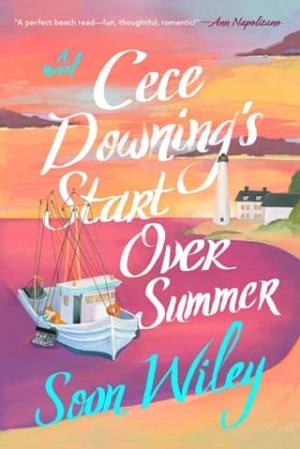
Cece Downing’s Start Over Summer (witty, heartfelt)
Chapter 1
Even with the benefit of hindsight, Cece Downing can’t seem to grasp how she’s arrived at this particular moment—renting an ivy-smothered pool house month to month in the backyard of a pleasantly deranged botany professor in New London, Connecticut—and yet, here she is, recently fired, newly single, and for the first time in what feels like a lifetime, without a plan.
The property runs parallel to the street, and from her spot on the rickety front deck, Cece has a good view of the road, just beyond the rebellious shrubs and arrowheaded hostas.
Bernard, her parents’ ornery three-year-old beagle she’s agreed to watch while they’re on vacation, expels a half whimper from underneath her chair, alerting Cece to his desire for dinner, preferably sooner rather than later. But Cece has other ideas.
Of late, she’s been fantasizing about how she can use Bernard to meet a guy who lives six houses down.
She’s considered letting the dog dig up the man’s flower beds so she has an excuse to knock on his door and apologize.
More than she cares to admit, she’s hoped Bernard might slip the leash on their daily walks and tear after the chipmunk that lives under his deck.
And sometimes, when she can’t sleep, the slap of the pool water tedious and dull, her mind drifts to more desperate ideas, like dropping the dog off in the man’s yard, outfitted with a new collar and tag with her address, and waiting for him to show up, Bernard cocooned in his burly arms.
This last stratagem, in all its foolishness, is almost enough to make Cece feel reckless—almost. Cece’s been thinking a lot about risk lately.
She’s been thinking about all the preparation, all the calculated decisions she’s made over the years to avoid it, and how they’ve proven ineffective against the yawning chasm of uncertainty and improbability that now spreads out before her like an impenetrable mist.
If everything—all the carefully crafted plans, the necessary sacrifices, the well-worn paths Cece’s taken—led her to this, what was it all for? What did any of it mean?
Like it was yesterday, Cece can still remember her confusion and anger during an eighth-grade English class when Mr. Gordon, a stuffy man with smudged glasses and thinning hair, introduced their new poetry unit by reading aloud Robert Frost’s “The Road Not Taken,” his voice scratchy and saccharine.
With equal parts horror and disbelief, Cece watched as her classmates clamored to agree with Mr. Gordon: Life was best lived when you chose the unfamiliar, the unknown.
A life spent following in the footsteps of those who went before you was a wasted one.
Cece had disagreed vehemently with Mr. Gordon, not only about his dangerous outlook on life, but with his interpretation of the entire poem.
Even so, she’d said nothing, fearful it would negatively impact her current grade of an A.
It’s the first Friday of June, and Cece’s rushed home from her job across the river in Noank to catch a glimpse of this mystery man who cruises by her pool house in his pickup truck every weekday at 5:30 p.m., like clockwork, on his way back from the shipyard that lies at the bottom of the street.
Naturally, she’s taken to calling him Mr. Shipyard.
Chilled Pinot Grigio sweats in the early evening heat, and Cece’s day job is a distant memory—the stench of the rubber gloves and waders scrubbed clean (she hopes), the clatter of oyster shells a mere rumor, the persistent cramp in her hands nearly gone.
Cece hadn’t been expecting anything glamorous when she’d applied for a seasonal job at the oyster farm, but somehow, she’s still shocked at the toll the menial tasks have taken on her body.
The ache in her lower back, the knotted muscle behind her shoulder blades are constant reminders that at thirty-two, Cece can’t bounce back like she used to, at least not like when she was a D1 athlete, her body a temple, a muscle-toned missile cutting through water.
She sips her wine judiciously. Nothing good ever comes from drinking on an empty stomach.
And yet, here she is. A cool breeze arrives off the Sound, brackish and sweet.
Cece loves living near the water, and even though the pool house is shabby, with its musty carpeting, Formica-topped junior kitchen, and cramped bedroom, she’s grateful to the landlord for renting it out on such short notice.
Bernard’s whines grow louder, and no sooner does Cece head inside to give him his kibble does she hear the low rumble of Mr. Shipyard’s pickup truck.
It starts in her chest, and as the horsepower gets closer, tremulous and teasing, Cece swears she can feel the vibrations all the way down to her crotch.
She checks her phone: 5:25. He’s early. He’s never early, at least not on any of the eight weekdays she’s been doing this—this stupid, necessary thing.
Sensing Cece’s excitement, Bernard abandons his food bowl for the screen door, where he mashes his wet nose against the screen.
“Back!” she shouts louder than she intends.
No matter how authoritative she makes her voice, the commands have no effect, with Bernard only growing more frantic.
What the hell, she thinks, clipping the leash onto his collar.
A dog can’t hurt her chances. If anything, he’ll make her look normal, less tragic.
Less tragic would be most excellent right about now.
Through the verdant foliage, a sight to see: The turquoise hood of Mr. Shipyard’s pickup crests the hilly road just as Cece gets settled in her chair, Bernard underneath her legs, tongue lolling from the heat.
It’s an old Ford Ranger with more rust than paint.
He’s smoking a cigarette, his arm dangling out the window like a weathered tree limb, tanned and speckled with paint.
He drives slowly, hand on top of the steering wheel—a veteran captain, guiding his ship into port.
Cece imagines his eyes behind those sunglasses, yellow and red-rimmed from welding or staring at the white bottoms of boats all day.
His long, black hair looks wild and unkempt underneath his baseball cap.
Stop staring, Cece thinks, stop staring.
But the Pinot Grigio tells her otherwise, and all she can do is smile.
As the truck passes, Bernard lets out three piercing yaps.
Nails scrabble across the deck, and the only thing that stops him from launching off the top step is Cece’s heel on his leash.
“Cut it out,” she growls while still trying to maintain her smile.
She hopes Lorraine, her landlord, can’t see the spectacle from her bay window.
The more Cece tugs the leash, the more he yaps.
Mr. Shipyard turns their way and raises a hand and smiles, his teeth obscured by a thick beard. Cece tucks a piece of stray hair behind her ear and waves back, her cheeks warm and itchy.
“Well done,” Cece says. “You’ve made a display of us.”
Bernard bashfully lies down and sets to licking the tops of his paws.
“What? Not my type?” She scratches him behind the ears.
The beard, the smoking, certainly the derelict truck—just one of these things would have been enough to turn Cece off in previous years. Dealbreakers. Nonstarters. But where had those rules gotten her?
Even when it came to hookups in college, Cece had played it safe, avoiding anyone who seemed like an artist or an activist, people her mother referred to disparagingly as bohemians, people who didn’t have a clue how the real world worked.
And if they weren’t going to have a viable career, if they weren’t going to make money, then Cece had no reason to waste her time and energy dating them.
She still remembers the first thing her mother said when her acceptance letter arrived in the mail from Bucknell: “Think of all the opportunities you’ll have, all the fine young men you’ll meet.
” Cece understood. Fine didn’t mean nice or fair-looking.
Fine meant rich, or even better, wealthy.
A part of Cece wishes she could blame her current predicament—single, a dead-end job, mounting student debt—on her mother, but the truth is, Cece was more than a willing participant.
When it came to romantic partners, Cece, from the earliest possible age, had always sought stability and predictability.
Her first crush, Jack Heinz, had caught her eye in the sixth grade because of a successful bake sale he’d organized for the baseball team, demonstrating his keen sense of fiscal responsibility.
In ninth grade, she fell for Paul Peters, a milky-faced boy who was running for class president.
In a dank gymnasium in front of a raucous crowd, he’d delivered a rousing—at least to Cece—speech on his plans for Tappan Zee High School: a more efficient lunch line design, a responsible fundraising campaign for their eventual prom, a car pool initiative.
He was a boy with a plan, a vision for the future.
There was nothing sexier, Cece thought, than preparedness.
But things are different now. With her funds dwindling, her once-promising career up in flames, Cece can’t help but acknowledge there’s no path left to follow, no plan to make everything right.
Failure, in its many forms, is something Cece has never been well acquainted with, and this realization only pushes her further into a place she cannot name.
Even with her entertainment for the evening out of sight, Cece can’t help but keep thinking about Mr. Shipyard, biceps like whiskey barrels, hands the size of spiral hams. As if to prove he’s telepathic, Bernard lets out a low and airy whine, garnering a half-begrudging pat on the head.
Distractions are important these days, and as far as distractions go, Cece could do much worse than Mr. Shipyard.