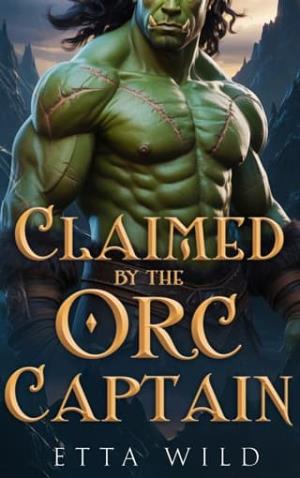
Claimed By the Orc Captain (Orcs of the Iron Wilds #1)
Chapter 1
The wagon jolted over a stone, and Delia's teeth cracked together hard enough to taste copper.
She'd stopped bracing for the ruts two days ago.
There was no point. The road through Stonehall Pass was carved into the mountainside by generations of travelers who'd clearly hated anyone who came after them.
Every bone in her body ached. Her wrists, bound loosely in front of her with rope that had long since rubbed the skin raw, throbbed with her pulse.
She'd learned to keep her head down. Eyes on her lap.
On her hands. On the dirty hem of her dress, which had been her second-best dress once, before her mother had packed it for her with trembling fingers and said it will be fine, Delia, noble households treat their servants well, you'll have good food and a warm bed, and when the debt is cleared—
Delia's jaw tightened. She made herself stop thinking about her mother.
The wagon hit another rut. The woman beside her swayed into Delia's shoulder. She was thin, all sharp angles and hollow cheeks, her wrists like kindling in their bindings. She didn't apologize for the contact. Didn't even seem to notice.
Three other workers shared the wagon bed.
An older man with a rattling cough that had gotten worse each night.
A boy who couldn't be more than fifteen, his eyes too large in his gaunt face.
And a woman about Delia's age, though she looked a decade older, her gaze fixed on some middle distance that held nothing at all.
Delia had tried to speak with them the first day. Soft questions. Where are you from? How long is your contract? Do you know what household we're going to?
They'd looked at her like she was speaking another language. Or like she was a child who hadn't yet learned that speaking was pointless.
She understood now.
The canvas covering the wagon did nothing to keep out the cold. Wind knifed through the gaps, carrying the smell of pine and wet stone. They'd been climbing for hours. Climbing toward the border. Toward the edge of the kingdom, where civilization thinned and the stories got darker.
The Iron Wilds, her father had called them, late at night when he'd had too much ale and his tongue loosened. That's where the monsters live. The orcs. They'll tear a man apart just to watch him bleed.
The wagon slowed. Delia lifted her head despite herself, peering through the gap in the canvas. The light was failing, dusk turning the world gray and gold, and she could make out the shapes of the two guards on horseback, silhouetted against a sky heavy with clouds.
"We stop here," one of them called back. Harren, his name was. A thick man with a beard that didn't hide his weak chin. "Storm's coming. We'll shelter by the rocks."
The other guard—younger, meaner, with eyes that lingered on the bound workers like they were calculating livestock—made a sound of disgust. "Half a day from the worksite and you want to camp?"
"Feel free to ride through lightning on the mountain pass. I'm not explaining to Castellan Vorn why his cargo arrived crispy."
Delia's hands curled into fists.
She should be used to it by now. Should have made peace with it somewhere between her mother's tears and the moment the guards had locked the wagon gate behind her. But the word still landed like a blow, still made shame curl in her throat.
Cargo. As if she were bolts of cloth. Sacks of grain. Something to be weighed and measured and found—
Wanting.
The wagon lurched to a halt. Delia's body swayed forward, her bound hands catching on the bench. Beside her, the woman's eyes were closed, her breathing shallow, her skin too pale in the fading light.
She's sick, Delia thought. She's dying.
Then: That's going to be me.
The thought should have brought terror. Instead, it brought something worse—a numbness that spread through her chest like frost. This was her life now. This was her future. Bound hands and silent companions and a destination that no one would tell her the truth about.
Household service, her mother had said. A noble family in the frontier territories needs staff. Clean work. Respectable.
Delia had believed her. Had wanted so desperately to believe her that she'd ignored the way her mother's voice shook, the way her father wouldn't meet her eyes, the way the debt collector had smiled when the contract was signed.
The guards dismounted. Delia heard the creak of leather, the stamp of hooves, the low murmur of conversation she couldn't quite make out.
She should stay still. Be invisible, the way she'd learned to be invisible her whole life, taking up too much space in a world that wanted her smaller, quieter, less.
You're too much, her aunt had told her once, pinching the soft flesh at her hip. No man wants a wife he can't get his arms around. You'll need to be useful in other ways.
Useful. That was the word they all used. As if she were a tool to be employed, not a person to be—
To be what? she thought bitterly. Loved? Wanted?
She almost laughed. Almost.
Instead, she shifted closer to the gap in the canvas. Close enough to hear the guards now, their voices carrying on the wind.
"—three days behind schedule already," Harren was saying. "Vorn won't be happy."
"Vorn can choke on his own tongue. It's not my fault the mountain roads are shit." The younger guard spat onto the ground. "Besides, he'll forget all about it once he sees the stock."
"I don’t know. The stock's looking thin."
"The thin ones always last longer. It's the big ones that slow down first." A laugh, ugly and knowing. "Like that one in the back. She'll owe double the years just from the food she costs them."
Delia's breath stopped.
"Probably won't last the full term anyway. None of them do out at the far site. The cold gets them, or the work, or—" He paused. "Well. You know how it goes. Accidents happen."
Accidents happen.
Delia's hands were shaking. She pressed them flat against her thighs, trying to still the tremor, trying to breathe around the pressure building in her chest.
Household service. Noble family. Clean work.
All lies.
She'd known. Some part of her had known from the moment she saw the other workers, their hollow eyes and silent mouths and the way they flinched from the guards' hands. But knowing and knowing were different things, and now—
Now she understood.
There was no noble household. There was a frontier worksite where the terms could be extended and accidents happened and no one came home. There was her body, which cost too much to feed and would never work fast enough to satisfy.
And there was nothing she could do.
The numbness covered her like a blanket.
Delia closed her eyes and let herself float in it, let herself drift away from this body that everyone had told her was wrong, this life that had led her to a wagon on the edge of the world with rope around her wrists and death waiting at the end of the road.
This is what happens, she thought. This is what happens to girls like me. We get sold and used and forgotten and no one—
Lightning split the sky.
Delia's eyes flew open. The flash was blinding—white-hot, close enough that the thunder came nearly simultaneously, a crack so loud it shook the wagon and set the horses screaming.
"Get them down! Get them down!" Harren's voice, high with panic.
The wagon jolted as the horses reared. Delia slammed into the side rail, pain exploding through her shoulder, and then the sick woman was falling against her, and the older man was coughing, and the boy was crying, and the whole world had become noise and chaos and the sharp ozone smell of lightning.
Another flash. Another crash of thunder. The canvas ripped, wind tearing through the gap, rain suddenly pouring in, ice-cold and driving.
Delia heard shouting. The guards were struggling with the horses, their mounts panicking, pulling against their leads. Through the rain-lashed gap in the canvas, she could see two men fighting to control animals that outweighed them, their attention wholly consumed.
And beyond them—
Darkness. Trees. The edge of a forest that seemed to swallow the dying light, its shadows deeper than any darkness she'd ever seen.
The Iron Wilds.
Her heart was pounding. Pounding so hard she could feel it in her throat.
Monsters live there, her father had said. They'll tear you apart.
Accidents happen, the guard had said. She'll owe double the years.
You're too much, her aunt had said. You'll need to be useful.
Delia looked at the forest.
She looked at her bound hands.
She looked at the guards, still fighting their horses, their backs turned, their attention elsewhere.
Lightning flashed again, and in its brief white light, Delia saw herself reflected in the woman’s empty eyes—saw her future, sick and silent and slowly dying on a road to nowhere.
Something cracked inside her.
A part of her that had been frozen for years, dead for longer, beaten and starved and shamed until she'd forgotten it existed.
No.
The word was small. A whisper in her own mind.
No.
Louder now.
NO.
Her hands moved before she could think. Twisted in the rope, pulled, worked at the knots that the guards had tied carelessly because why would they bother with proper bonds for a woman like her? She wasn't dangerous. She wasn't strong. She wasn't anything.
The rope loosened.
Slipped.
Fell away.
Delia stared at her bare wrists, at the raw red bands where the hemp had bitten into her skin, at her own hands that suddenly seemed like they belonged to someone else.
Move, she thought. Move now or die here.
The guards were still fighting the horses. The storm was still raging. The other workers hadn't moved, hadn't even looked up, their spirits too broken to recognize opportunity.
Delia couldn't save them. She knew that with a clarity that felt like a knife.
But she could save herself.
Maybe.
She moved. Clumsy, shaking, rain-soaked in seconds as she slipped through the torn canvas and dropped to the muddy ground.
Her ankle turned on a stone; she caught herself with one hand, mud squelching between her fingers.
Cold. Everything was cold. The wind cut through her wet dress like it was trying to strip the flesh from her bones.
The forest was fifty feet away. Forty. The shadows waited, patient and deep and full of things her father had warned her about.
Monsters.
Behind her, the guards were shouting, and she heard the sound of boots hitting mud.
She ran.
It wasn't graceful. It wasn't fast. Her body was not built for running, and the mud sucked at her feet and the rain blinded her and her lungs burned with every step.
But she ran anyway.
Ran toward the darkness. Toward the trees. Toward the unknown terrors of the Iron Wilds, because whatever waited in that forest, it couldn't be worse than the certain death behind her.
Monsters, she thought.
And: Maybe I'd rather be eaten than worked to death.
And: Maybe I'm already dead anyway.
The forest swallowed her whole.