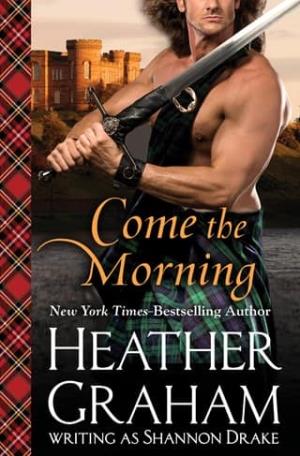
Come the Morning (Graham Clan #1)
Prologue
Scotland, The Borderlands
He was dead, he thought. He had died from the great battle-ax of his opponent, and had entered into a new world.
It was strangely familiar. It smelled of the sweet grasses of the sweeping plains, and of the fresh, clear lochs that lay like teardrops scattered across the borderlands.
If it was heaven, and it must be—for surely hell could not smell so sweet—then heaven was filled with flowers and thistles and the rich smell of the earth.
And, he discovered, managing to open his eyes at last, heaven was blessed with a sky brightened by a strange gibbous moon that cast an eerie glow of bloodred light down upon the earth.
Then pain set in; he wasn’t dead. He lived. Yet his skull pounded as if it had been rent in two. He nearly groaned aloud, yet some instinct kept him silent. He gritted his teeth and inched up on his elbows and looked about the field.
So many men … limbs pale in the moonlight except in those places where they were bathed in blood, and there he saw darkness and shadow. The sweetness on the night air was not just that of long green grasses and of flowers; it was the sticky-sweet scent of spilled blood, blood soaking the landscape.
The land was covered with the sad, grotesque carnage of battle. As it had been before, he realized dimly. As it would be again.
The pain roared to a greater life within him. It threatened to steal his consciousness again. He became aware of the feel of night-wet grass against his flesh. Each small wound burned, each greater injury seemed alive with all the fires of hell.
Dead, so many dead, and he was so nearly dead himself.
He had been left with the slain, he realized, by friend and foe alike, for not far from where he lay was a small cottage made of earth and stone.
Light radiated from a fire that burned inside it; those who had survived the carnage had gone there to dress their wounds and make their plans.
Please God, his father would be there, he thought. His kin.
Yet even as the hope flashed through his mind, so did fear and a certainty of knowledge.
Dead or alive, his father would never have left him.
He realized his hand lay upon cold flesh, and he looked to his left.
His heart shuddered within his chest; tremors seared into him, hot, scaling his spine, cold, ripping into his limbs. Tears welled in his eyes.
For his father, William the Great, lay at his side, blue eyes opened and unseeing upon the sky above them, chest cleaved by an enemy’s sword.
“Da!”
He whispered the word in a husky cry of agony, reaching for his father’s head, his fingers traveling lovingly through the deep auburn curls that graced it. “You cannot leave me, Da! You cannot leave me. Nay, ye canna leave me …”
He could dress for battle, wield a sword.
And he was tall and strong, a promising youth, the men had all said.
But seeing his father dead, he knew that he was just a lad, and he knew that whatever the jokes and the laughter had been, and even the pride, he was a boy still, with far to go to equal not only his father’s great prowess and strength, but his wisdom, mercy, and judgment as well.
But age didn’t matter, nor could his anguish change what was.
Love could not bring back the dead, nor change the outcome on this battlefield.
He’d have to be a warrior now, he knew. The tears within his eyes fell unashamedly down his cheeks.
Great William was gone, with all that he had taught, and all that he had given.
And there … with the moon coming from behind a cloud, he could see more of the field of slaughter.
Just feet away, he saw his father’s brother, proud, handsome, laughing Ayryn, as close in death to William as he had been in life.
Now he was stretched across the sweet rich grass as well, arms splayed as if he reached out to embrace heaven itself.
“Ah, Uncle! You cannot leave me, too!” he whispered again. “You cannot leave me alone.”
A scream rose within him, fierce and terrible.
It threatened to tear from his lips. Again, instinct rose to serve him.
He mustn’t make a sound. He fought down his cry of pain, a sound that would have ripped across the grasses, a howl of loss, a moan of primal fury, rage, and agony.
Instinct served him well; he did not betray himself.
He heard footsteps, and he swallowed down the threatened sound along with the bitter bile of anguish that filled his mouth from what he saw of this day’s most terrible work.
Footsteps …
Furtive in the night. Footsteps moving quietly through the grass. He saw the forms of those who were coming. They began to circle the crude cottage where the Scottish survivors had gathered after the savagery of the battle.
He held his breath. Studied the men who came. Their enemies.
He lay still as they passed by him.
Da! He wanted to cry out again, warn the men and his father that an enemy walked with silence and menace among them.
But his father was dead; his uncle, too.
I am alone, he thought again, the wretched, dreadful truth. Alone in the world, of all his people. Those who loved him would never speak his name again.
He waited.
And he watched.
And when the last of them disappeared around the cottage intent upon a silent assault, he began to rise.
He staggered, nearly passing out from the pain that swept through his head as he came slowly to his feet.
He paused, letting the pain subside, gathering his strength and awareness.
Then, he, too, began to move furtively through the grass.
Michael, Lowland chieftain of the MacInnish family, listened to the talk that went around the fire.
He’d been born himself at Dunkeld, the most ancient home of Gaelic and Celtic being.
A younger son, he’d come here to this fine sweeping borderland when he’d taken his wife, the last of the MacNees, the traditional owners of this fair stretch of earth.
But the MacNees were no more, for since olden days, conquerors had come here.
The Romans had at last been stopped by the fierce Highlanders and rugged terrain beyond; the Vikings continued to raid inland even now upon occasion.
And always, the English—or those purporting to be English, such as the new Norman aristocracy—came here.
The lands were rich, good. Men held tenaciously to them; men became a part of them.
Perhaps they came to seize land, but instead they became one with it, they became Scots.
Aye, now they were Scots. Often considered barbarians, they had never been conquered by Rome; the first time a Roman commander, Agricola, had severely beaten the Caledonians then in Scotland, he had been called back to Rome.
Soon, all Britain had been deserted by the Romans.
Different Celtic and Teutonic tribes had come in, the Picts, the Scots, the Britons, and even Anglo-Saxons.
The kingdom of Scotland remained a land inhabited by different peoples, and they still had their differences, but since the day of the great Kenneth MacAlpin, king of the Scots of Dalriada, they had begun to become a united country.