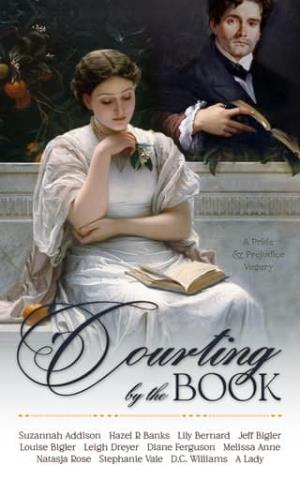
Courting By the Book (Pride & Prejudice Vagary)
Chapter 1 Entirely Unsuitable
by Jeff Bigler
Hunsford, Kent
It is a truth universally acknowledged that a young, single gentlewoman of modest means must be in want of a marriage proposal.
Elizabeth Bennet wondered how it was decided that a truth was “universally acknowledged.” Perhaps a group of scholars met to decide whether a truth was a candidate for universality, and then voted on the matter?
Once a truth had been declared to be universal, was it possible to revisit the decision? Was there a process for appeal?
Whatever the process, this particular truth must be one of the universal ones; she could think of no other explanation for her having received two marriage proposals within half a year, the first of which was farcical and the second mortifying.
She collapsed into a chair in the sitting room at the parsonage in Hunsford, too stunned to move.
The first had been from her cousin, Mr Collins, a parson who stood to inherit her family’s estate of Longbourn when her father passed.
The man was ridiculous and self-centred, and in his proposal—if indeed it could be called such, for he never once asked for her consent—he spoke of the benefits she would bring to him and to his esteemed patroness in a marriage.
Of course, she had refused; she could not countenance the thought of being bound to such a man for life.
She had just received the second, and she could imagine nothing that would have made it worse.
Mr Darcy, the arrogant, insufferable man who had burst into her life uninvited six months ago in Meryton, had insulted her at a public assembly and thereafter looked upon her as if to pass further judgement on her inferiority.
A few moments before, he professed that he “ardently admired and loved” her, yet his so-called “proposal” was a diatribe against her presumed faults and those of her family.
Had she reason to like the man before his proposal, she might have given the matter some consideration before refusing; as it was, there was nothing that could have persuaded her to marry him.
Excepting his wealth, he was entirely unsuitable.
Fitzwilliam Darcy stormed out of the parsonage at Hunsford, his mind reeling and Elizabeth Bennet’s final words ringing in his ears: “You are the last man in the world whom I could ever be prevailed upon to marry!”
Darcy had bared his soul to Elizabeth. He had shown her the depths of his affection. How, for her, he would overlook everything that ought to have repulsed a man of his station.
He recalled the Gothic romance novels that his sister Georgiana enjoyed.
He had even read a few to ensure that they were suitable before allowing his sister to read them.
Did Miss Elizabeth also read such books?
If so, she would surely recognize that his behaviour toward her had been just as the hero in one of those novels ought to be—and yet she had refused him!
How could she not realise that his willingness to see beyond her shortcomings was high praise indeed?
The walk back to Rosings was lined with hawthorn trees, their pale green leaves heralding an explosion of pink blossoms in the month to come. The trees were beautiful, best admired from a safe distance, lest one suffer the sting of their thorns. And so it was with Elizabeth Bennet.
Darcy marched up the drive to Rosings, straight past the house, and into the stables. He asked the stable boy to saddle his horse, and set off on one of the paths—if pressed, he could not have said which path or where it might have led.
Darcy gave Shadow his head, and the gelding picked his way along the winding woodland path.
Darcy’s thoughts followed a similar course, tracing the tangled turns of the past few months.
Every road led to the same place. Each one ended with Elizabeth Bennet.
He found her everywhere in Meryton: at a country assembly, on the streets of the village, and at most of the social events.
At Netherfield Park, he found her in the house, sparring with him verbally whilst she cared for her sister, her liveliness and sardonic wit drawing him in like a moth to a flame.
And charming and radiant at Bingley’s ball, leading him through the dance by the heartstrings.
One of those routes should have led to a lifetime of marital bliss.
Yes, every path could be treacherous, and this one was laden with unsuitable relatives, an almost non-existent dowry, and no connexions to speak of.
Along the way, he would have had to navigate disappointment from his family, censure from the ton, and pity from the other gentlemen at White’s.
It would have been difficult indeed, but well worth the trouble.
Alas, that path was now firmly closed, invisible, and unnavigable.
When Darcy returned from his ride, he was in even poorer spirits.
It was enough that Elizabeth had expressed her disapproval, but the universe itself seemed to concur.
Unfortunately, there would be no respite from his feelings, for his aunt, the insufferable Lady Catherine de Bourgh, had heard him enter.
“Darcy,” her Ladyship began in the haughtiest of tones, “you must come sit with your cousin Anne and me. It would not do to plan your wedding without you present.”
“Aunt Catherine,” replied Darcy, barely concealing his irritation, “we have discussed this subject many times, and I am at a loss to understand why you insist on revisiting it. Whilst I am fond of my cousin Anne, neither of us wishes to marry the other. Indeed, Anne would bring ample wealth and connexions to such a union. Still, there are two insurmountable obstacles. First, neither Anne nor I love each other well enough for marriage, and second, Anne’s health.
I would not have my cousin risk her life in childbirth only to unite our two houses. ”
Darcy looked apologetically towards Anne. However, Anne’s opinions were indeed of no consequence to her mother, a fact that was not lost on Anne, whose mien mirrored Darcy’s understanding.
“It was your mother’s wish as well as mine. Surely you would not insult your mother’s memory thus?”
“My mother’s expressed wish was that I would one day find a wife whom I love, who would manage Pemberley alongside me as a true partner, united not just in our wealth and connexions, but in our hearts.
My mother and father shared that kind of love.
If I were to honour their memories, it would be with a marriage like theirs. ”
Lady Catherine huffed. “People always marry for love in those sordid novels that Anne is forever reading. I should remove every one of those books from the library! They do nothing but fill young girls’ heads with absurd notions of matrimony that are wholly insupportable.”
The conversation continued in the same vein. At last, realising that there would be no respite from his aunt’s browbeating, Darcy retired to the library. Soon after, Anne joined him there.
“I have finally escaped my mother. I wanted to thank you for continuing to be steadfast in your insistence that we not marry.”
“It pains me, Cousin, to use your health as a reason to preclude our engagement. I dislike talking of you as if you were not in the room..”
“Think nothing of it. I have long since stopped trying to argue with my mother, for I have never known her to be influenced by reason. My feelings for you are the same: I love you as my cousin, but I agree that we would never suit as husband and wife. And my health…. But I do hope that you will one day find the kind of love that your mother described.”
Darcy struggled to hold back tears. “I have long hoped for the same. And I have found her.”
“Should I wish you joy?”
Darcy felt the colour creeping into his cheeks. He would not lie to his cousin, but neither was he ready to admit the truth in its entirety. “She stirs my heart. Alas, she would be entirely unsuitable. She has no connexions, no dowry to speak of, and her family is an embarrassment.”
“Worse than my mother?”
Darcy snorted. “Not worse, but not better either. Her youngest sisters run wild, her mother is loud and a gossip, and her father is indolent. Such a union would be…” He struggled to finish the thought, as though saying it aloud would seal his fate. “Insupportable.”
Anne shook her head thoughtfully. “In novels,” said she, “the hero always rallies and attends his reproofs, and the heroine forgives him in the end. If this young lady is enamoured of you and is a worthy woman, I hope you are not so mean as to resent her because of her circumstances. Otherwise, you can never reach the happily ever after.”
That night, Darcy’s mind still raced, and he found himself unable to sleep. After nearly wearing a hole in the carpet in his bedchamber, he went down to the library, in the hope that he would find a book that would take his mind off Elizabeth.
How is it that an estate as grand as Rosings has such a paltry library? he thought. Where are the histories? The philosophies? There are not even great works of fiction to be found—nothing by Cervantes, Swift, Johnson, Pope, or even Shakespeare.
He browsed shelves devoted to improving sermons but found no book on building a happy marriage. Do such books even exist? Darcy mused that Lady Catherine ought to have at least one, as she loved to meddle.
With a sigh, Darcy perused a shelf of popular novels.
These must be Anne’s books. Ha! It appears that Anne and Georgiana have similar tastes.
Darcy amused himself by thinking perhaps he ought to read one of them.
Perhaps one of these novels could teach me a thing or two about how a proud gentleman might woo a spirited lady.
He read the titles: Hunsford Happenings, Rich Man, Poor Man, Beggar Man, Part of Something Greater, Seize the Day, In Defence of Honour, Unhappily Ever After, From Hunsford to the High Seas, Lessons from a Dream, Their Share of Conversation, Possessing Equal Frankness, A Bleak Future, Her Ladyship Strikes Back, Sorrow and Regret, At the Edge of Destiny, Unwitting Spellcasters, Winter Storms, Peril and Partnership, The Yellow Sprigged Muslin, Runaway, and The Morning After.
Each sounded more dreadful than the one before.
Resigning himself, Darcy took down Hunsford Happenings by Leigh Dreyer and began to read.
He always started with the Foreword; he never understood how a reader could jump into a story without first meticulously discovering what the author believed he ought to know.
1 Forearmed with the necessary information, he read the opening line: It is a truth universally acknowledged that mirrors contain a thousand echoes of the beyond.
He knew not whether he would learn anything about courting, but the book at least promised to be a welcome diversion.