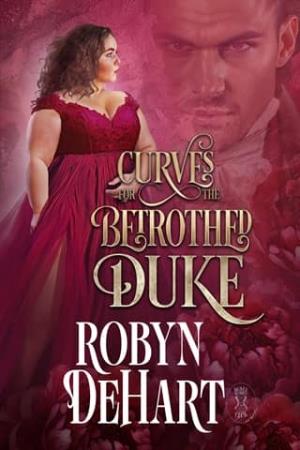
Curves for the Betrothed Duke (Busty Bodice Club #5)
Chapter 1
Chapter One
Imogen Harrington had never imagined her wedding day would feel like a battlefield. And yet, as she stepped into the aisle, every inch of her felt braced for war.
The soft strains of the organ swelled through the small Surrey church, the music rising and falling against ancient stone walls that had borne witness to a hundred years of vows—some kept, some broken, and surely none quite so spectacularly fraudulent as the one she was about to make.
The sound seemed to come from very far away, muffled beneath the thunderous beat of her own heart, which had taken up such a vigorous rhythm in her chest she half-feared it might be visible through the bodice of the borrowed gown.
The borrowed gown.
She nearly laughed at that, an awful, brittle sound she swallowed before it could escape.
The silk was too fine for her—heavy ivory shot through with the faintest blush of pink, embroidered with seed pearls along the bodice and trailing down the train in a pattern of climbing roses.
It had been fitted for Eliza’s slimmer frame, and Imogen had spent the better part of the dawn standing very still while Eliza’s lady’s maid—red-eyed but discreet, bless her—had taken hasty pinches at the seams along Imogen’s ribs and let out the bodice across her fuller bosom.
The result was passable. Barely. The dress sat snug where it ought to have draped, and the lace at her wrists felt a half-inch too short, as though the gown itself knew it was being worn by an impostor and meant to give her away.
Thankfully, the long veil covered most of her figure, so perhaps the groom would not notice his bride was rounder and fuller than he’d last seen.
The scent of lilies clung too sweetly in the air, mingling with the cooler note of beeswax candles and the faint, dusty-stone smell that lived in old churches no matter how vigorously they were polished.
The gathered guests blurred into a sea of indistinct color beyond the fine veil that shielded her face.
Pale lavenders and dove greys, a flash of crimson here, the glint of a gentleman’s pocket watch there.
She did not let her eyes settle on any of them.
To look directly would be to acknowledge them, and to acknowledge them would be to remember that every single one of them believed her to be someone she was not.
No one stirred. No one questioned.
Of course, they did not.
They believed her to be Eliza.
Imogen tightened her grip on the small bouquet in her hands—white roses and a sprig of rosemary, for remembrance, Eliza had insisted on that, sentimental creature that she was—and willed her fingers not to tremble.
The stems were bound too tightly with ribbon, and she could feel the moisture of her gloved palms seeping into the silk wrapping.
Her steps remained measured and deliberate.
Each one taken with the same careful precision she had used as a girl crossing the frozen pond behind her grandfather’s house, certain that if she moved too quickly or breathed too deeply, the ice would crack beneath her and swallow her whole.
It was not too late to turn back.
The thought came swift and sharp, as it had a dozen times already that morning.
It had come to her in the carriage, when the wheels had jolted over a rut in the road and she had nearly cried out for the driver to stop.
It had come again at the church door, when the wind caught her veil and pressed it against her mouth like a hand seeking to silence her.
And it came now, with each step, an insistent little voice that sounded a great deal like her own good sense.
You could stop. You could lift the veil, confess everything, and endure the inevitable scandal. The whispers. The ruin.
Her ruin she could survive. Scandal would touch her, certainly, but as the sixth daughter out of eight it hardly seemed like it would negatively affect her two younger sisters. She could simply be the wayward Harrington.
But then Eliza, her dearest friend in the world, would still be forced into this marriage.
Still bound to a man she did not love, to a life she did not want—still pacing some shabby room in Dover at this very moment, white-faced and clutching that ridiculous valise with both hands, waiting for the packet that would carry her across the Channel and into the arms of the only man who had ever made her laugh as though laughter were a gift instead of a duty.
Imogen lifted her chin beneath the veil.
No.
If there was to be scandal today, she would bear it. She had promised. And Imogen Harrington, whatever else might be said of her, kept her promises.
She had known all of her life that grand romance was not for her.
She was the sixth of eight daughters and possessed no great beauty or wit to distinguish her.
Her face was—in her mother’s words—pleasant enough, though her body was far rounder than was currently popular.
In fact, the only noteworthy thing about her at all was that she was exceptionally well-read.
A quality that—she had been assured numerous times—was almost as unappealing as her figure.
So, no. Imogen had no hopes for a great romance, but oh, how she longed for one. If not for herself, then at least for Eliza.
Of course, there was also the matter of the blasted red envelope. The one that gave her the dying wish of her father for his sixth daughter. You shall travel abroad, but only as a married woman.
Traveling abroad sounded divine and, frankly, would be quite beneficial should today’s antics explode in her face. But this, her charade as his bride, would also take care of that married requirement. Provided he didn’t call everything off the minute he suspected something was amiss.
Her gaze rose, settling on the man waiting at the altar.
Tristan Somerset, Duke of Winfield, stood tall and composed, his broad shoulders perfectly set within the tailored lines of his dark coat.
The candlelight caught at his temple, his dark hair the color of a raven’s wing, with not a single strand out of place.
The strong, clean line of his jaw was set in an expression of polite, ducal patience.
He did not fidget. He did not shift his weight.
He did not even glance at the small clock above the vestry door, though by now they were a full quarter hour past the appointed time, and a lesser man might have allowed himself the small discourtesy of looking irritated.
He simply waited, with the quiet, unwavering confidence of a man entirely certain of his place in the world.
Of a man entirely certain of how this day would unfold.
A faint, almost hysterical laugh threatened to rise in her throat, and she had to press her tongue hard against the roof of her mouth to keep it from escaping.
He had no idea.
They were not strangers, the two of them.
Imogen had encountered him more than once in London drawing rooms and crowded ballrooms, had stood not five feet from him at Lady Carrington’s spring rout last April, when he had been holding forth on something tedious about Parliament to a gentleman whose name she could not now recall.
He had always been polite to her on the rare occasions when politeness had been required.
Distant. Amused, perhaps, in the way one might be amused by a sparrow that had wandered too close to a picnic—mild, fleeting, ultimately inconsequential.
He had never once looked at her as if she were a woman of consequence. He had never, she suspected, looked at her long enough to be certain of the color of her eyes.
Well.
That was about to change.
She reached the altar at last, and the rustle of her train settling against the stone was the loudest sound in the church.
The vicar—a round, kind-faced man with spectacles that kept slipping down his nose—gave her a small, encouraging smile that she could not return, then prompted her gently to place her hand into the waiting grasp before her.
Tristan’s hand.
She had not expected it to be warm. Foolish, she knew—he was a man, not a marble effigy, however much he resembled one—but something in his stillness, his composure, had made her brace for cold.
Instead, his fingers closed around hers with a steady, sure pressure, and even through both their gloves, she could feel the heat of him, the contained strength, the way he held her hand as though it were a thing already belonging to him.
Her father’s absence did not go unnoticed—another irregularity among many—but no one spoke.
No one dared interrupt the ceremony now that it had begun.
There had been a story prepared, of course; an attack of gout, a carriage gone lame on the road from Hampshire.
Eliza had drilled it into her last night between sobs and frantic, whispered apologies. If anyone asks. Only if anyone asks.
The vicar cleared his throat and began.
The words flowed over her, familiar and solemn.
Sacred vows spoken in measured cadence, the same vows she had heard at half a dozen weddings in her four-and-twenty years, the same vows she had once, in girlhood, imagined speaking herself to some shadowy, kind-eyed gentleman of her own choosing.
Imogen forced herself to listen, to respond when required.
Her voice did not falter. It did not betray her—though she had taken some small precaution there, pitching it just slightly lower than her usual register, softening the consonants in the way Eliza always did when she was nervous.
“Wilt thou have this man to thy wedded husband, to live together after God’s ordinance in the holy estate of matrimony? Wilt thou love him, comfort him, honour and keep him, in sickness and in health; and, forsaking all other, keep thee only unto him, so long as ye both shall live?”
“I will.”
The words left her lips steady and sure, and a small, terrible part of her marveled at how easily she had said them. As if they had been waiting on her tongue all along.
Across from her, Tristan did not hesitate.
“I will.”
There was no flicker of doubt in his tone.
No pause. No suspicion. His voice was deeper than she remembered—or perhaps she had simply never stood close enough to hear it properly before, never been close enough to feel the low resonance of it travel through the slim bones of her wrist where his hand still cradled hers.
Imogen’s pulse quickened until she could feel it in her throat, in her temples, in the tender place behind her ear where the veil’s pins pressed against her scalp.
He did not know.
A strange, almost disorienting calm settled over her as the ceremony continued.
It was happening. Truly happening. Each word spoken bound them further, sealed a fate that neither of them had anticipated and only one of them yet understood.
She felt curiously detached from her own body, as though she were watching herself from the back of the church—a slim, veiled figure in ivory silk, her hand laid trustingly in the hand of a duke who believed her to be his bride.
“…to love, cherish, and to obey…”
She nearly choked on that last word but forced it out all the same, and felt his fingers tighten almost imperceptibly around hers when she did. Whether in approval or in some unconscious reflex, she could not say.
To obey.
The irony of it nearly undid her. She had defied her family, her conscience, the laws of both Church and State, and the simple practical wisdom of every novel she had ever read—all to stand here and promise obedience to a man she had just deceived more thoroughly than any wife in the history of England.
“…till death do you part.”
The vicar smiled, lifting his hands in a small, beneficent gesture, his spectacles catching the light from the high windows.
“I now pronounce you husband and wife.”
The church seemed to exhale as one—a soft, collective sound, half sigh, half murmur, the rustle of silk and the faint creak of pews as the guests permitted themselves to settle into the satisfaction of a thing well done.
Imogen did not breathe at all.
“Your Grace,” the vicar said warmly, “you may kiss your bride.”
Yes, he had expected a great many things from his wedding day, but Imogen Harrington was not one of them.