Darcy’s Portrait (Pride and Prejudice Variation)
Chapter 1
In the quadrangle of Somerset House, Elizabeth Bennet surveyed palatial buildings completed just a decade before. The location was on the Strand, lapped on the south side by the Thames; the north wing housed the Royal Academy of Arts.
She turned to her uncle. ‘Impressive.’
‘Palladian.’ Mr Gardiner smiled. ‘The office interiors are bland, but wait until we reach the gallery! I never saw prettier plaster work.’
He waited for the other ladies: Mrs Gardiner, Jane, and Maria Lucas, who was returning with Elizabeth from Rosings.
They had arrived an hour before closing time, hoping to avoid the worst of the congestion (the haut ton by now were parading on Rotten Row); their purpose was to view an exhibition of Venetian art in the tradition of Canaletto.
For Mr Gardiner the event was nostalgic, as he had visited Venice in his youth when establishing his first trading links.
For Maria Lucas it was another excitement to be recorded in her diary, alongside the Vauxhall gardens, royal theatres, and dinners at Rosings.
Elizabeth found herself unable to share these agreeable feelings.
For her, at best, the outing provided distraction from memories of Darcy’s proposal and its aftermath—a letter that had not only overturned her opinion of Wickham, but shaken her confidence in her own judgement.
She had struggled these last days to put aside such worries and adopt an appearance of normal cheerfulness.
After all, she was away from Rosings and need no longer endure Collins, or Lady Catherine, or Darcy.
She had also found Jane in better spirits and relieved to escape Meryton, where tongues still wagged over her disappointment.
In the foyer of the Royal Academy their party paused to admire high ceilings, marble floors, and Grecian columns, before passing to the main exhibition room.
It was not Elizabeth’s first visit, but the scale of the hall still took her breath away.
High as a four-storey town house, it had long curved windows just below the ceiling; the walls beneath were filled with paintings packed so closely that the frames sometimes touched.
Some were huge, so tall that the artist must have climbed a ladder; others no more than two foot high.
Around the perimeter some fifty people were studying the art, with a similar number taking their ease on upholstered benches in the centre.
A lot of visitors, yet the gallery did not seem crowded.
They began to circle the room, focussing on the lower paintings.
Many depicted the canals and ancient buildings of Venice, and Elizabeth was moved to see her uncle and aunt in whispered exchanges as he pointed out landmarks seen long ago.
The artists on the first wall were well known: Canaletto, of course; also Marieschi and Guardi.
These works, owned by the gallery, often bore labels acknowledging rich donors.
Further along came paintings lent by their owners for the exhibition.
Finally she reached a wall with works offered for sale, some stating a price, others marked as already bought.
Elizabeth smiled at her uncle. ‘Tempted?’
He glanced at a few, and shook his head. ‘Overpriced. And of doubtful provenance.’
These must be minor artists, Elizabeth thought.
Their names were unfamiliar, and the section was attracting little attention.
But there were lovely landscapes among them, and accomplished portraits of dignitaries with their wives and children.
She paused at a view of the Grand Canal, letting Jane and the others get ahead; then, moving off, suddenly froze.
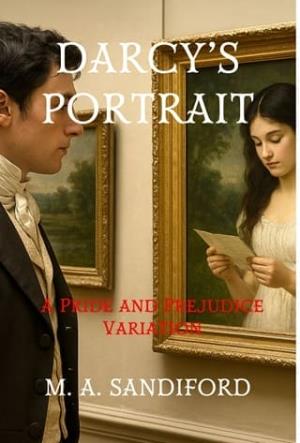
She was facing a portrait. Smallish, three foot by two.
A young woman sat on the edge of a rock, with a dark tree behind, faint clouds, and setting sun.
The white dress was high-waisted with elaborate folds.
The long dark hair hung loose, framing a face with rosy cheeks and brown eyes.
The expression radiated intelligence, humour, and a hint of sadness, or perhaps yearning.
Elizabeth gasped.
It was like looking in a mirror.
Not the environment of course. Nor the dress with its short sleeves revealing soft lightly tanned arms. But the features and the expression, especially in the eyes …
In trembling eagerness Elizabeth looked at the label on the frame. It gave a title, Young lady with letter, and the name of the artist, Lorenzo Pavan. And bore a stamp: SOLD.
Young lady with letter.
Another connection.
Jane appeared at her side. ‘Lizzy, we were thinking of going to the tea room.’
‘Oh.’ Elizabeth blinked. ‘Good idea.’ She stepped away from the portrait, and pointed. ‘What do you make of that?’
‘Charming.’ Jane looked closer. ‘She reminds me rather of you, especially in the eyes.’
Elizabeth turned as Mr Gardiner joined them. ‘Sorry to delay you, uncle.’
‘Take your time, my dear. But we need to order before the kitchen closes.’ He regarded the portrait with a frown, and stooped to read the label.
‘Are you familiar with the artist?’ Elizabeth asked.
‘Pavan?’ Mr Gardiner glanced towards the exit, where his wife was waiting with Maria Lucas. ‘Rings a faint bell. I’ll see you later, Lizzy. Don’t miss the Regatta landscape. Jane, are you coming?’
Left alone, Elizabeth gazed a few more seconds at the painting, then on impulse approached the gallery official at a nearby desk.
‘I have a question …’ She led him to the portrait. ‘Does your catalogue give the lady’s name?’
‘No, ma’am.’ The official was grey-haired, with a stately manner.
‘Her identity is unknown?’
‘The dealer might have further particulars, which he will have passed to the purchaser.’
‘May I know who bought the picture?’
‘I am not at liberty to tell you, ma’am.’ He smiled, leaned closer, and lowered his voice. ‘But since this is the last day of the exhibition, servants may come at closing time to collect works that have been lent—or sold.’
‘Ah.’ She returned his smile, and glanced briefly at the remaining paintings before adjourning to the tea room.
After a restoring cup of tea and slice of cake, Elizabeth decided to forget about the painting.
Yes, there was a certain likeness, but differences too, and nobody else had seen anything worth remarking.
Conversation had moved to a concert two days hence at Hanover Square Rooms, on the eve of their return to Longbourn.
Elizabeth joined in, but her thoughts kept returning to the lady with the letter.
Why had she, Elizabeth, felt such a strong sense of connection, even kinship?
Could this be some remote cousin, perhaps in the Collins branch of the family?
Surely not: the lady was probably Italian.
She recalled her uncle’s reaction to the artist’s name.
Rings a faint bell. Was it her imagination, or had he been taken by surprise, and eager to move on to other matters—the painting of the regatta, the tea room?
Could he have met Lorenzo Pavan in Venice, or even the young lady who had modelled for the painting?
If so, why evade the topic?
An attendant announced the closure of the gallery. Tea was no longer served but visitors could finish their drinks at their leisure. Elizabeth jumped up.
‘A moment. Back soon.’
In the exhibition room almost all visitors had departed, while the gallery staff pushed a staircase on wheels to retrieve the paintings higher up for packing.
At the wall displaying works for sale, servants were already reclaiming purchases under the watchful eye of the gallery official she had spoken with earlier.
Elizabeth inched closer, and saw two men standing beside Young lady with letter.
One was a manservant in livery, holding a crate a little larger than the painting.
His companion was a tall gentleman with a proud bearing.
Instinctively Elizabeth dodged behind two ladies lingering in the centre of the gallery.
The tall gentleman turned to speak to his servant, and Elizabeth’s stomach lurched as she glimpsed the familiar profile. At any moment he might look across the hall and spot her. Trembling, she spun away and hurried to the exit.