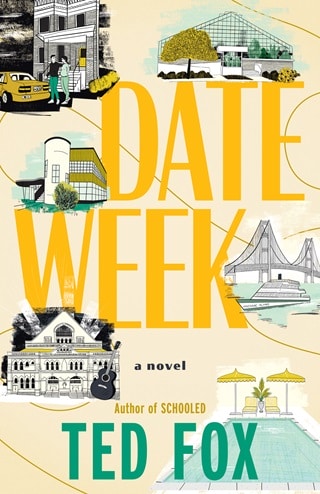
Date Week: A Novel
Chapter 1
Will Easterly was not the kind of guy who spent a day off painting a room because he was just that handy.
To feel confident and capable as a self-sufficient 34-year-old, one who might someday prove adept at being responsible for something more than choosing between Thai and Italian for dinner? Maybe. To occupy his mind with something other than the major life change on the horizon that he felt woefully unprepared for?
Absolutely.
And that was how he came to find himself rolling the walls of the second bedroom in the apartment that third Friday in June. He and his wife had picked the color together, a shade cheekily named Can of Green Gables, but the fact that Will was going to have the room done when she got home from work was a surprise.
Not as big a surprise as seeing that plus sign on the pregnancy test she had taken three months earlier. But a surprise nonetheless.
Because when it came to making things look good, you usually wanted Rachel Armas around.
A graphic designer, she worked in the communications unit at a university, not because she was particularly passionate about higher education but because the school was near where she grew up outside Chicago, which meant she could live with her parents that first year after college to save money before she got her own place. (Will had followed her to the Windy City another 18 months after that.) Now she had the combination of earned experience and natural-born talent that could take her anywhere, and yet she was still designing departmental newsletters and posters for lectures that would be attended by 10 people.
When the two of them had graduated from the University of Michigan, Rachel had actually had another offer, a paid internship at an art gallery in New York City. She had been so excited, and he had been excited for her—and himself since he had lined up his own internship in Philadelphia, only a couple of hours away. He had been convinced she was taking it up to the moment she hadn’t. When he’d asked her why she’d changed her mind, she’d just brushed it off and said it was too impractical. Not until they were living together had she told him it had been her parents who’d talked her out of it and she wished she could do that decision over.
A philosophy professor told me he needs me to “Photoshop something that conveys the rationality of belief,”she’d texted Will one day at lunch a couple of weeks ago. He’d just gotten done talking with his own boss—Will was one of the main IT people at his company, and apparently they didn’t teach you how to turn off your vacation out-of-office email at CEO school—and he’d responded to Rachel with a GIF of a cat punching a stuffed tiger repeatedly in the face.
This—this is why I married you,she’d replied. You get me.
So what’re you going to do?Every time they talked about something like this, he wondered if she was questioning her decision to play it safe a decade earlier. It pained him to think about it.
Ehh I don’t know. Probably just put some old guy under a tree looking depressed.
Sure, Can of Green Gables had been a joint decision—well, maybe 80 percent Rachel, 20 percent Will—so he wasn’t going completely rogue. And it wasn’t like she had actually said anything about waiting to do it together. Then again, this was going to be the baby’s nursery, their future daughter’s or son’s room. Forget that daughter and son still sounded like relationships that should be reserved for people who didn’t have a Dave Buster’s rewards card in their wallet. That was a given.
But priming and painting the nursery without Rachel? Again, it would be a total surprise, and not necessarily one that would be met with enthusiasm. Will could try to play it off, pretending he didn’t think the paint fumes would be good for her, but he could already see the look on her face when she shot that down. It was the look she’d given him their sophomore year on the quad at Michigan when he’d first asked her out.
He may have had a hacky sack on him. In retrospect, he couldn’t blame her for saying no.
So why in God’s name had he started painting that room? Short answer, manual labor was an effective distraction.
From worrying about the baby being healthy, of course. But also about him and Rachel. He told himself that a miscarriage or any other worst-case scenario could never get between them. And mostly, he believed it. But in the corners of his consciousness, which he visited at 2:00 a.m. when he traded sleep for all the uncertainty awaiting him as a dad, his brain would sometimes remind him that he and Rachel had never been tested in that way, so how could he really know? How could he be sure they could survive not becoming parents now? And once he went there, it was a short jump to a different catastrophe:
What if he lost her in the process? Not their relationship. Her.
He had, in fact, seen a story about maternal mortality rates that Friday morning. It’d jarred loose those 2:00 a.m. thoughts straight into his first cup of coffee and threatened to send his brain into a tailspin. So, too, had the dream he’d had the night before. In it, Rachel had gone to the hospital to deliver, and the doctors had told them they were sorry, but if there had ever been a baby to begin with, they’d lost it due to a lack of this one piece of critical knowledge. When Will had asked what it was, he couldn’t understand their response, and he’d started awake in a cold sweat in the spot where he’d dozed off on the couch.
It was only after he was done priming and on the last wall with the initial coat of paint that it occurred to him that a superstitious person might view his doing this when Rachel was still five months away from her due date as a needless tempting of the Fates.
A shiver went down Will’s spine, and he did the only thing he could think of: he went to his happy place.
He cranked the T. Swift.
Perhaps not an entirely unexpected move coming from the guy who’d used his senior yearbook quote in high school to parrot a Rascal Flatts lyric. He saw the pop-country continuum to Taylor, anyway. Rachel, however, who had been laughing for a good five minutes upon discovering his passion for “Bless the Broken Road” while helping him unpack boxes when they moved in together, did not appreciate the connection. She immediately turned serious and told him that if he ever compared Taylor to Rascal Flatts again, he’d be waking up to Rachel’s perpetually expanding The-Gift-That-Is-TS playlist every morning for the rest of their lives.
Rachel had meant it as a joke, but she’d loved the idea so much she’d done it regardless. Almost a decade later, the playlist was still going strong far more mornings than it wasn’t. Which was fine with Will. He’d always liked Taylor—although maybe not to the point of finding a Rascal Flatts comparison blasphemous—so he had no regrets.
The same couldn’t be said of his soft spot for would-be romantic gestures.
Sometimes he got it right, like his and Rachel’s first Christmas as a couple. It had been junior year. Rachel was a voracious reader, and he’d set up a scavenger hunt for her at a local bookstore, where the clues had taken her to five books on her to-read list and then ultimately to him in the café, where he had been waiting with her favorite latte and that week’s earnings from his tutoring job to buy the books with.
But other times? Less successful.
For instance, right before graduation, he had gone to Build-A-Bear and made a bear. With a recording of his voice saying “I love you.”
In 15 languages other than English (most of which he had no business attempting).
Culminating in him sappily declaring, “No matter how you say it, I love you, Rachel Armas.”
He’d led her to it with rose petals sprinkled throughout her apartment.
“Oh wow,” she had said, taking his hands. “Okay. We’re going to set aside that that teddy bear is the most chillingly creepy thing I’ve ever seen and focus on this: I love you, too, Will. So much. You are amazing, and we’re great. Graduation isn’t going to change that. I need you to trust that that’s true.”
He’d nodded, still not quite able to shake the feeling that she’d eventually move on from him once they didn’t have a college campus to keep them together. She stood out from the background hum of life, unlike anyone he had ever met. He was smart, had been described on more than one occasion as “almost impossibly kind,” and was not unattractive—she’d even convinced him to pose for her for a nude drawing assignment—but he felt like the world was destined to open up for her in a way that would be inaccessible to him.
And yet somehow, here they were.
“Ah, when did we get so old, Taylor?” he said to the wall as he worked on spreading out a drip to the undeniable banger that is “22.” “Well, not you. You’re flawless. But me? How am I going to be a dad? I can’t even keep paint off the baseboard. Crap. There is paint on the baseboard. And the floor! There is paint on the baseboard and the floor! Okay—nobody panic!”
It was odd advice, given he was the only one there, but in a weird sort of way, it helped. He liked having such a defined task in front of him: remove the paint from where it wasn’t supposed to be. He discovered it came off pretty easily with a little bit of scrubbing, and he guessed that had something to do with it being water based.
“Sounds plausible at least,” he said to himself.
It was a warm day, and with the air conditioner off because of the open window, the sweat was beading up on his forehead and back as he crouched close to the floor. But he didn’t mind. He felt like maybe he had stumbled onto something, like maybe this was the secret to parenting. Not the scrubbing itself—although based on the horror stories he’d heard about diaper blowouts, who knew—but this whole focusing on the little thing right in front of you and not getting overwhelmed by the enormousness of the entire project (i.e., raising a child to adulthood).
Because while Rachel’s pregnancy had come as a shock and Will felt completely overwhelmed by it at times, he also hoped that raising a child together, their child, would only bring them closer. And how awesome was this baby going to be if she or he grew up to be anything like his wife? So creative. So talented. So caring.
So what if he was stress rollering a nursery and finding that maybe there was something to that paint-fumes defense after all? Rachel being pregnant was still a good thing. An awesome thing.
“I wonder if I have the shoulders to pull off a BabyBj?rn,” he said, standing back up, his body literally lifting with a renewed sense of optimism as he crossed the hall to open a second window and get a better breeze going. He was thinking about baby names—Rachel really liked Lane for a boy or a girl, but he was worried about the potential for all the stay-in-your jokes—and just putting on the finishing touches of that first coat when he heard Rachel’s voice behind him in the doorway.
“Babe?” she said.
Will jumped, startled. It was only 4:00 p.m., meaning she was home from work a couple of hours before he expected her. Maybe she’d left early because they’d both taken the next week off—their annual Week of Nothing, when they allowed themselves to revel in being as lazy as they wanted—and she was just ready to start vacation. He’d taken the whole day for the same reason.
In any event, this was the moment of truth. He wished he’d had a chance to get the second coat on to bring out the full luster of Can of Green Gables, but overall, he was pleased with his handiwork.
“Now, keep in mind,” he said, turning around and narrowly avoiding stepping in the paint tray in the process, “I still have one more coat to do, but ...”
He stopped. Rachel was crying. His heart sank.
“Look, I know it’s not perfect,” he tried, “and I should’ve waited for you. Crap. I’m sorry, Rachel, I wasn’t—”
“No,” she said through her tears. She was barefoot but otherwise still dressed as she had been when she’d left that morning. “No, it’s not that. The room looks great.”
“Okay, now you’re freaking me out because I would’ve believed okay or not bad, but not great.”
That was the kind of thing that normally would’ve made her laugh, and she tried to muster one, but nothing came out.
Will’s mind began to race, his painting-inspired parenting platitude a distant memory, and he began to panic for real. What was going on?
Oh God.
It was the baby. Something had happened with the baby. That had to be it. Why else would she be so upset? And she’d come home to tell him, only to find him in the midst of painting the nursery for the child they would never have. She would never have. All because he’d been freaking out about the pregnancy and gone looking for something to do—something that, even as he was doing it, he had thought could be a jinx.
He noticed that she still hadn’t stepped into the room, which now would be an ever-present reminder of loss, and instantly felt sick to his stomach.
“Hey, what’s going on?” he said as he rushed over to her and took her in his arms. She kept crying, now into his shoulder, the purple highlight in her otherwise jet-black hair pressed into his chin.
“Rachel, I need you to talk to me,” he said after another 10 or 15 seconds had passed, hearing his own voice starting to catch in his throat. “You really are freaking me out.”
She sniffed loudly. “It’s nothing. I’m being stupid.”
Will felt himself exhale.
He was upset that she was upset. Clearly. But she’d never be so dismissive of a problem with the baby. And he was pretty sure this also meant no one had died. He just had to give her time to regroup. That he could do.
Rachel kept hugging him for another minute or so before letting go. He took a step back into the room, and she followed.
“You said you’ve still got a coat to do, right?” she clarified, scanning the walls. “Because it’s a little uneven by the window. And over in that corner.”
“There’s the woman I love.”
She did succeed in laughing this time and wiped her eyes with the back of her hand. She had on a sleeveless blouse, so the arm motion drew his attention to the tattoo on the underside of her right forearm. It was a Georgia O’Keeffe quote, written in script: “I believe that to create one’s own world in any of the arts takes courage.” Will had gone with her both when she’d gotten it and the first time when they’d known her parents would see it, at a dinner at Morton’s steakhouse in the city.
Rachel had done it knowing they’d disapprove. Despite having talked about wanting that tattoo since college, she’d waited until she was 25 to get it, understanding that inking those words on her body would represent an unerasable rejection of her parents’ sensibilities. And yet she’d hoped that somehow it would make them finally see her for who she was, who she’d become.
“But it’s not ... permanent, right?” her mom had asked upon discovering it when Rachel rested her arm on the table after they’d ordered the appetizers.
“Well, it hurt like hell, so I hope so.”
Her dad had frowned before dipping his eyes back down to the menu. “That never would’ve flown in a boardroom,” he’d said under his breath but still loud enough for everyone to hear. When she was in college, her parents had pushed her to major in something like economics, with an eye toward law school or getting an MBA. They’d never gotten over her choosing the arts, and if her decision to bail on the gallery position had been her way of belatedly appeasing them, the tattoo was meant to signal she’d made a mistake not going to New York.
Will had started to object to her dad’s comment, but Rachel had squeezed his hand under the table and subtly shaken her head. Not worth it. They’d proceeded to move their way through an awkward dinner, and then they had driven home, laughing about her parents’ infatuation with the television show Blue Bloods and planning what they were going to watch that night. She hadn’t seemed to want to talk about the tattoo, so Will hadn’t brought it up. It hadn’t been until he’d almost been asleep, their bedroom dark and quiet, that her voice had come almost out of nowhere, no louder than a whisper.
“Nothing ever changes.”
He’d put his arm around her, and she’d started to cry. Eventually she’d fallen asleep, and then he had too.
Now here they were again, and he wondered if, like that time, her parents had done or said something.
Rachel took a deep breath. Despite that laugh about her reaction to his painting, she still looked sad.
“So,” she said, “I basically got offered my dream job today.”
Will couldn’t hide his confusion. “You basically got offered your dream job today?” he repeated.
“Uh-huh.”
“Okay. But isn’t that, like, a good thing?”
“It would be”—she sighed—“if I weren’t about to have a baby.”