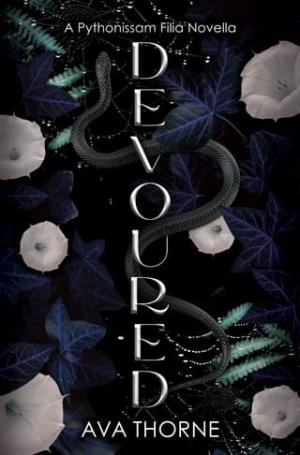
Devoured (Pythonissam Filia #1)
1. Flavia
Flavia
T he lake stretched before me like a dark mirror, its surface now so still it might have been polished obsidian.
The moon hung—full and yellow—over the black waters.
Its sickly light turned my hair to silver threads that caught and held the darkness between them as I sat on the stone steps of the villa’s eastern terrace.
My bare feet dangled just above the dry grass of late autumn and wondered if tonight would be the night I finally found the courage to use the knife hidden beneath my stola.
The blade was a small kitchen thing I’d stolen three nights past when my husband, Tiberius, had left me crumpled on the foyer floor, blood seeping into the expensive mosaic depicting Medusa’s severed head.
How fitting , I had thought through the haze of pain.
The monster’s azure eyes had stared up at me from the floor while monsters wearing human faces looked down.
I dreamed I was her, before, when I still fought back.
I imagined serpents wrapping around the neck of my husband as I squeezed the life from him.
But unlike the Gorgon, I could not turn my tormentors to stone.
She had been punished for being violated, transformed into something terrible for crimes committed against her.
I could only bleed and endure and dream of an ending to the pain—any ending.
Now, all my dreams were nothing but nightmares.
Behind me, the villa sprawled in all its imperial splendor. Forty-three rooms of heated floors and painted walls, baths that steamed with water brought through ingenious Roman engineering, and corridors lined with stolen treasures from lands that no longer existed.
I was one of those treasures.
It should have been a palace. Instead, it was my tomb—a beautiful, expensive tomb where I rotted alive, breath by breath, day by day.
The hypocaust system, which heated the tiles, hummed beneath the floors like some great beast’s breathing.
The furnace pumped hot air beneath the floors to drive away the chill of the northern climate.
I knew those heated chambers too well. Tiberius—my dear husband—enjoyed the way a heated tile could sear skin, the way screams echoed differently in the underground chamber that held the furnace.
The villa’s luxury was a lie; every comfort had been perverted into an instrument of torment.
Even now, I could smell the lingering scent of burning flesh that no amount of frankincense could mask.
I shifted on the cold stone, welcoming the bite of chill against my skin. Cold was honest. Cold was clean. Cold numbed the constellation of injuries that mapped my body like some twisted cartographer’s chart of suffering.
The burn on my left shoulder blade still wept beneath the thin fabric of my stola.
A gift from Tiberius’ heated broach. My ribs ached where Marcus—Tiberius’ second in command—kicked me yesterday for spilling wine.
Worse were the thin cuts that laced my arms and legs like some perverse form of decoration.
Gaius, barely old enough to need a razor, took pleasure in his blade’s work.
He carved shallow lines with a surgeon’s precision, never deep enough to truly damage, only to hurt.
Only to remind me that my body belonged to them, to mark however they chose.
But it was the ache between my legs that shamed me most, that hollow, burning throb that spoke of the night’s earlier entertainment.
Three of them this time, taking turns while Tiberius watched and offered commentary like some depraved instructor.
The pain radiated through my pelvis with each shift of position, a deep wrongness that made my stomach clench with nausea.
I should be used to it by now—the gods know it happens often enough—but the shame never lessened.
The first time, I’d bitten off one of the men’s fingers.
It had only made it worse, and the lashing I had received later nearly killed me.
I’d learned it was better to sink into my mind, a place they could not touch.
When it was just me and my songs, no one could hurt me.
My mother would weep to see what has become of her daughter.
Though perhaps she would understand. She had been a slave before my father had married her.
Had she not suffered similarly before death claimed her?
Had she not whispered warnings about wolves in men’s clothing; about the price of beauty in a world that devours the vulnerable?
The old gods still walk, hidden in the shadows , my mother’s voice whispered in memory. When the wind carries the scent of eternity, it means the veil grows thin. It had been a warning to stay inside on the night of Samhain. To light fires to keep away the demons that lurked.
But fire brought me no comfort now. So as the moon hung full on the evening when the veil grew thin, I prayed to fall through that veil, never to be seen again.
But my mother was seven years dead, claimed by fever.
Her death had perhaps been a relief to my father.
He had shamed himself by marrying a Briton slave who spoke too often of the old ways, who traced protective symbols in the air when she thought no one was watching, and whose wildness was never truly hidden.
Now only I remained, and my Roman name Flavia sat bitter on my tongue.
Flavia—the golden one, named by my father for hair that had doomed both my mother and I.
Hair that caught light like spun gold in daylight and silver in moonbeams, hair that had made my mother beautiful enough to claim and me cursed enough to keep.
Moon-blessed , she had whispered, running gentle fingers through my pale strands.
Moon-cursed , I corrected, for what blessing had it ever brought but pain?
The wind picked up again, stronger than before, and with it came a sound like whispers—or perhaps breathing.
Massive oaks beyond the lake’s far shore swayed, their ancient branches creaking like old bones.
The forest stretched dark and deep beyond them, older than Rome itself, older than human memory.
The Wildwood, which even Rome could not tame.
Even the legions avoided its heart, claiming savage beasts and the ghosts of conquered tribes haunted it.
The truth was far worse. The slaves called him the Devourer, a man-eater, when they dared speak of him at all—a demon who wore human shape until the moment he shed it.
No one who entered the forest’s depths ever returned, though sometimes hunters found tracks that began as a man’s footprints and ended as something else entirely—something with too many joints, too many limbs.
The Devourer suffers from endless hunger, and he would consume us all without sacrifice , or so the stories said.
So the old tribes gave him brides to appease him , my mother’s words flowed like dark honey in my memory.
Only the most beautiful girls would he take.
They become his, body and soul, and in return.
.. my mother had smiled then, a terrible smile.
And in exchange for that bargain, their homes were spared .
It had not been a comforting bedtime story, but I saw now that maybe it wasn’t meant to be. Instead, it was a warning of the appetites of men, and the price for denying them.
I looked out into the dark woods again. Was it just a story to keep your children tucked in bed at night? Looking into those deep shadows, I doubted it. If monsters dwelled in homes and villas, why wouldn’t they live in the heart of woods more ancient than man himself?
How hungry was he now? Years without sacrifice with the old tribes scattered from these lands, and only the scraps that dared wander through the woods to eat. Was he starved, desperate, driven mad by his hunger?
My hand closed around the knife’s handle beneath the wool of my stola.
The metal was cold against my palm, but not as cold as the certainty crystallizing in my chest like winter ice.
Had I been driven mad, craving the escape of death from my endless pain?
Was I any different from that demon in the woods?
The wind whipped my hair, and the fresh cuts on my arms stung as my lower belly throbbed. Yes, they had driven me to madness, to desperation. I would not be their plaything any longer.
The wind gusted again, and this time I was certain I heard something calling from across the dark water. Not words, precisely, but something that made my blood sing with recognition.
Come to me , the wind whispered, carrying with it the scent of dark earth and old magic. Come to me, moon-blessed daughter. Come to me, and learn what hunger truly feels like.
I rose slowly, my legs unsteady from the day’s fresh bruises.
The stone step felt like ice beneath my bare feet, but I welcomed it.
The forest seemed closer now, though I knew that was impossible.
My ancestor’s songs rang in my ears. Of dark waters that served as doorways, of lakes that had no bottom because they opened onto the Otherworld.
Beware the waters, beware their calling sound.
Turn back, my love, or you’ll be drowned.
The knife’s weight in my hand felt suddenly insignificant.
What was one small blade against the enormity of my suffering?
What was one quick cut against years of slow dying?
The dark lake called me to the underworld, to a place where suffering ended, where I could be wrapped in cold until I was numb to everything.
I took a step toward the lake’s edge, then another. The water lapped gently at the shore, dark as spilled blood in the moonlight. My toes breached the surface, and the cold was so deep it burned. But it was a burn that would end.
“Stop, Flavia.”
A voice cut through the night air, and my blood turned to ice in my veins. I knew that voice. Knew the particular mixture of amusement and ownership that colored each syllable of my hated name.
Tiberius.
I didn’t turn around. If I did, I’d lose what little courage I had. Instead, I took another step into the water, toward the calling of the wind, toward the darkness.
“I said, stop.” His voice was closer now, boots clicking against stone tiles. “Step away from the water. Now.”
Come, before it’s too late. Before they drag you back to die slowly in their heated halls.
But firm hands seized my shoulders before I could take another step, fingers digging into tender bruises with practiced cruelty. Tiberius spun me around to face him, his dark eyes glittering with anticipation that made my stomach clench with familiar dread.
“Did you think I wouldn’t notice you’d left your room?” he murmured, his breath wine-sweet against my face. “Did you think I wouldn’t find you here, contemplating something foolish?”
His gaze dropped to the knife in my hand, and his smile widened. With casual ease, he twisted my wrist until my fingers spasmed open and the blade clattered to the tiles at our feet. The sound echoed across the water like a death knell.
“Tsk, tsk,” he said, and there was genuine amusement in his voice. “Were you planning to use that on yourself? Or perhaps...” His smile turned savage. “Were you planning to use it on me?”
I didn’t answer. The calling in the wind was fading now, growing distant as he dragged me backward, away from the lake, away from the forest, away from the only hope I’d known in months.
“Come,” Tiberius said, his grip tightening until I could feel bones grinding together. “My men are waiting, and the night is still young. We have such wonderful games planned for you.”
Fear squeezed down on my heart until I thought it might burst. Dread crept through me, a familiar companion. I would not let it show. I had learned long ago that only made what came next far worse.
As he hauled me back toward the villa’s heat, I cast one last desperate look toward the dark forest beyond the lake. The trees swayed in a wind I could no longer feel, and for just a moment, I swore I saw something move between their trunks. Something large and patient and utterly without remorse.
The hypocaust system breathed as Tiberius led me deeper into the torch-lit corridors, back to the rooms where pain had its own language and mercy was a word that has been forgotten entirely.
Heat surrounded me until clammy sweat covered my whole body.
The air was still and smothering, and—despite my best efforts—my body shook, knowing what came next.