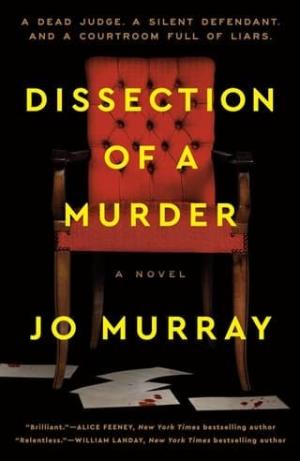
Dissection of a Murder
Prologue The Accused
Prologue
The Accused
What is justice?
That’s the question I’ve asked myself, repeatedly, over the past eight days.
Is it following the law to the letter? Or is it ensuring real justice is carried out, even if it means slightly bending the rules? Most people never need to think about it.
Would I class myself as a rebel? Yes, I suppose I would. A rulebreaker? No.
I know which rules I can twist without getting caught.
But it’s only ever been for the greater good.
Selling this concept to a jury, however, is another matter.
What they need to see isn’t necessarily the “truth,” but whatever appears just. You think those are the same things, don’t you? They’re not. Especially in this case.
I know from experience that if jury members turn around to look at you when they enter the courtroom to deliver their verdict, you’re about to be acquitted. If they don’t, they’re going to find you guilty.
It makes sense, I suppose. You wouldn’t want to look directly into the eyes of someone you’re about to send to prison.
A killer.
I’ve studied them all, sitting in the jury box to my left. Seven men and five women. Together, twelve ordinary members of society will decide my fate, having listened to the gruesome evidence that has stained the air of Court 1 with its squeaky spring benches and windowless walls.
It’s a modern courtroom, not like the old ones you see on TV.
I imagine it was designed to feel spacious, going by the abnormally high ceilings and soft gray paneling, but, at the end of the day, it’s still a room where people are forced to pay for their sins under the glare of fluorescent strip lights.
The prosecutor stands to address the jury for what will be his closing speech.
He’s one of those aggressive lawyer types—cocky, full of himself.
Brash and arrogant. He kept me in the witness box for an entire day during cross-examination and acted as if he’d already won.
There was no doubt in his mind that the evidence he placed before the jury was strong enough to convict me.
He stood, leaning against the bench, arms folded as he fired questions like a machine gun.
The temptation to punch someone in the face has never been stronger.
I couldn’t do that, though. I couldn’t show any signs of anger whatsoever because, to the ordinary people watching, aggression would indicate I’m a murderer.
My barrister is the prosecutor’s opposite. She is quiet but firm, clever with her tactics and cool under pressure. Personable. I’ve a feeling the jurors have warmed to her. I hope they have.
“Ladies and gentlemen,” the prosecutor says in a patronizing tone, gripping the lectern for additional gravitas.
“You’ve now heard all the evidence in this case, and it is time for you to reach your verdict.
The defendant before you is accused of murdering Anton Smythe, a fifty-six-year-old Crown Court judge.
It is alleged that on Friday, September 6, 2024, he was killed by the defendant after suffering a fatal blow to the head.
“Now,” he goes on, adopting the sinister tone he’s used throughout this spectacle. “This trial has not been conducted free of drama. You will recall the defendant’s evidence was ‘colorful,’ to say the least.”
As I sit in the dock, my eyes flick toward the jury.
The man in the front row, who barely looks old enough to vote—I’ve named him “Young Hannibal Lecter”—raises his eyebrows in a way he obviously wants me to see.
“Sad Susan”—who seems about to burst into tears any second—glances over to see my reaction.
She looks very stressed. I know how you feel, love.
I don’t move an inch—it’s not like I can smile at her.
“If this trial has taught you anything, ladies and gentlemen, it’s that not everything is as it seems. One thing you can be sure of, however, is that this defendant is not trustworthy.
The Crown rejects the preposterous tale offered by the accused.
It is one of a fantasist. One of a liar.
One of a killer. And in due course, I will invite you to return a guilty verdict. ”
I remain silent as he bangs the nails even further into my coffin. While he runs through the evidence against me, I watch the jurors stare at him intently. The judge’s eyes scan the packed courtroom. Each day has been busier than the last. They’re all waiting to see: guilty or not guilty?
In a case like this, a jury starts not with a presumption of innocence, as they should, but with a presumption of guilt. The evidence against me is damning. The plan was always to sow a tiny seed of doubt in their heads, then water it and watch it grow.
Twelve jurors. Even if the majority are against me, all we have to do is plant enough doubt in at least three of their heads and they can’t convict me.
Three. That’s it.
Did it work? I’ll find out soon enough.
The official nature of everything, rehashed and retold in this clinical setting, unsettles me as I sit imprisoned within the dock at the back of the courtroom.
As the prosecutor outlines the main pieces of evidence that ended Anton Smythe’s life—which have led to my ruin—snapshots of that night flash through my head like a strobe light.
I see his body lying on the floor; you wouldn’t have even known he was hours from death if it weren’t for the delicate yet fatal trickle of blood coming out of his nose.
I knew then that everything would change. That I’d end up here.
My eyes scanned the room that night—“the crime scene”—knowing every inch of it would be investigated.
I’d been in the system long enough to know this was the calm before the storm.
Everything I did from that second onward would be scrutinized.
Next time I saw the injuries, they would be in photos, only everything would look brighter because of the flash from the scenes-of-crime officer’s camera.
Rulers would be placed next to inanimate objects and take on names like “the murder weapon.”
I thought I’d been so careful.
My downfall was the phone.
But what if all the evidence points toward you and it was more complicated than it seems? Are we just to accept you’re either the victim or the killer and there’s nothing in between?
That is not real justice.
The prosecution can tell whatever story they want, but I know what really happened. Don’t get me wrong—it all got completely out of hand. When I think about the lies I’ve told, the people I’ve involved, the lives I’ve destroyed, I despise myself. But a life sentence for this wouldn’t be justice.
I killed him, yes. But it wasn’t my fault. I had to do it.
I never had a choice.