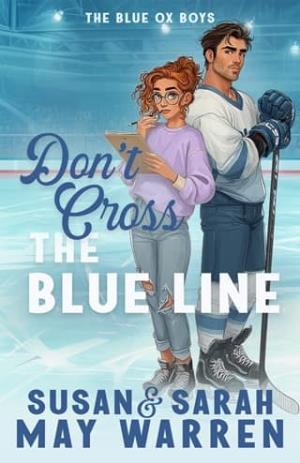
Don’t Cross the Blue Line (The Blue Ox Boys #2)
Chapter 1
One
Everly
Here’s the problem. I lie for a living. Sort of.
I mean, as a novelist, I live in a world of make-believe and fiction, so technically, it’s all not true.
Unless you count the source material, but see, that’s the problem.
When a gal has spent her life making up people, events, and things, real life gets complicated.
Especially when you run out of ideas for characters and…
Never mind. If I just look the other way, maybe this will all be over soon. Like a tetanus shot.
Welcome to the EmPowerPlay charity dinner, where the hockey players are charming, the donors are generous, and I am one lie away from my entire life imploding.
Longest three hours of my life, and I completely blame my overeager editor from Stratton Publishing.
“Everly, smile. You look like you’re attending a funeral.
” Bree Holloway nudges me while arranging copies of Thriller on Ice on the signing table like holy relics.
She’s relentlessly cheerful. Painfully sunny, really.
“This is a charity event. For children. Try to look like you enjoy children.”
“I enjoy children. I mean, let’s not go overboard—I wouldn’t sign up to be a daycare provider or even a crossing guard, but in theory, children are cute.
What I don’t enjoy is”—I wave vaguely at the ballroom.
Blue-and-white everything. Hockey sticks crossed over centerpieces.
A screen playing a highlight reel of EmPowerPlay kids learning to skate—“this.”
“You mean the free food, the open bar, and a room full of potential readers?”
“I mean the hockey.”
Bree raises an eyebrow. “But isn’t—”
“Zip it, Bree.”
She sighs and gives me a look that says Get over it and You’re going to sign books if I have to staple your hand to the pen.
Here’s what nobody in this room knows—no one except God and Bree.
I’m not just E.J. Hartley, thriller author, here to sign copies and support a children’s charity.
I’m also Sutton Blake. Hockey romance writer.
Author of Breakaway, Slap Shot, and the currently-very-unfinished blank-page disaster Ice Cold Heart, featuring a hero who is suspiciously, embarrassingly, career-endingly similar to the Blue Ox defenseman standing approximately forty feet from my signing table.
And lastly, I’m also Everly Hart. Coach Hart’s daughter. The only identity I didn’t write for myself.
Three names. Two secrets. One room full of hockey players who would lose their minds if they knew I’d been turning their locker-room culture into fictional love stories. Sounds like a rom-com, right? Except if any of them—especially a particular someone—finds out…
Well, there might be more lying.
I scan the room, checking for trouble. There’s Wyatt Marshall, the goalie, looking uncomfortable in a suit that doesn’t fit his shoulders.
Conrad “King Con” Kingston, former center, now a fellow defenseman, charming donors with his rich fiancée by his side.
Brody “Candy” Kane—if you’re seeing a trend here, it’s because apparently professional athletes can’t do their job without a dumb nickname—tucked into a corner booth with his new girlfriend. Cozied up. Happy and oblivious.
And then, of course, there he is.
Beckett Benson. Defenseman. Cue the dumb nickname: “Blue Line.” Currently standing by the bar in a navy suit with a loosely dangling tie, and I’m annoyed to report that he grew up. Ugh. He grew up good.
The last time I saw him in person—and believe me, that’s a memory I’ve been trying for over a decade to exorcise—he was a gangly fourteen-year-old with too-long limbs and a chip on his shoulder the size of Minnesota.
That boy is gone. In his place is a man built like he was designed by a committee of women who wanted to ruin other women’s lives.
Broad shoulders the suit is struggling to contain.
Dark hair pushed back, all wavy and messy in that annoyingly effortless way that makes it seem purposeful.
Commanding jawline. Dazzling smile (which is really saying something, if you know anything about hockey).
And his eyes—even from forty feet, I can see those eyes. Ice blue. Cool. Unapproachable.
Shoot, he looks like the cover of a hockey romance novel, doesn’t he? And believe me, I would know, because I write hockey romance novels, and I have literally described this exact man on the pages of Ice Cold Heart.
Yep. I did that. Don’t judge me. Like I said, I was desperate.
Photographs are one thing. But knowing from social media that a man fills out a suit is entirely different from standing forty feet away and feeling it somewhere in your sternum.
It’s fine. Art imitates life. It doesn’t mean anything.
He’s talking to a blonde with a clipboard—Felicity something, the team publicist—deploying the kind of practiced smile that makes donors write checks and makes me want to throw something.
He’s leaning against the bar, one hand in his pocket, the posture of a man who knows exactly how much space he takes up and isn’t sorry about it.
I hate that I notice all of this.
I hate that my writer brain is cataloging the way his jacket pulls across his back.
And I really, really hate that somewhere in the last seventeen years, the skinny kid who sprayed ice in my face turned into this, and that my stupid, traitorous novelist brain thinks it’s interesting.
Sure, he’s hot. I can admit that. The sky is blue, water is wet, Beckett Benson is devastatingly attractive. I’m not blind.
But I’m not going to let all that go to my head, because I know him from before. Before he was the Blue Line. Before the jaw and the shoulders. Back when he was just a skinny kid who needed extra coaching. Beckett Benson.
A.k.a. the kid my father chose over his own family.
So yes. I am writing a romance novel with a hero based on Beckett Benson. A grumpy, emotionally-walled-off hockey player. In my fictional book, he’s a hero who learns that vulnerability is strength and love is worth the risk.
See what I said about lying?
Here’s the problem, however. I can’t make it work, because deep down, I don’t believe Beckett Benson—or any hockey player—is capable of any of those things, at least in real life.
In fiction? Well, anything’s possible. And admittedly, my heroes are compassionate, heroic, and vulnerable.
(I did mention the fiction part, right?) But in this book…
well, I can’t seem to land it. My editor’s feedback rings every time I open the manuscript: The hero feels generic, emotionally distant. Where’s the vulnerability?
Great question. If I figure out the answer, I’ll let you know.
Truth is, and we all know this, vulnerable heroes sell books. So I have to dig deeper, find some reasonable-sounding truth in all this.
I might be doomed.
I tear my eyes away and focus on the EmPowerPlay highlight reel, which is a mistake of a different kind. A boy, maybe ten, in a helmet so big it wobbles. Laughing. Falling. Getting up. A coach—not my dad, someone younger—is skating beside him. Not holding him up. Just there.
My throat tightens.
I touch my wrist—the bracelet with the tiny silver book charm I’ve worn since college—and the cool metal settles me. Slightly.
“I’m going to grab food before signing,” I tell Bree.
“Grab me a few mini quiches if they have them.” She straightens, reaching toward me. “Oh, hey, I think we’re short on books. Only brought twenty, and I count forty in that line.” She snatches her purse. “There’s an extra box in my car.”
A glimpse of fresh, clean, non-self-impressed-hockey-player air flashes in front of me. “I can grab it after I eat.”
Bree smile-grimaces. “If you eat first, that line hits fifty and we run out halfway through, and people give you the disappointed face and—”
“Fine—fine. I’ll get the box first.” Anything to stop the spiral forecast. “Where’d you park?”
“Lower-level garage. Row C. Blue Civic. Box is in the trunk.” She hands over her leather jacket. “Keys are in the pocket. Wear it—it’s cold out there, and you only have a dress.”
“I’m fine.” I take the keys from the pocket.
“You sure?” Bree asks. “I can go.”
“You stay. Guard the table. If anyone asks where E.J. Hartley went, tell them…”
“I’ll tell ’em you’ve finally had it, and you’re running for the hills.” She winks conspiratorially.
“See, you get it.”
I slip away with the keys and practically run for the door.
The main elevators are packed—every donor in Minnesota apparently arrived in the same fifteen-minute window. But there’s a service elevator, which I spotted earlier during my initial reconnaissance.
Listen, if you’re casing your hotel as though you’re about to be part of a casino heist…well, maybe you’re completely normal. But I’m an author with thriller brain. Can’t turn it off.
The service hallway is blessedly empty. Dim. Quiet. The ballroom noise drops to a muffled hum, and my shoulders finally come down from my ears.
I press the Down button and exhale.
The elevator dings. Small—scuffed metal walls, a handrail that’s seen better decades, ominous-colored stain on the floor that I instantly catalog for future thriller stories.
I press the button for the lower level and turn away to look out the window of the elevator, which betrays an icy, pre-blizzard Minnesota night.
With my peripheral vision, I see a hand shoot through the gap.
I jump back, heart relocating to my throat, as the doors bounce open and a man steps in. His head is down, and he doesn’t look at me. Fine by me. I’m too tired for rando-stranger eye contact tonight anyway.
I turn back to the gloomy view, watching in my peripheral vision as he punches the lobby level. His other hand loosens his tie another inch, like the fabric personally offended him. Then he sighs like a man wishing to be anywhere other than here.
Yeah, you and me both, slick.