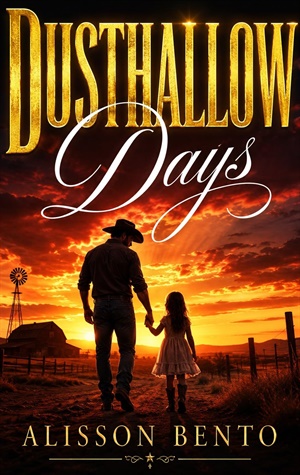
Dusthallow Days (The Wild Sky Legacy #16)
CHAPTER 1
Wren
◆
By the time Wren Calloway saw the first Dusthallow city-limit sign leaning in the weeds, her car had developed a cough that sounded personal.
It rattled once under the hood, missed a beat, then lurched over a seam in the narrow county road. Wren kept both hands on the wheel and smiled at nothing, because panic was a luxury item and she had already spent her last thirty dollars on gas outside the Hill Country.
"Almost there," she told the dashboard.
The blinker clicked, though she had not touched it. Excellent. A dramatic entrance would have been excessive otherwise.
Heat shimmered above the road. Late Monday light turned the caliche shoulders white and every fence wire sharp. Dusthallow, Texas, had never been polished. It was limestone, cattle guards, patched roofs, and hand-painted signs sun-baked into stubbornness.
Wren rolled down the window because the air conditioner had given up twenty miles back. Hot cedar dust pushed in, dry and resinous, coating her tongue. In the back seat, two suitcases leaned against each other like exhausted relatives.
Two suitcases. One garment bag with Della's emergency bridesmaid dress alterations pinned into its plastic sleeve. A cracked laptop and a portfolio from an event-design job that no longer existed.
In her bank app: $82.14 available after gas. Three maxed credit cards. Zero paid work booked. One failed engagement she had described to Della only as It ended, which was neat, tasteful, and about as true as a silk flower.
Wren eased off the accelerator when the car coughed again. The engine gave a hot metallic shudder. She checked the temperature gauge, the road, and the hard blue sky, as if weather might offer employment or mercy. Dusthallow sat ahead exactly as she had left it eight years ago.
Her phone buzzed in the cup holder.
Della.
Wren glanced at the cracked screen, then back at the road. She was not ready for bridal brightness, not with her bank balance etched behind her eyes like a receipt she could not throw away.
The phone buzzed again.
"I am alive," Wren said to it. "I am nearby. I am emotionally unavailable to seating charts."
She let it go to voicemail.
Sudie Crane's cottage sat on the south edge of town where the road narrowed and followed an old fence line toward scrub pasture. Wren had spent childhood summers counting the cedar posts from the cattle guard to the porch. Twenty-three posts, then the leaning mailbox.
At eighteen she had counted them while leaving for Austin with a scholarship folder on her lap and Colt Duvane standing in the dust behind her, too proud to ask and too hurt to chase.
At twenty-eight she started counting again before she could stop herself.
One. Two. Three.
The fourth post was down.
Wren slowed. The cedar post lay cracked at its base, dragging two strands of wire into the brittle grass.
A section of rail had sagged inward, and beyond it the brush pasture stretched in thirsty brown waves toward the low rise that marked Duvane land.
A toolbox sat open beside the fence, and a man in a dust-gray shirt worked a pry bar under the old concrete footing.
For half a breath, her mind refused to put his name to him.
It registered pieces instead: sun-dark forearms, hat shadow, shoulders shaped by labor, the patience in the way he waited for stubborn earth to give. The boy she remembered had been all elbows and summer growth, grin quick as creek water. This man moved slower. More contained.
Colt Duvane looked up.
The car chose that moment to backfire.
Of course it did.
Wren pressed the brake too hard and stopped half on the gravel, half in the weeds. Dust settled across her bare arm. Colt stood with the pry bar in one hand, his hat tilted low, expression unreadable in the glare.
She had imagined seeing him again across the chapel aisle, with flowers and relatives giving them places to look. She had not imagined the south fence, a dying car, and her whole life packed like evidence in the back seat.
Wren shut off the engine. It kept ticking after the key turned, a hot, uneven complaint.
Colt's gaze moved from her face to the car, then to the suitcases, then back to her face. He did not hurry over. Colt had never wasted motion, even as a boy, but this stillness had weight to it. Hurt had made a fence post of him, sunk deep and weathered hard.
She got out before he could decide whether to be courteous.
The heat hit at once. Dust lifted around her shoes. She smoothed the front of her blouse, then hated herself for doing it. As if he could not see the eight years between them, the worn tires, the chipped nail polish, the gas-station sunglasses.
"Colt," she said.
His name felt different in her mouth. Older. More expensive.
"Wren."
One syllable each. They had once needed whole afternoons to say nothing.
She tucked her keys into her palm until the teeth pressed little half-moons into her skin. "Della said she had someone coming out to look at Sudie's fence."
"She called the feed store," he said. "Junie called me."
Of course Junie had. Dusthallow did not have a communications network. It had Junie Mabry, which was faster and came with opinions.
"I expected a handyman."
"You got one."
The answer was plain, almost flat, but something moved behind it. Some old rhythm noticing the gap where humor used to be.
Wren looked at the broken line of fence because looking at him too long was a bad use of limited courage. "I can pay whoever Della arranged. Or Sudie can. I mean, not today, necessarily, depending on what she already set up, but I can make sure--"
"Della said put it on Ruston's account until she sorts the wedding expenses."
Wedding expenses. Flowers, chapel ribbons, pasture lights, barbecue counts, alterations, favors.
Della had three weeks to turn a century-old stone chapel and a ranch reception pasture into the kind of wedding Odette Pryce could not sneer down to size.
Wren had come home because she was useful with budgets and impossible timelines.
Also because she had nowhere else to go.
"Right," Wren said. "Good."
Colt set the pry bar against the rail and crouched to inspect the split post. "You staying at Sudie's?"
"That's the plan."
"She know you came today?"
Wren smiled automatically. "Sudie knows everything five minutes before it happens. She left the key under the blue pot."
"Blue pot cracked two winters ago."
For a foolish second, memory rose bright: Wren and Colt at seventeen on Sudie's porch, Colt pressing a blue thumbprint to Wren's wrist like a secret signature.
She made herself shrug. "Then under whatever replaced it."
"Tin coffee can."
"Still charming."
"Still leaks."
He bent to the work again, the brim of his hat hiding his eyes. Wren should have taken the dismissal, found the key, and unpacked. Instead she heard the dry scrape of the post shifting in the hole and noticed the sagging rail straining the wire toward the road.
"Do you need help?"
Colt paused.
"With the fence," she added, because apparently clarity was necessary when a woman who had broken his heart offered anything at all.
"No."
The old Wren would have argued. She had argued with Colt about everything: chapel bells, bluebonnets, whether leaving Dusthallow meant winning. The woman beside the dying car knew better than to spend pride where cash would do, and she had almost no cash.
She stepped closer anyway. "I can hold the rail."
"It'll splinter."
"I've met wood before."
His mouth tightened, and there it was: the boy she had loved, buried under restraint, almost smiling despite himself because she had always irritated him into being honest.
Then it vanished.
"Suit yourself," he said.
Wren crossed the shallow ditch, careful of the twisted wire.
Her shoes were wrong for pasture edges, thin-soled flats better suited to hotel ballrooms than cedar chips and caliche.
A grass burr caught at her hem. She bent to free it, and the scent of hot dust rose stronger from the broken post, sharp enough to sting.
When she gripped the sagging rail, cedar dust smeared across both palms. It was hot from the sun, powder-fine and gritty at once.
Splinters snagged her skin. The smell cut through the road heat, the car's engine burn, the faint sweetness of crushed weeds.
It threw her backward: thirteen years old, holding fence rails for Sudie while Colt showed off by carrying two posts at once; sixteen, hiding behind this same line to eat peaches stolen from a community supper; twenty, pretending ambition did not taste like ash.
She tightened her grip.
"Careful," Colt said.
"I am."
"You never were."
The words came quiet. Too quiet to be accusation in any useful way. They slid under her ribs before she had a chance to defend herself.
Wren kept her eyes on the rail. "That's not entirely fair."
"No?"
"I made lists. I researched. I color-coded."
"You drove off."
There it was. No raised voice. No scene for the road to carry toward town. Just four words set down like tools he had cleaned and kept sharp.
Her fingers pressed deeper into cedar dust.
She had answers, some true and some polished. I was eighteen. My mother said things. Your silence said more. I thought you wanted me gone.
None of them belonged at a broken fence in the first ten minutes.
"I did," she said.
Colt looked at her then. His eyes were the same brown she remembered, though memory had softened them and life had not. Grief had taught his face to hold back before it gave anything away.
"You staying long enough to unpack?" he asked.
Her phone buzzed again before she could answer.
The cracked screen flashed Della's name for the third time.
Wren almost laughed. Timing had always been Della's secret weapon and worst habit. She shifted one hand on the rail, pulled the phone from her pocket, and answered with more brightness than she felt.
"Tell me nobody set anything on fire."
"Where are you?" Della demanded. "I have called you three times."
"Near Sudie's."