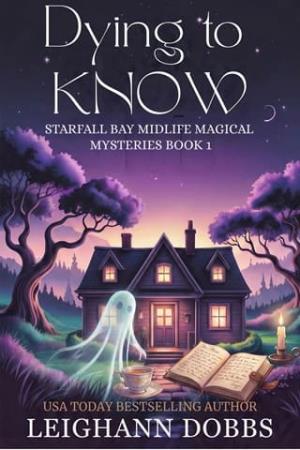
Dying To Know (Starfall Bay Midlife Magical Mysteries #1)
Chapter 1
CHAPTER ONE
My dead mother-in-law was standing in my bathroom mirror, and she was criticizing my hair.
“You look terrible,” Rosaria said. “Like something the cat dragged in and then dragged back out because it was not worth the effort.”
I gripped the edge of the sink so hard my knuckles went white. Water dripped down my face from where I’d been splashing it, trying to survive the hot flash that had sent me stumbling down the hallway thirty seconds ago. My heart was attempting to exit my body through my throat.
“You’re not real,” I said.
“I am standing right here.”
“You’re dead.”
“Obviously.” She smoothed down a pearl button on her cardigan, which was insane because she didn’t have hands anymore, she didn’t have anything, she was dead and buried in St. Anthony’s cemetery and I had worn black to her funeral even though she’d spent thirty years telling her son he could do better than me.
I spun around. The bathroom was empty. Just me and the claw-foot tub and the pedestal sink and the soap dish I’d knocked to the floor when I’d first seen her. Shattered ceramic everywhere.
I turned back to the mirror.
Still there. Silver hair perfectly set. Pearls at her throat. That expression of perpetual disappointment I knew better than my own face.
“This is a stress hallucination,” I said. “This is my brain finally cracking. I’ve been eating cereal for dinner for three months and talking to myself and this is just—this is a thing that happens to women my age, probably, there’s probably a pamphlet—“
“Gina.” Rosaria’s voice cut through my rambling like a knife through my overcooked brisket, which she had complained about at Easter dinner four years ago and clearly never forgotten. “Stop babbling. I do not have time for your hysterics.”
“My hysterics? You’re the dead woman in my mirror!”
“Yes, and I have been trying to get your attention for a week, but you are apparently impossible to reach unless you are having one of your episodes.”
The hot flash. The heat that had started in my chest and spread outward like wildfire, sending me stumbling to the bathroom or sticking my head in the freezer at—I glanced at the clock on the wall—nine-thirty at night, desperate for something cold.
The hot flashes had been getting worse. So much worse.
My doctor had said it was normal, that menopause could be “disruptive,” which was the understatement of the century.
She had not mentioned anything about it making you see dead people.
Although maybe she should have. Aunt Amelia’s cottage was full of things I’d been avoiding since I moved in.
The books on her shelves with titles like Conversations Beyond the Veil and A Medium’s Guide to Spiritual Boundaries.
The dried herbs still hanging in the kitchen, giving off a faint smell I couldn’t identify.
The collection of antique mirrors in the spare bedroom, at least a dozen of them, all different sizes, all covered with sheets like she’d been hiding them from something. Or hiding something in them.
I’d told myself she was just eccentric. A little odd. The family’s weird aunt who lived alone in Maine and never came to holidays.
“I did not die of shock,” Rosaria said.
“What?”
“At the dinner. When Salvatore announced your little divorce.” She said divorce the way she’d always said it—like it was a communicable disease. “Everyone thinks I died of shock. That my heart simply gave out from the stress of learning my son’s marriage was ending.”
“That’s what the doctors said. That’s what—“ My voice cracked. “Everyone blamed me. Your sister called me a murderer at the funeral.”
“My sister is an idiot who married a man with a toupee. Her judgment cannot be trusted.” Rosaria’s eyes met mine in the mirror, and for the first time in thirty years of knowing this woman, I saw something other than criticism. I saw rage. “I was murdered, Gina. Someone poisoned my tea.”
The word hung in the air. Murdered.
Three months ago, I'd let Sal keep the house.
I didn't want it—didn't want the kitchen where I'd cooked ten thousand dinners nobody thanked me for, didn't want the bedroom where I'd lain awake for years listening to him breathe and wondering when I'd stopped caring if he stopped.
Let him have it. Let him have the granite countertops and the three-car garage and every memory I was trying to outrun.
Somehow, the kids took that as a confession.
As if walking away from the house meant I was the one who'd broken the marriage, not the one who'd finally stopped pretending it wasn't already broken.
Josie called me a selfish monster. Nick just stopped calling at all.
They were twenty-eight and twenty-six—grown adults with jobs and opinions about wine—and they'd picked sides like children choosing teams at recess.
Only Carmen still talked to me, still believed that leaving her father after thirty years wasn't an act of cruelty but an act of survival.
So I'd come here. Aunt Amelia's cottage in Starfall Bay, inherited and unused for years, one town over from my old life.
Close enough that I wasn't running. Far enough that I didn't have to see a Ferraro at the grocery store every time I needed milk.
I'd come here to lick my wounds. To figure out who I was when I wasn't someone's wife or mother or punching bag.
I had not come here to be haunted by my mother-in-law.
“Even if that’s true,” I said slowly, “why are you telling me?”
Rosaria’s expression flickered. Something almost human passed across her features.
“Because you are the only one I can trust.”
I laughed. The sound came out sharp, slightly unhinged. “You never trusted me a day in your life. You told Sal our wedding was the worst mistake he ever made. You said it at the reception.”
“Yes. And I was right. He was making a mistake.” She waved a translucent hand. “But I was wrong about which one of you was the problem.”
I stared at her.
“My son is not a good man, Gina. I knew that. I enabled it because he was mine and I could not help myself.” Her jaw tightened—same stubborn set I’d seen a thousand times across holiday dinner tables.
“But someone in that family killed me. And you are the only person who does not benefit from my death.”
“What do you mean?”
“Everyone else inherits. Salvatore, George, Paula—even though she claims she does not want the money. Claudia has been circling the estate like a vulture since the funeral, asking about property values, about my jewelry, about the house.” Rosaria’s lip curled.
“But you? Because of the divorce you knew you would not benefit financially. You had no reason to kill me.”
“Gee, thanks for the reminder.”
“It is not a criticism. It is a qualification.” She fixed me with those dark eyes, so like Sal’s but sharper. “You have nothing to gain from my death and everything to gain from finding my killer. Clear your name. Make the family see who the real monster is.”
Something twisted in my chest. The family. My kids. All these months of being the villain in a story I hadn’t written.
“I can’t investigate a murder,” I said. “I’m not a detective. I’m a fifty-two-year-old woman who hasn’t unpacked half her boxes and keeps forgetting to buy milk.”
“Then it is time to become something else.” Rosaria straightened her spectral shoulders. “I did not survive seventy-eight years and two ungrateful sons to be poisoned in my own home by someone who is probably redecorating my living room as we speak.”
The venom in her voice when she said redecorating made me pause.
“Someone like who?” I asked. “Rosaria, do you know who did this?”
She hesitated. Actually hesitated. In thirty years, I’d never seen Rosaria Ferraro pause before answering a question. She always knew everything. She always had an opinion. She always—
“Unfortunately, I don’t,” she said quietly. Her form flickered, going staticky at the edges like a bad TV signal. “It is difficult. To speak of it directly. It... destabilizes things.”
“That’s convenient.”
“It is not convenient, it is—“ She flickered again, more violently this time, and something like pain crossed her face. “I will tell you what I can but you need to investigate. You need to find the evidence.”
“And if I refuse?”
Rosaria smiled. It was not a nice smile.
“Then I suppose we will be spending a great deal of time together, Gina. I have nowhere else to be.”
The temperature in the bathroom dropped. Not a hot flash this time—the opposite. Cold crept up my arms, raising goosebumps which actually felt pretty good.
“You can’t just—haunt me forever.”
“I am anchored by unfinished business. My murder is unfinished business.” She examined her translucent fingernails with studied disinterest. “Find my killer, and I cross over. Refuse, and...” She shrugged. “I hope you were not planning on having any privacy. Ever again.”
“This is blackmail.”
“This is motivation. You always needed external motivation, Gina. Thirty years of marriage and you never once stood up for yourself until you had no other choice. Consider this your push.”
The words landed like a slap. Because she wasn’t wrong. That was the worst part. She wasn’t wrong. I looked down at the sink, gathering my thoughts.
When I looked up she was gone.
Just my own reflection staring back. Flushed and sweaty, hair sticking to my temples, dark circles under my eyes.
The faucet was still running. I turned it off with shaking hands.
Murdered. Rosaria had been murdered. And I was apparently the only one who could see her, which meant I was either developing supernatural abilities at fifty-two or having a complete psychological breakdown.
I walked back to the kitchen on unsteady legs. The bowl of soggy Cheerios was still sitting on the table where I’d abandoned it. The cottage was quiet except for the tick of the radiator and the distant crash of waves against the rocks.
On the shelf by the window, one of Aunt Amelia’s books caught my eye. When the Veil Thins: A Practical Guide. I’d shoved it there weeks ago, not wanting to deal with whatever weirdness my aunt had been into.
Now I pulled it down and opened it to a random page.
The gift often awakens during times of hormonal transition, the text read. Many mediums report their abilities emerging during puberty, pregnancy, or menopause. The body’s changes seem to thin the barrier between worlds, allowing communication with those who have passed.
I closed the book. Opened it again. Read the passage three more times.
Then I poured myself a very large glass of wine and sat down at the kitchen table, in my dead aunt’s house surrounded by mirrors and herbs and books about talking to the dead.
Rosaria wanted me to solve her murder. Fine. If that was what it took to get her out of my bathroom, out of my life, out of my head—fine. I’d figure out who killed her, hand the information to the police, and wash my hands of the entire Ferraro family forever.
How hard could it be?
The hot flash that hit me twenty minutes later came with Rosaria’s voice, distant but unmistakable:
“That wine is terrible. I always said you had no palate. And do something about your hair before you go anywhere. You look like you have given up on life.”
I put my head down on the table and seriously considered screaming.
This was going to be a long investigation.