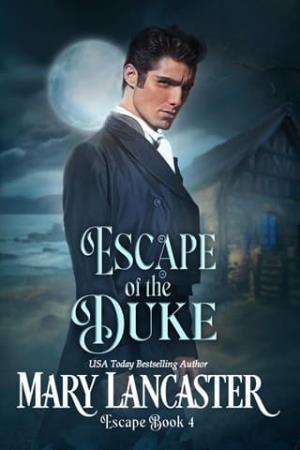
Escape of the Duke (Escape #4)
Chapter One
His current grace of Isbourne, Rudolph John De’Ath, had always been known to those with a dark turn of humour as the Duke of Death.
This posthumous child of the sixth duke had not been expected to live more than a few hours, and ever since his birth, day by day, year by year, everyone he knew appeared to be waiting anxiously for him to die.
“The dukedom,” Uncle Hazlett pronounced, “endures. We must proceed to the next step.”
His grace was heartily glad to hear it. Recently, he had come to regard himself in terms of a barrel of gunpowder with the fuse rope burning ever closer, and at Lord Hazlett’s unprecedented optimism, the burning slowed and sputtered into hope.
Uncle Deptford nodded wisely. “It is time, my boy.”
The duke, who had been standing by the sunny window, gazing over his lush acres so that his face would not give away his internal explosions, turned to give his uncles his full and eager attention.
“You mean to break the Trust early?” he asked, almost afraid to breath.
By the terms of his father’s will, the uncles and family solicitors were the trustees of his person and his estate until he was five-and-twenty, unless he married, or they agreed unanimously to hand the reins over earlier.
“An inevitable outcome,” Uncle Lacey said.
At last. The duke walked across to the table and sat down.
“I am ready for the responsibility. Over the last few years, I have spent much time with Gatting on the management of the estate. I have been reading on the subject too, and we have been discussing ideas for the future. I am sure that between us—”
“Oh, no, my boy!” Uncle Hazlett sounded scandalized.
“There is no need for you to tire yourself, let alone dirty your hands over that sort of thing. Gatting will continue to do his duty well under our own exacting eyes. The truth is, Isbourne, the dukedom needs heirs. You must marry and fill the Isbourne nursery—”
He broke off rather suddenly, leaving the words “before it is too late” unsaid but somehow hanging loudly in the air.
The disaster of the dukedom reverting to the Crown had been held over the duke all his life.
He had grown up with the weight of that responsibility, the knowledge that it was his duty to take care of himself and survive as long as he could for the sake of all the people and the land that depended upon him, for all the great history of his ancestors.
His frail, sickly person was all that stood in the way of catastrophe.
It was an intolerably dull life, just surviving.
In the last year or so, since coming down from Oxford, his interest in his acres and his tenants and workers was all that he had.
Fortunately, the subject fascinated him, and he was eager to take up the reins and, with Gatting the steward’s help, to make ambitious improvements.
It took a moment for Uncle Hazlett’s words to penetrate. The subject had been changed.
The duke closed his mouth. “Nursery,” he repeated blankly. “Marriage.” But I have not even lived...
“That’s the ticket,” Uncle Lacey said, beaming at him.
“And the perfect lady is available,” Uncle Hazlett told him. He might have been recommending a horse.
“She is?” Isbourne was torn between astonishment and outrage. Even in this...
Hazlett nodded. “It was an arrangement agreed by his grace your father with the Earl of Sark. That the eldest Isbourne son should ally with a Sark daughter. And Lady Lily is now eighteen years old. Your father and the late Lord Sark were great friends, of course, but the new earl is quite amenable to the match.”
“Is he.” The duke’s words did not quite constitute a question, more of a blank statement.
The uncles did not notice.
“Oh yes,” Hazlett said. “In fact, he is anxious to detach her from her stepmother’s unsuitable care and influence.
“And the young lady concerned?” Isbourne asked.
“Oh, Lady Lily is an old friend of yours,” Uncle Deptford said.
Isbourne blinked, for he did not have any friends. “She is?”
“You met as children, here at Isley Place.”
Isbourne’s encounters with other children were not so many that he could have forgotten.
He had a vague recollection of a pretty little girl in pigtails hiding behind her mother’s skirts until the two of them were hailed off to the nursery by both of their nurses.
He had been ten years old. Lily was a mere six, and Isbourne had found her half-fascinating—for she was another child—and half-silly, for she was interested in bizarre things like tiny tea-cups and dolls and his old carved dog on wheels that he hadn’t touched for years.
She had mostly played on her own while he had read his book, until the little girl’s nurse offered to take them both to play by the lake.
Nurse Blossom, his own nurse, had refused to allow it, so the little girl had gone without him, while Isbourne had watched enviously from the window as the child ran and skipped and picked flowers into the distance.
It was one of the only two childhood occasions on which he had met anyone of roughly his own age and rank.
On the second, he must have been fourteen or so when the uncles had brought the Earl of Sanderly’s two sons for a short visit.
Since the other boys had been eighteen and twenty respectively, they weren’t terribly interested in a sickly adolescent, and he had felt somewhat overwhelmed by their size and energy and the fact that the younger already had an army commission and was heading off to war.
They had been carelessly kind to him, taken him for a short ramble with them and he had tried to keep up.
It was his tutor who put a stop to that, insisting it was far too tiring for him to go any further.
He had even, humiliatingly, been sent to bed to rest.
Tragically enough, it had been the elder of those two terrifyingly healthy boys who had died, making the younger the new earl.
And Isbourne, doggedly defeating the wagerers and the worst fears of his uncles, guardians, doctors, nurses, and tutors, who was still clinging onto life. Though God knew why.
“You want me to marry Lily Lisle,” Isbourne said with deliberation. “When?”
“Oh, the sooner the better, we think.”
Do you? “What does Lily think?”
Uncle Hazlett blinked. “She is an agreeable girl, sweet-natured, dutiful, and submissive. Of course she is happy to marry you. She will be a duchess. Her son will be Duke of Isbourne one day.”
“I would like to see her before we agree to this.”
All three uncles gaped at him. This was only the second time he had ever argued with them. The first had been about going to Oxford. He had won that one although the subsequent experience had been somewhat...disappointing. Not to say humiliating.
“Well,” Uncle Deptford said dubiously. “It is only right that we should arrange a meeting. I shall ask Lady Sark to bring her here for a night or two. Perhaps next week.”
For no obvious reason, the little victory did not please the duke. He envisioned a slightly more adult version of their previous meeting, constrained and chaperoned, where he could never establish what she wanted, let alone what he did.
No, that was not true. He was not ready to wed anyone. Marriage would not give him the freedom he craved like a starving man. It would only substitute one lot of fetters for another while the powder keg continued to burn.
In fact, if anything, the idea of being chained to a silly girl for the sole purpose of begetting children, appalled him.
He could not marry her at all unless he knew the girl was willing to be sacrificed, and who would truly choose to be chained to an invalid until he had the good manners to turn up his toes?
Leaving a nursery full of boys behind him, of course.
It all felt so bizarre that he didn’t know whether to laugh or run screaming from the room until they sent for the doctor. Which would not be hard since the man still lived in the house.
As he gazed from one uncle to the next, he thought longingly of his old boyhood fantasy of escaping the lot of them, of ignoring the hurt and the panic that he would leave behind him, shrugging off all he owed to them and to his name, just to go somewhere else, anywhere else, blissfully alone...
This vision had got him to Oxford, though not alone.
In order to achieve his goal, he had made so many concessions that he might as well have stayed at home, despite the first- class degree he had attained.
He had been seventeen then. Now he was two-and-twenty and surely anything was possible. And he needn’t do it by quarrelling.
“I have a better idea,” he said, as the sudden excitement caught him by the throat. “I shall call on Lady Lily on my own, and she and I will decide if we should suit, and when.”
The uncles exchanged glances, but they had never been cruel.
By their own lights, they had devoted themselves selflessly to his person and his interests.
They must have recognized that the wedding—to say nothing of the begetting of children—would be a far quicker and less fraught affair if he and Lily liked each other.
“We could possibly arrange for that,” Uncle Hazlett said cautiously at last.
“No, I shall do it myself, Uncle,” Isbourne said, springing to his feet. “As you say, it is time.”
They could see the sense in that too. In fact, after his original reaction, they were probably relieved to have won him over so easily with such a minor concession.
They probably imagined that an uncle and a doctor could easily be added to his entourage when he departed.
What they did not grasp until later was that he did not say when he would arrange to call on Lady Lily.