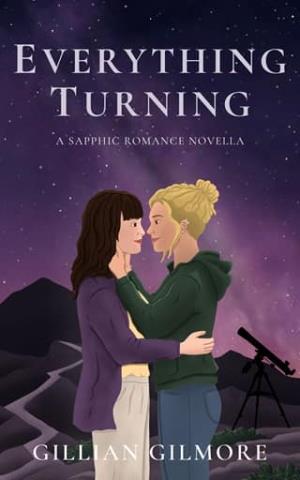
Everything Turning
Chapter One
The pad of my thumb finds the blister before I am even aware I'm doing it — a pink, tender circle that has formed at the base of my middle finger.
I press it lightly and wince. Either I gripped the base of my rabbit far too tightly this morning, or I have simply been applying myself to the thing with a dedication that would impress most professionals.
Five orgasms before breakfast, following three the night before, does seem, in retrospect, overzealous. Even for a woman on holiday.
I shift in my chair and immediately regret it.
A tenderness stirs between my legs that the hard wood does nothing to soothe, and the thick, breathless heat of the room presses in from every direction.
I make a mental note to search online for a toy with a softer base.
Perhaps with more ergonomic consideration.
An entire industry was built on this pleasure, one I have only recently begun to navigate, and surely, someone has considered the blister.
I run my palms over my skirt, the fabric now creased from the heat, and sit up straight, tucking the hem of my top back into the waistband where it belongs. The clink of glasses and murmur of voices draws my attention back into the room.
The restaurant is cut into the hillside, far enough from the tourist strip to feel almost secret.
There’s no one here except the fifty-odd people I have been lumped together with on the coach, and whatever arrangement this place has struck with the excursion company is, I'll admit, rather clever.
With no air conditioning, the humid Tenerife heat is forceful even at five o'clock in February, and the room smells of warm wood; a garlicky scent drifts from the kitchen. The chair opposite, its back carved with an intricate flower — my chair’s pair — sits empty.
The tour guide, Gabe, moves between the tables with the energy of a man who has done this hundreds of times and has decided to find it meaningful anyway.
Then, cutting through the noise of the room, a voice — low, assured, the vowels clipped and English — drawing attention without asking for it: “I'll take that one there.”
She appears opposite me. All smiles and eye contact.
Her energy is bright in a way that feels almost physical, like that scintillating light across the sea I’ve witnessed here in the afternoons.
Her shirt — white, thin, hanging open over a white vest — looks as though she put it on without thinking and somehow arrived at exactly right.
Sunglasses pushed to the top of her head reveal hazel eyes, and they land on me without hesitation.
A small smile, just for me, before she turns to give the table a nod of hello and pulls out the chair.
She's tall. Taller than me, I think, which doesn't happen often.
She drops into the seat — broad shoulders wide, the space around her reorganising itself accordingly.
Her forearms rest on the table, lightly tanned, the inside of each one carrying the faint line of muscle, if you happen to notice that sort of thing.
She tilts her head slightly in my direction. “Want some?”
For a second, I don’t follow. Then her hand catches my gaze, the loose gesture towards the bottles gathered at the centre of the table. I open my mouth. Gabe speaks first.
As his voice carries across the room, explaining the three courses we’re about to be served, the history of the restaurant, and the cultural significance of the bread, I give myself permission to look at the woman again.
I didn't notice her on the bus; I was one of the last pickups and spent most of the ascent staring out the window as the mountain road climbed and turned and climbed again.
She watches Gabe with genuine attention, one arm resting over the back of her chair now, shirt hanging open, gaping slightly at the arms. My eyes move, almost independently of intention, across the smooth tanned skin at her chest, up the line of her neck to where her ash-blonde hair is pulled into a tight bun, an undercut shaved close beneath; that clean line following the curve of her skull.
I wonder, distantly, what the shaved nape would feel like under my palm.
I catch myself.
I came on this holiday because my boss told me, in the gentle but firm tone of a woman who has watched me accrue leave for three years, that I had to take the time owed to me.
Working as a solicitor's assistant at a small firm on a small Irish island had been, up to this point, a reliable anaesthetic.
Without it, the days had no shape, and the island had no neutral ground.
I knew every road and every road knew me — knew me as Daniel's wife, or the woman whose marriage had quietly ended.
We had been together since we were teenagers.
An island couple, devout and steady, the kind people point to.
I needed somewhere nobody had a version of me already.
So, I booked Tenerife. Alone. For the first time in my life.
What I intended: space, rest, a novel.
What has actually happened: I have been unreasonably, persistently, almost insultingly aroused since the moment I stepped off the plane.
The heat, perhaps. The desire to be in as little clothing as possible. The HRT patches finally doing something useful. Or the fact that nobody here knows my name or my situation or the quiet, deflating logic by which my marriage dissolved.
I have had more orgasms in the last four days than in the final four years with Daniel.
I shift again on the hard chair, the sensitivity a reminder of the morning — of fresh white sheets and the luxury of having nowhere to be, of lying naked on the bed while the ceiling fan turned slowly as I read my book.
The romance novels, I'm beginning to suspect, may not be entirely innocent in all of this.
It suddenly occurs to me: this woman opposite me looks just like a character from the book I’m currently reading. Well, how I imagined her from the character description.
Gabe winds down his welcome. “The bread roll,” he says, with appropriate gravity, “may seem very hard. I promise you this is traditional. Please break it open, use the dips on the table, and your first course, a soup, will be served shortly.”
Across the table, the woman — who is very much not a fictional character in my book — lifts a hand with a small, easy hello. “I'm Emma.”
I nod. “Hello.”
I pick up the bread roll and knock it against the rim of my bowl. The sound resembles dense, utterly unimpressed stone. This could absolutely be used to bludgeon someone. And then consumed. Harder to convict with no weapon.
“I'm going for the white,” Emma says, already reaching into the centre of the table.
Two bottles of wine sit amongst soft drinks — old green glass, corks resting loosely in the necks.
Very small cutlery sits atop a plastic table covering; it has the faint atmosphere of a child's party, except with wine. I appreciate the distinction.
The bottle makes its way around the table and arrives back at Emma. “Would you like some?”
She is looking at me. “No, thank you.”
It makes no sense whatsoever. I would give a considerable amount for some wine right now.
I glance at the excursion leaflet still folded in my bag.
Three-course dinner, it said. Drinks included.
It did not say: seated indoors at a long table amongst strangers you are implicitly expected to converse with.
This is, objectively, worse than eating in silence with Daniel.
The weight of social expectation presses in from all sides.
I clear my throat and push back my chair.
The wooden legs scrape horribly across the uneven stone floor, far louder than seems architecturally fair.
I am about to say it — just nipping to the loo — the words already forming, a reflex so ingrained I nearly offer them to the empty air.
There is no one to say it to. Everyone at the table seems to have moved closer.
The easy, instant intimacy of strangers who have decided to get along, the kind that has always looked, from where I'm standing, like a foreign language.
I reach down for my bag and move towards the back of the restaurant.