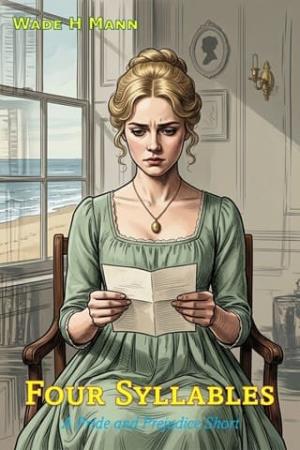
Four Syllables (Pride and Prejudice Shorts)
Chapter 1 Composition - Georgiana
“Oh! it is of no consequence. I shall see her in January. But do you always write such charming long letters to her, Mr Darcy?”
“They are generally long; but whether always charming it is not for me to determine.”
“It is a rule with me, that a person who can write a long letter with ease, cannot write ill.”
“That will not do for a compliment to Darcy, Caroline,” cried her brother, “because he does not write with ease. He studies too much for words of four syllables. Do not you, Darcy?”
“My style of writing is very different from yours.”
“Oh!” cried Miss Bingley, “Charles writes in the most careless way imaginable. He leaves out half his words, and blots the rest.”
P but being twelve years my senior, he was in an odd position, somewhere in the intersection between brother and father.
We shared a cordial relationship, but I would not call it especially affectionate.
I was in my sitting room, fully dressed and preparing to meet my beau, Mr George Wickham, who was possibly the handsomest and most amiable man I had ever met.
He proposed marriage, an idea I viewed with some satisfaction; but he also advocated elopement, a scheme I was far less comfortable with.
I put off the final decision for weeks and thought to happily procrastinate forever; or simply decline and demand he court me properly with my brother’s consent.
While I had not mentioned my proposed matrimony to my brother explicitly, I had mentioned I met the old family friend and spent significant time with him.
The gentleman was my father’s godson, so I supposed that made him nearly family.
My companion, Mrs Younge, asserted such with quiet authority.
Since she was my protector, chosen by my brother himself, I was inclined to believe her.
I awaited Mr Wickham for a walk on the beach, whiling away the time looking to see if my brother’s latest letter contained anything useful I had previously disregarded.
While revisiting particular correspondence, my eye stopped abruptly on a single word: facilitate.
There it was, sitting innocently in the middle of a paragraph, taunting me for lack of concentration.
In fact, the presence of the word in an innocuous sentence brought to mind an entirely different four-syllable word: consternation.
My brother’s good friend and confidant, Mr Bingley, loved to tease him, saying he wrote slowly because he studied too much for words of four syllables.
The gentleman usually said similar things when his sister praised his straight lines or even hand, both of which made my brother want to shudder or throw his ink bottle at her.
(I expected the former but hoped for the latter).
I took up the tease one Sunday evening when my brother was bored because he had nothing to do.
In retaliation, he started including such words in every letter and demanded a definition for each such word in my return correspondence, along with a valid application, via a demonstration of its proper execution, and an illustration of how it could be used in conversation.
(See how that works—not to mention how pretentious my brother can be).
In that particular letter, received the evening before, the word ‘facilitate’ was used incorrectly.
Not only was it used incorrectly, but even more suspiciously, it was in a part of a sentence that did not even make sense.
Fitzwilliam Darcy did not use words incorrectly.
No matter how busy, distracted, angry, (or infrequently inebriated) he was; the Master of Pemberley never put pen to paper before he knew exactly how to communicate accurately.
Unlike Mr Bingley, my brother wanted his correspondents to know exactly what he said in precise detail.
If a four-syllable word was appropriate, he used one.
With the amount my brother travelled or stayed in town, one could easily advance the hypothesis that he was a professional correspondent since substantially more Pemberley business happened in writing than with direct conversations.
He never wanted his readers to suffer from disappointment or uncertainty.
The word nagged at my mind, making me wonder about the implications of my discovery. Ultimately, my analysis forced me to reread the entire letter. That exercise raised more reservations. Indulging my suspicions left me trembling in trepidation.
I subsequently reread all correspondence received during the month Mr Wickham had been courting me, and the results made me want to curse (in four-syllable curse words if there was any such thing). After that, it made me want to regurgitate my luncheon into the chamber pot.
The letters appeared correct, and they seemed to respond to my own.
However, they were obviously written by someone who knew Fitzwilliam well—but not by him.
There were odd little references I missed on the first read, where Fitzwilliam was responding as if he had forgotten the previous three years.
There were two other four-syllable words used incorrectly: obligation and proposition.
I concluded my brother had either fallen in love and was too smitten to write correctly (a possibility whose likelihood roughly matched being struck by lightning—twice in a row), or the letters were inauthentic.
In the end, I favoured the forgery hypothesis and decided to test it with an experiment.
I sat for an hour considering my new intelligence (or speculation).
I was to meet my beau shortly and thought about the coincidence of his appearing in Ramsgate right when I arrived with no apparent occupation.
I knew he was not flush, as we needed my pin money to purchase anything.
I knew my father gave him a gentleman’s education and a legacy in his will.
I knew any man of his age could usually handle a few minor expenditures if he was ready for marriage.
I was six years from my majority, and I knew my brother did not expect me to be anywhere near the state of matrimony as I was not even out for another two years. I knew—
With a start and a shudder, the obvious conclusion struck me, and I proceeded to its implications.
He knew Mrs Younge, and he was in some sort of scheme with my companion!
What other possible explanation could there be for my companion—the woman my brother hired to teach me propriety and accomplishments—to allow me to spend time with a man alone—the worst possible violation.
It mattered not that he was an ‘old family friend’.
It would be one thing if he was a fifty-year-old clergyman with a formidable wife and a dozen children like the vicar in Kympton.
That sort of family friend was safe as kittens.
But a handsome, young, solitary, unoccupied man without two farthings to rub together half a decade after finishing school (which my father paid for), who was pushing me relentlessly towards an elopement—that was an entirely different situation.
I quickly came to a startling and disconcerting realisation.
I felt tremendous uncertainty about the morality and propriety of my preparations for marriage, not to mention its practicality.
I owed long-standing obligations to my brother.
This could ruin both of our reputations.
Ruining my own would be bad enough, but hurting my brother was intolerable.
It would be the worst possible violation of his trust.
This had to stop!
Resolution formed, I decided to take my life and fate into my own hands.
Assuming Mrs Younge was complicit, who could I trust?
Several servants came and went during my stay, and my companion had the final say on all hires.
Who was to say I was not being watched regularly, if not consistently?
I mostly lived a life of isolation like a fish in a bowl.
One underhanded servant could easily observe me and report the results.
Who could I trust? Nobody! I could not trust a single, solitary person in my establishment.
Panic rising, I threw a bonnet on my head and boots on my feet, then burst out a servants' door with no objective save escape.
Thus began the worst six hours of my life.