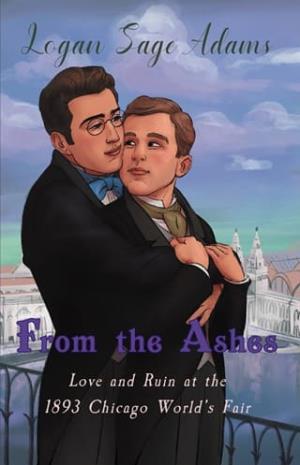
From the Ashes
Chapter 1
Chapter One
Arthur
Flames flickered in the nearby fireplace while Arthur Hughes sat on the yellow-and-brown-striped sofa, one foot resting on top of its opposite knee, his right thumb tap-tap-tapping his thigh.
Musical notes filled the room. Arthur flinched at each of the occasional mistakes in the familiar sonata.
Dammit, how many more times would Emma have to play this piece before he could even pretend that her performance had been satisfactory?
He let his eyes wander to the mantel clock.
Noon. Arthur was scheduled to meet with Harry Putnam in less than one hour’s time.
He couldn’t keep listening to Emma’s half-hearted, unpracticed performances for much longer.
Returning his focus to the piano, Arthur caught the eye of Emma’s tutor, Charlotte, and forced a tight-lipped smile. Charlotte simply crooked an eyebrow in response. Arthur had to then purse his lips to try to contain a very real smile that was threatening to burst forth.
Charlotte placed a hand on Emma’s shoulder, signaling her to stop playing.
“I think your father is running short on time,” she said. “We’ll practice more later.”
Emma heaved a sigh. Arthur could practically hear her eyes rolling. Biting back the urge to reprimand her, Arthur uncrossed his legs and stood.
“Your playing is better,” he said simply, straightening his jacket. “Definitely better.”
Still terrible. But better.
Emma swung her legs over the bench, her fast movement so inelegant it had to have been purposeful. Arthur held back from commenting. Again.
“I have no ear for music,” Emma said, with the overinflated sense of self that most other sixteen-year-olds possessed but typically kept better contained. “I keep telling you.”
Arthur replied, “I know piano isn’t your favorite—”
“No, it’s not,” Emma clipped.
“Emma,” Arthur said, leveling a look. “Your mother loved to play the piano. And I know for certain that she would have liked for you to learn. Can’t you at least try to share this with her?”
“It’s not like she’s here,” Emma said bluntly.
Arthur fought back a wince. Even though her callousness pained him, he tried to tell himself that his wife was more of a folktale or a specter to Emma than a mother figure, as hard as that was to believe.
It took Arthur an extra moment to collect himself enough to respond.
“No, she’s not,” he finally said. “But I like to think that she—”
Before Arthur could finish his sentence, Emma hopped to her feet. Rather than try to stop her, Arthur watched her skulk off. Charlotte came up beside him and touched his forearm.
“I’ll talk to her,” she said.
“Don’t bother,” Arthur said wearily. “I had a temper myself when I was her age. It’ll pass. Eventually.”
“I’m sure you were more respectful to your parents.”
“Only to their faces. Did you forget the reason why Ella and I had to marry so young? And in such haste?”
Charlotte had been friends with Ella. It was how Arthur had met her. He had even liked Charlotte a little before that ball where Ella had really caught his eye. Thinking back on his exploits, Arthur ran a hand over the lower half of his face.
“I was a master manipulator,” Arthur said.
“Deceitful. I was so cavalier, too. Eager to be the opposite of whom my parents wanted me to be. But I realized, eventually, that I needed to change.” His face fell as the weight of that statement settled into his brain.
“Now I’m exactly like my father, only I’m more miserable. ”
“You’re nothing like him,” Charlotte said. “Trust me.”
“How am I not? I live for my work. If you can even call my pitiful investments that. I have no real friends, either.” Charlotte reeled back, prompting Arthur to correct himself. “Alright, I have one real friend. But I pay her to be my friend so I’m not sure if it counts.”
“It counts. I’m not your friend because I work for you. Frankly, I could probably be paid better elsewhere.”
Arthur huffed a barely-there laugh. “I pay my staff poorly. Add that to the list.”
“You pay me well. I was only trying to be funny.”
“Can’t recognize humor. Another similarity.”
Now Charlotte was laughing. “Stop.”
“Loves to hear himself talk.”
“Alright, now you’re spouting complete nonsense.
” Arthur opened his mouth to say something in protest, but Charlotte’s threatening look stopped him, and he held up his hands in mock surrender.
She continued. “You are nothing like your father. Other than the fact that your offspring could stand to be better behaved.”
Arthur sighed. “I know she could be. But, honestly, I’d rather her be rude to my face than try to sneak off behind my back. I’ll take honest eye rolls over false smiles every time.”
“I still want to talk to her. I want to make her see how lucky she is.”
“Now you’re starting to sound like my father.”
“I’m not referring to your family’s money. But the fact that you care for her.”
“Oh, yes, and I know what she’ll say. She’ll say that I’m too busy.
She’ll tell you that if I really cared, I’d spend more time here at home.
I’d spend more time with her. And the worst part is, she’ll be right.
” Arthur paused to remove his spectacles—pince-nez-style frames that pinched the bridge of his nose—and rubbed his eyes before putting them back on.
“I’m busy because when I’m not busy, I can’t stop thinking about how miserable I am.
And I’m mostly only busying myself by either participating in events that I’m expected to participate in or tending to my investments and businesses.
I know I should set more time aside to be with her. ”
Charlotte’s expression softened, her eyebrows lifting, her brown eyes shining with unbridled kindness. “She’s still lucky. She’s lucky that you never fault her for her honesty, whether over her opinions or her emotions. And I want her to see that.”
“Best of luck to you, then,” Arthur said, a teasing edge to his voice. He took out his pocket watch to check the time. “I need to head over to Putnam Press. Soon to be . . . well, not Hughes Press because that’s taken, but something else, maybe.”
“Good luck to you, then, too.”
“None needed. I made an outlandish offer for his business last week, and Mr. Putnam said that he would happily sell. He’ll have the papers ready today.
So, I better not be late.” He bowed his head slightly and started toward the hall before stopping to turn back around.
“I should be back by six. Maybe seven. If you could tell Gertrude, that would be helpful. I’d rather not have her prepare dinner early only to have the food grow cold. ”
Charlotte hooked her hands behind her back and nodded. “I’ll tell her.”
Arthur threw her a wink and left.
***
Five hours later, Arthur was having a meal with Harry and Grace Putnam, knowing full well that he ought to have refused their impromptu invitation but suffering through the visit nonetheless.
Mostly because, well, he had just purchased the man’s business from him and he couldn’t seem to make himself not feel bad about it.
It was clear to Arthur that Harry Putnam would have liked to have kept his print shop had he and his wife not needed to relocate to New York soon for personal reasons.
Reasons that probably involved some sort of family matter, though Arthur wouldn’t pry to find out what it was.
And so, feeling sorry for the man, Arthur had pretended to be thrilled to be invited over to eat with them (well, as “thrilled” as he had been able to muster, which had likely seemed more like “mildly pleased”).
Moving the roasted beef back and forth with his fork, Arthur wondered whether it might look like he had eaten more of his food if he piled the cubes together or if he spread them out.
Arthur stabbed a piece of meat and suddenly remembered the time he had shoved a handful of unwanted vegetables into his pocket as a boy to make it look as though he had finished them.
Stifling a smile, he buried the urge to repeat the past with the hunks of beef and instead reached for the wine in front of him.
As Arthur raised the glass to take a sip, Harry Putnam caught his eye.
“So, Mr. Hughes, you said you were hoping to exhibit in the fair?” the man asked.
Arthur nodded, swallowing the wine and setting his glass back on the table. “Yes, that’s right. I’ve been in talks with Mr. Burnham himself.”
Daniel Burnham was the chief organizer of the upcoming World’s Columbian Exposition. Arthur’s father had met him some years back, and Arthur, wanting to be part of history, had swallowed his pride and asked his father to introduce them.
Mrs. Putnam spoke up. “Will there really be exhibits featuring . . . print shops?”
“So I’m told,” Arthur replied. “Mr. Burnham wants to showcase the latest technology, whether from the printing business or transportation or farming. It will be spectacular.”
Arthur could scarcely contain his excitement.
It flickered to life in his chest like electricity, making his heart stutter.
Electricity! Another wonder that was to be shown at the fair!
Mr. Burnham planned to have the entirety of the fairgrounds lit up, every building powered by generators.
Arthur shifted in his seat, trying his best to keep his budding exuberance contained, not only because it wouldn’t have been proper for him to shout with uninhibited glee, but because he really didn’t want Mr. Putnam to regret selling his shop.