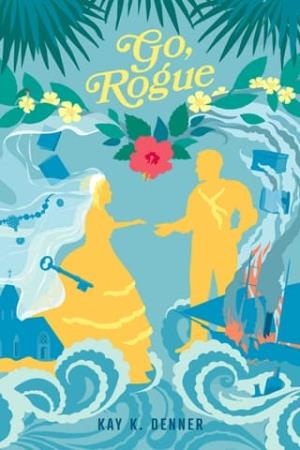
Go, Rogue (The Mavericks #2)
Prologue
Port of Kingston, Jamaica
Andrew McGann rocks his considerable weight back and forth on his heels and shoves his hands into the pockets of his peacoat. He has to set this fire.
He has to.
Even though he feels terrible about it—he’s a ship’s captain, not an arsonist, for fuck’s sake—there’s no way around it. His future, and likely his life, depend on it.
He picks up the bottle of paraffin oil he’s preserved just for this purpose, and walks the entirety of the ship’s upper and lower decks, dousing them with the stuff.
The smell is sharp and acrid, and he closes his eyes against its scent.
But he can’t block it out; each splash burns his eyes and assaults his nostrils.
“Courage, man,” he mutters to himself and takes his tinderbox out of its storage place in the captain’s cabin.
Slowly, he unwraps its waterproofing sealskin and removes the sulfur matches contained within.
He’s spent the last three months and all goddamned day preparing for this moment.
Time he’d rather have spent elsewhere, with the grandmother he’s finally located or even carousing with his recently dismissed crew.
Anything but this.
The thought of arson chills his blood. But if he’d managed to keep his nerve through those long months—commandeering an East India Company ship, selling its cargo port by port with a skeleton crew he replaced as he went, returning the money to the Punjabi people the Company had robbed, and sailing all the way here to Jamaica—then he can damn well keep it together now.
He lights the match and tosses it before he can change his mind, and watches as the first of the flames catch on the deck.
McGann straightens his massive shoulders, wipes the sweat off his forehead, and uses the Jacob’s Ladder to lower himself down into the last rowboat.
It’s a tricky proposition for a man to do alone, without the benefit of a crew to help steady the ropes he’s clinging to, but he manages to settle himself in the rocking dinghy.
And then he uses the oar to shove off from the hull just as waves of smoke begin to billow up.
Black clouds against an already black sky.
Row faster, eejit.
He throws his considerable weight and strength into the job of removing his person from the side of the burning ship as quickly as he can. He keeps his head down to better concentrate on the task at hand, listening to the crack and pop of the fire as it spreads.
Soon enough, he can feel the heat of it scorch his face. The flames are moving more quickly than he thought they would, engulfing the ship and devouring its timber and ropes and masts with an insatiable greed.
A ship as big as this one—he’d taken one of the giant, three-masted, East Indiaman vessels—would normally take hours to catch fire and go down.
But “normal” precludes arson with paraffin oil, and tonight, it only takes a half hour or so for the flames to light up the evening sky in a bright orange conflagration.
Row faster.
The muscles of his arms and shoulders protest the cadence of his strokes, and his calloused hands grip the wooden oar handles hard enough to blister his palms. But still he pushes.
Further.
Faster.
When he reaches shore, he makes fast the rowboat in the small cove he’d chosen that morning for its location well away from the pier and scrambles up the coastline. He plans to make his way to the main road and then lose himself among the others gathering at the water’s edge to watch the fire.
But by the time he reaches them, the mast has already tilted, pulling the ship over. Minutes later she’s gone—dragged under and bound for a watery grave at the bottom of the Caribbean.
There she’ll remain, forever a ghost of her former life. Buried with her: the records of McGann’s decade of employment with the East India Company and every piece of proof he’d collected of their wrongdoing. Save one.
The port city of Kingston Harbour is brightly lit in the distance, but he isn’t making his way there.
He waits until he can be certain the ship is truly sunk, and then he plans to find somewhere quiet to wait out the remaining nighttime hours.
In the morning, he’ll make haste for the ship that will see him back to London and his new life.
He gives one last, lingering look to the dark water and then turns to leave.
“Hold it right there, mate.”
Damn it all to bloody hell.
He feels the pistol wedged in his side before he sees the man holding it. McGann glances around, only to find at least two more men appearing out of the crowd to surround him.
“We’ve a bloke what would like a word,” the one with the pistol says.
“Aye,” McGann agrees, a sinking feeling in his gut. “Seems you do.”
For fuck’s sake.
Even after all his preparation, he’s still going to have to fight his way out of this mess. He doesn’t want to. Despite his size, and his talent for it, he doesn’t like fighting. But as the pistol maneuvers him out of the crowd and into the dark interior of the island, he knows he’s got no choice.
Because Andrew McGann has no intention of dying tonight, especially not from a bullet in his side. He thinks of his grandmother, whom he met for the first time this afternoon. And of the diary and small daguerreotype that had been hidden in his pocket while he did.
Thank Elphame these men didn’t find him then or he’d have put his gran in danger and lost the only insurance he still has against the East India Company.
He’s destroyed all evidence as promised—except for that daguerreotype featuring Lord Comstock, the governor general of India, and his right hand, General Sir Hugh Nash.
The two stand atop a pile of bodies, with their guns slung over their shoulders and smiles plastering their faces. Nash rests his boot on the pile as if it were the day’s quarry—elephants instead of men, women, and children. God help him, children.
He frowns in the dark while the pistol pushes him forward. Up the road and away from the crowd.
He goes willingly, biding his time. He is not going to die tonight. He just needs to find the right moment to strike.
He can wait for it, because he knows it will come eventually. It always does.