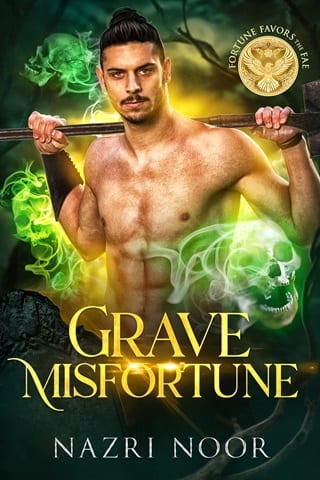
Grave Misfortune (Fortune Favors the Fae)
1. Orphium
Chapter 1
Orphium
R ed ink flowed from the tip of my quill, every stroke against the parchment like a knife drawing blood. I had to check again, you see, take inventory of all the bottled treasures I’d collected on my travels, glowing like fireflies in their little jars and phials. All my hopes, dreams, and memories.
At least they belonged to me by right, now that I’d stolen them from gullible, greedy humans.
No. Inaccurate. These goods were not ill gotten. I’d won them fair and square in games of chance that I’d played through the lands of Aidun. Wherever my caravan could take me, that is. It rumbled and rattled along the path, my bottled treasures jingling and clinking as we trundled on to our next destination.
“Just you and me, Wagon,” I called out from the cabin, grinning through the little window that opened up to the driver’s seat, except there was no driver in sight. No horse, either. It was worth spending so much time mastering that single spell, the one that allowed me to move anything on wheels with little more than a commanding thought and a kindling whisper.
We fae were notorious for knowing all kinds of mischievous magic, but I often held that it was better to know a handful of truly powerful spells than a pile of feeble charms and cantrips. What good was a hedge wizard’s spell book to Orphium of the Dawning Court, a man with a lovely smile and an even lovelier head of hair? What use were all the charms in the world to a fae man who had all the charm in the world?
And it was all so practical at the end of the day, anyway. A horse was just another mouth to feed. A wagon didn’t need much apart from the occasional grease for its axles, a quick spell of maker’s mending for a broken wheel. Best of all, Wagon — my sweet carriage, my beloved caravan — did not talk back. A horse, depending on its temperament, just might.
My stomach gurgled, the only entity in my daily life that engaged me in any conversation. Typically it spoke up to remind me that we hadn’t eaten in days. Sometimes it slipped my mind completely, especially when I was too enraptured by the acquisition of trinkets.
These phials filled with the sweetness of human hope and memory, it was a way to feed a different hunger. Such was the curse of the fae. As high in regard as we held ourselves, especially compared to humankind, we simply could not resist our baser instincts, the inclination to hoard, to gather, to covet. Like magpies, or dragons. Like the First Folk, like the truest, oldest fae of ancient Aidun.
More often, I did not eat because I was too busy being chased out of town. Sometimes there was nothing to forage. And sometimes it was sheer bad luck, an exceptionally poor string of unsuccessful hunts. Orphium of the Dawning Court excelled at seeking out rare and precious things — but you couldn’t trust me to capture a two-legged rabbit.
I shook my head, loosening the cobwebs of exhaustion, the sands of sleep. The cabin was warm, the rolling of my caravan so soothing. Too soothing. I glanced out the window, seeing little evidence of civilization through what may as well have been a ship’s porthole. How much further did we have to go? We were supposed to have reached Barrowdeep by now.
My fingers curled into a loose fist, the bud of a sleeping flower, gathering tangles of magic toward my fingertips. I opened my hand again, parting my fingers like the petals of a blossom in bloom. The spell uncoiled itself from the depths of my body, penetrating glass and wood to take hold of the wagon and its flagging wheels.
It jerked into sudden renewed motion, revivified by fae magic, bottles and cabinets rattling and clattering as it picked up speed. And even as the caravan trundled, guided along by its second wind, I felt the air leak from my lungs, the strength seep from my muscles.
Magic took its toll on everyone, sapping energy and life force, something to be replenished by food and rest. And soon, hopefully. Spellwork did not discriminate. Fae or human or otherwise, magic would exact its price, whether in breath or in blood.
My stomach grumbled louder than before. I gave it a rub and a guilty pat, scanning the cabin. Not a single scrap to eat. When did I nibble my last berry, my last mushroom cap? And where in the blazes were we?
“The map,” I muttered, scrabbling at the shelves. “The map. Where did I leave it?”
Oh, of course, buried under the pile of compasses and sextants I understood little of and therefore had no use for. Purloined on my travels, useful enough to trade for a quick, hot meal or a night in something slightly more luxurious than my caravan, whether it was just a bed of straw for a change of pace.
I grabbed the map, crinkling it in my frustration, hardly caring as the compasses went clanging to the floor. I cared little for the contraptions of men, only knew that it was the sparkle of metal and flash of glass that drew my attention in the end. I hated to admit that the fae still shared this weakness with humanity, our mutual love of shiny, pretty things. Why else would I keep all those visions and memories under polished glass, in gleaming bottles?
Shoving my boot between two such bottles — a man’s wedding day, a mother’s first smell of her newborn’s head — I carefully hoisted myself up to the secret second exit in the roof, cleverly disguised as a sort of skylight. The door in the back was serviceable enough, but the skylight allowed for expeditious retreats in times of direst emergency.
Grunting, the map clenched between my teeth, I punched upward, unsealing the hatch and pulling myself up into the cold night air. Ah, like rising from the depths of a warm lake in summertime, the sudden contact brisk, crisp, bracing .
I pulled the map from between my lips as I climbed onto the cabin roof. Stone and dirt crunched under the wagon’s wheels. I splayed my legs and spread the map out between them, wiping at traces of spit, smoothing away the marks of my teeth. I squinted at the map, then into the gloom, this night as dark as any other.
“Wagon, where are we?” I asked, waiting for it to answer, knowing it couldn’t.
Perhaps it was madness. Delirium. More likely that it was hunger, driving me to speak to myself out loud, to hallucinate distant lights on the horizon as I squinted yet again into the gloom and wilderness. Wait. Distant lights. I leapt to my feet, miraculously keeping my balance on the roof of the cabin.
There they were. The familiar glow of fire — torches, perhaps, hanging from the eaves of warm taverns and cozy homes. The tiny flickering flames of candles sitting on bedside tables, living their briefest lives before they were snuffed out for the night, before they burned to little stumps.
Barrowdeep did not strike me as a settlement of any great significance, far more likely a town of peasants, farmers, and laborers. But where there were people, there was food to be found. Shelter, too, of course, and I had plenty enough to bargain with. A game of chance or two, in exchange for a meal, a bath, one night in a clean bed.
A tumble of ivory dice, a flourish from my deck of cards. Everybody loved to gamble with the nice fae man and his sparkly smile. But I only won as much as I needed to. Win too many times and the humans would get suspicious, resentful. Better to let them believe that they were the winners, leaving my caravan wealthier, their pockets heavy with coins that would vanish as soon as I left town, their minds and hearts lightened of the burden of dreams and memories.
“Still so hungry,” I grumbled, unintentional, a physical reflex, as natural and necessary as breath.
I sat back down and sighed, the twinge of hunger in my stomach momentarily overwhelmed by a wave of disgust. Here I was, a creature purported to be superior to these dirt-dwelling humans and their barbaric ways, and yet I was so reliant on their very existence for my own.
Did that make me a parasite? I couldn’t be sure. Did parasites burrow into the homes and hearts of humans, earning their trust and delight with a show of smoke and mirrors and glamor before scurrying away into the night having stolen their possessions, both worldly and otherwise?
Who could say?
I sat back down on the roof of my caravan, legs splayed once again, savoring the ambient, subtle thrum of magical warmth that coursed through the wood of the cabin. It amused me to think of my wagon as a sort of ship in the night, heading toward its destination, this distant lighthouse, this beacon of comfort.
What a wonder that I didn’t attract more bandits on the road, considering the constant glow spilling out of the cabin, the illumination cast by so many human memories and dreams crammed into a tiny space. I couldn’t dim their light if I tried. Quite the savings on candles, don’t you know?
Perhaps it was because these toothless, mud-swilling bandits had already heard tell of fae magic, of our love of mischief and malevolence. Surely any hypothetical highwaymen would be frightened off by the sight of a wagon that could pull itself. More fool the man who didn’t recognize fae magic when he saw it.
Truthfully, on some nights, I welcomed the possibility of highway robbery. Honestly, anything to dispel the drudgery and boredom of life on the road. They could come and try to steal away my beloved treasures and trinkets. Orphium of the Dawning Court had ways of defending himself. Magic, first and foremost, but I also had a deft enough hand at wielding the dagger I kept sheathed at my hip.
In fact, on one fine night, I had done a fair portion of the banditing myself, attacking a lone thug who was sleeping soundly under a bush. No spoils, however, very little loot apart from a flask of flat ale, some strips of salted meat. A life of crime, apparently, did not pay very well at all.
I tempered my excitement as the little town drew nearer and nearer, the dirt path slowly solidifying into loosely strewn cobblestones. Surely these people would know that I wasn’t some common criminal, merely a merchant passing through. One equipped with entertaining magic, no less, and access to the arts of prestidigitation.
And, of course, plenty of interesting games to play.
Hopefully this time no one would call me a snake oil salesman. Perish the thought. Didn’t they know that snake oil didn’t sell? And had any of my accusers ever tried to make that stuff in the first place? Very challenging to wrestle a snake into a bottle to begin with, much less squeeze out all the insides.
Closer and closer, the looming shadows of buildings in the distance. Silhouettes of people huddled under the archways, crammed into doorways, at once yearning for fresh night air, neighborly gossip, and the relative warmth of the indoors. These humans and their strange habits, their many, many dreams and desires.
I was doing them a kindness, was I not? Freeing them from the shackles of want, removing all the unrealistic aspirations and painful memories that kept them muzzled, limited their potential. This would be my gift to the people of Barrowdeep.
“Orphium of the Dawning Court has come to untether you,” I whispered, a smile on my lips.
The caravan rolled merrily onward, already drawing shadowed figures to the glow of my cabin. Like moths to a flame. Finally. My spirit lit up as bright as my treasures, these brilliant bottles of joy, agony, ecstasy, sorrow. I licked at the edge of my teeth, held my head up high.
It was time to put on a show.