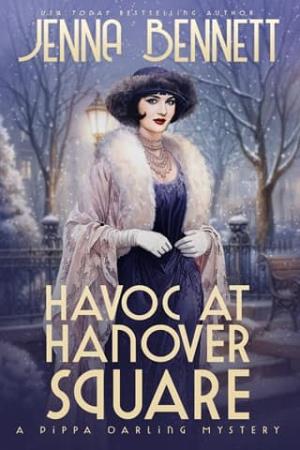
Havoc at Hanover Square (Pippa Darling Mysteries #9)
Chapter 1
Chapter One
(The second biggest surrounded tabloid darling and newly-minted Duke of Sutherland, Crispin Astley, and his fiancée, the lovely Lady Laetitia Marsden, although only a few of us knew about that as it was going on.)
(Typical self-centered bloke, am I right? Leaving the wife is one thing, leaving the child is quite another.)
But I digress. Upon Archie’s defection, Mrs. Christie packed a suitcase and left the shared home herself, after entrusting Rosalind’s care to the maid.
(Stellar parenting on both parts. But again, I digress.)
The next morning, Mrs. Christie’s motorcar was found several miles away by Surrey police.
It was partly submerged in bushes at Newlands Corner in Guildford, the apparent result of having skidded off the road and only narrowly escaped the fate of ending up nose-down in a chalk quarry.
The headlamps were on and a suitcase and coat remained in the back seat, but the motorist was conspicuously absent.
And with that, the affair—I use the word advisedly—became front page news, and a handsome reward was offered for any new evidence or fresh sightings of the famous novelist.
“We should motor to Surrey and have a look around,” I told Christopher as I folded the London Times—bearing Mrs. Christie’s somewhat equine face on the front page—and laid it on the table beside my teacup.
My cousin and best friend snorted. “Don’t you think the local chaps will have combed the area, Pippa? We’re not likely to find anything that they haven’t. Besides, how would we get there? We don’t own a motorcar, remember?”
“We could hire one,” I said. “And you have to admit it’s fascinating, Christopher. Just like one of her novels.”
Christopher shrugged and lifted the teacup to his mouth. “I don’t find it fascinating,” he told me before taking a delicate sip and replacing the cup and saucer on the table. “In fact, it’s most likely fairly simple. I think the husband did it.”
I folded my hands in my lap and eyed him across the table. “Did what, precisely? Waited for her to leave and then followed her? Forced her off the road and abducted and killed her?”
“Something like that,” Christopher said blithely. “He had motive. He wanted to leave his wife and marry his mistress. Or so I assume.”
So I assumed, as well. Unless, of course, Archie was simply having some fun, and it was his mistress, one Nancy Neele, who wanted Agatha out of the way so she could marry Archie.
The titillating details had been all over the newspapers for days, here in London as well as everywhere else. I had even seen a copy of the New York Times at the newsagent’s, with the story prominently displayed for the international crowd.
A manhunt had been undertaken by what sounded like thousands, law enforcement as well as civilians.
A lake in Surrey, near where Mrs. Christie’s motorcar had been found abandoned, had been dredged, just in case the novelist had stumbled off in the dark, woozy from her near-fatal mishap, and had accidentally drowned herself.
Archibald Christie and Nancy Neele had been together at the time of his wife’s accident, according to the Times (London, not New York).
The pair had attended a weekend party at Hurstmore Cottage, the home of their friends, the Jameses.
I had no idea whether Sam and/or Madge James would lie for Archie and Nancy, or whether it would have been possible for anyone to leave Hurstmore Cottage without Sam and/or Madge noticing.
Archie and Nancy might have been involved—singly or together—or they might not.
There were other options, after all. Agatha might have met with an accident, just not in the Silent Pool, and her remains were still out there, undiscovered.
Or she might have been found by someone after the mishap, and had been taken off somewhere, willingly or not.
She might be hurt, and be recovering in some farmer’s cottage in the wilds of Surrey—although if that were the case, no such farmer had come forward to claim the reward, and if he hadn’t realized at the time who he had picked up, one would have thought he knew it now, after all the notoriety surrounding the disappearance.
Or she might be held captive, while her jailer was waiting for peak frenzy to submit a ransom demand. The Christies weren’t poor, so money was a definite possibility.
“Agreed,” Christopher nodded when I said as much. “I’m certain she made more money than her husband. Yet another reason for him to resent her, and also another reason for him to kill her rather than divorce her. He won’t inherit in a divorce.”
Not one he had initiated, certainly.
“I’m not saying you’re wrong, Christopher.” Or that everyone else who believed the same thing was wrong. Archie was the obvious suspect, as the significant other always is whenever someone goes missing or ends up dead under mysterious circumstances. “I just think there are other possibilities.”
Such as my personal favorite, which was that Mrs. Christie might have staged the whole thing herself, to make her husband look bad and to get back at him for the affair and the request for a divorce.
The mind that had conceived The Murder of Roger Ackroyd and The Man in the Brown Suit, not to mention The Mysterious Affair at Styles, was definitely capable of that kind of plotting.
“That’s a good point, Pippa.”
Of course it was. I preened.
He added, “Although I wish you weren’t so preoccupied with this. We have bigger fish to fry, don’t we?”
“We do?”
He sighed. “Less than two weeks, Pippa, and Laetitia Marsden becomes Duchess of Sutherland.”
That was true. But—
“There’s always divorce,” I said brightly. “If it’s good enough for Archie Christie…”
“You don’t mean that.”
I tilted my head to contemplate him. “I don’t know that I don’t, Christopher.”
He made a face, and I added, “I mean, it’s his funeral, isn’t it? He was the one who proposed to her—”
He opened his mouth to quibble, and I raised my hand to silence him.
“Yes, I’ll take my share of the blame for goading him into it, but it wasn’t as if he had to, was it?
If he didn’t want to marry her, he didn’t have to propose.
He could have sat with my letter for a few days, gnashing his teeth, and he would have probably gotten over the insult.
And after all, I could have told him to propose to someone else—Lady Violet Cummings, say, or the Honorable Olivia Barnsley, or even Millicent Tremayne—and I don’t think he would have done it. ”
Christopher shifted irritably on his chair, but he didn’t say anything, so I assumed he must agree.
“He wanted to marry her,” I said gently. “Maybe not as much as he wanted to marry certain other people—”
“You,” Christopher said. “At least be honest about it, Pippa.”
I rolled my eyes. “Fine. But if we’re going to be honest about it, let’s also admit that he never proposed to me, and probably didn’t consider doing so, either. Not seriously. He was more afraid of being disinherited than he was of marrying Laetitia.”
“I think that had more to do with thinking you’d say no than anything else,” Christopher pointed out. “And he’s not in a position to be disinherited anymore. He’s Duke of Sutherland now. He can’t disinherit himself.”
“Of course he can. It’s called renouncing the title.”
And it was likely to be the only way Laetitia would relinquish her hold now that said title was within reach.
When Crispin had been merely the Viscount St George, and his father had been Duke of Sutherland, there had been a slightly better chance that she might have allowed herself to be shaken loose.
But now that she’d be Duchess of Sutherland the second the vicar said, “I now pronounce you husband and wife,” with no need to wait for Uncle Harold to kick the bucket, she’d be that much harder to dislodge.
“We could kill her,” Christopher suggested, not for the first time.
I shushed him, with a look around the packed tearoom.
We were sitting at a table at Lyons’ Corner House on Coventry Street, and we were surrounded by people who might know who we were talking about, and who may take the suggestion seriously.
Or at least who might think that Christopher had suggested it in anything but jest.
“I mean it,” he told me. “I refuse to let him go through with this.”
“You’re going to have to figure out a way to talk him out of it, then. I’m not becoming an accessory to murder. Not over Laetitia Marsden.” And not when Crispin lacked the stomach to simply call the whole thing off himself.
Christopher tilted his head to look at me. “This would be so much easier if you loved him back.”
“I’m sure it would be. Although I’m not certain I would have wanted to commit murder over it then either.”
Christopher looked mutinous, and I shook my head.
“He chose her, Christopher. However he might feel about me—and if he can propose to someone else and seriously plan to go through with marrying her, I doubt he loves me as much as you think he does. He might be a bit infatuated, perhaps. Or simply appreciate the fact that I don’t fawn over him the way most women do. ”
Crispin has been blessed with more than the usual amount of charm, it seems. I can’t see it myself—to me, he behaves like a brat most of the time—but other women fall at his feet with boring regularity.
The title doesn’t hurt, admittedly. There are only so many dukedoms in England, and being heir to one of them is a big deal. And it doesn’t hurt that he’s genuinely easy on the eyes, too.
He and Christopher look enough alike to be brothers—there’s a reason for that, one I’ll get to later; the simple act of thinking about it in a public place felt a bit fraught—and as I looked at my cousin across the table, it was easy to see why someone might feel a little flutter.
Indeed, there was a young lady a couple of tables over that kept shooting him glances when she thought he wouldn’t notice.