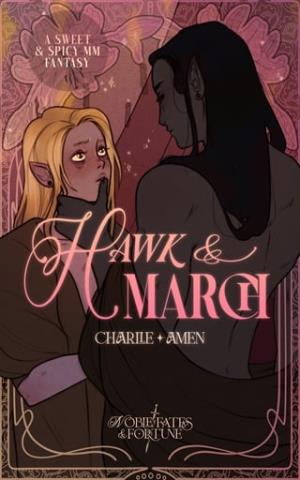
Hawk & March (Noble Fates & Fortune #1)
Chapter 1
I
He was ten years old, and he was afraid.
Hawk’s shadow trembled before him, and he could see nothing but the twiggy shape, like his body had been snapped off a tree and given life.
His frail little arm stretched high in the air, straining against the weight of the hardwood spear that had passed down from his grandfather, to his father, to him.
He moved deeper into the river, and the sun followed, mocking his shape and flashing light against the babbling water.
Already his muscles ached from the effort of holding the weapon aloft, and he couldn’t see. He couldn’t see the fish.
“Hawk,” said his father from the bank. “Now. Do it now.”
He stabbed, blind to anything other than his own skewed shadow, and when the spear sank into the sand and mud below, Hawk grimaced. He’d failed. But then he tried to raise the spear again, and it was heavier than before, and it took Father shouting in joy for him to realize he’d done it.
He speared a fish. It thrashed, spraying water and blood across Hawk’s face, and he gasped. He held the spear with both hands now, stumbling back towards dry land, and all at once he felt pressure at the back of his tongue, in his throat, and within his gut.
Father snatched the spear from him and barked, “Don’t you dare throw up again.”
Hawk, relieved of the weight, fell onto his ass. The damp grasses soaked through his beige tunic, but the cool feeling of it was welcome. He pressed his palms against his eyes and gasped for air, settling his stomach and his nerves, until he could finally speak. “I’m sorry.”
Father didn’t reply at first, and when Hawk peeked between his hands, he saw why: he’d bashed the poor fish against a sharp rock at the river’s edge, stilling it, and he worked to wiggle the spear out from the flesh—careful to not do much damage.
Father stood tall and threw the fish into his large and near-empty reeded basket and said, “No mind. You’re just a boy. You’ll grow to like all this in time.”
And then Father pinned him with a look that was more an inquiry than anything else.
You will, won’t you? Hawk, old enough to know that some lies were safer than some truths, but still all too trusting of his parents, shook his head no.
He stood, legs trembling like his arms, and he wiped the grass from his bare, pale, purple skin.
“I don’t like fishing,” he said. “I don’t like killing the fish. ”
His father sighed as he marched closer. He placed a hand beneath Hawk’s jaw, forcing him to look up and into narrowed blue eyes. “You may not fish, but you will do something for us one day. You will not be a burden to me. Or your mother.”
Hawk tried to nod, couldn’t, and instead said, “Yes. I can do something. I can—ah. Flowers.” He swallowed and said, “I’ll keep flowers.”
His father released his face and busied himself scooping up the basket to carry home. “That’s not a useful job, Hawk. Flower-keeping?”
“I’ll plant them,” said Hawk, following behind, trying to explain, hands wheeling in the air as he spoke. “I’ll grow them. I’ll sell them. And you and Mother can have the gold.”
“No one around here buys flowers,” his father said, voice gone light with the sound of laughter.
“Really?” Hawk continued to jog behind him, and he watched the planes of his father’s back shift behind his thin white shirt. His brow furrowed in thought as he said, “Okay. I’ll find something useful to do, Father. I promise.”
His father glanced at him from over one shoulder. “But not fishing.”
“Please, not fishing,” said Hawk.
Later that night, in the wood-clad cabin his family called home, he heard his mother say, “He’s a lover, not a fighter. We can make use of his love. It’s a skill as much as any.”
“Surely you don’t propose he works as an adame.”
His mom released some kind of scoff. “Not exactly.” Hawk wracked his brain for the word. Adame. Wasn’t that an elf who married for money? “Look at him. He’s got the worst traits from you and me. No brothel will house his type. Half luname? Half Elys?”
Those words, he knew. Luname—a moon elf like his mom.
Elys—the elven god associated with the blond-haired, blue-eyed type like his dad.
Hawk hugged his knees to his chest, seated on the handwoven rug just outside the doorway to his parents’ room, blond hair obscuring his vision.
Tears obscuring his vision. He swallowed them down and leveled his breathing, because he didn’t want to be caught.
And he certainly didn’t want to be caught crying.
His mother added, “He’s pretty in his own unique way.” This sentiment quelled some of the tears; some of the heaviness within his chest.
His father said, “But as an adame—”
“That’s not what I suggest. The Spears Coterie has continued to shrink with every generation.”
His father sputtered his defense. “And so?”
His mom continued, tone gentle, “We’re nearly two hundred and fifty years from the war; our spears are used for hunting alone in these times. Not against humans.”
That’s right, Hawk recalled from his days at the schooling house on the edge of his forest home—adame were elves married to humans. Or something similar to that. Humans were friendly to elves after many years of bloody war.
Mother said, “Hawk is our chance to blend, I think, with the Eddys.” The Eddys weren’t humans, but a neighboring band of elves.
Hawk heard his father make a happy, thoughtful sound, and his mom continued.
“We’ll marry him to one of theirs. They’ve a boy his age.
At twenty-two—we’ll make a promise to them. ”
“I suppose this plan is fine. I doubt the boy being a boy will be a problem.”
“I doubt any of this will be a problem. Hawk is a good child. He’ll do what we wish.”
“He’s weak.”
His mother laughed. “He’s a lover, Artur. Let him be a lover. We’ll expand the Coterie. He and his husband can give our families at least one child.”
“Only if they truly love one another,” Father said, and Hawk caught himself nodding along. Elven babies were the result of true love, after all.
“That’s my point. Hawk can learn to point his affections at someone he’s told to. He’ll take the one we say he should take.”
Hawk scrambled away as he heard his father leave the bed, no doubt to prepare for the night’s rest. Hawk did not rest that night; he went over the conversation again and again. He understood. He knew what he had to do. He just had to love.
He was twenty-two years old, and he was burdened with terrible sadness.
Hawk’s mother had been wrong about him. He gazed into the impassive, pale face of his husband, and could see nothing there. There would be no children manifested from love. Hawk was no lover. Nor was he a fighter. He was, by his estimation, nothing at all.
March was two-hundred and twenty-six years old, and he was bored.
Meredith’s trembling voice danced through the emptiness. “Do you act as stone because you look like you’re carved from one, March?”
He may as well have been. He offered a smile. “Am I so cold?” March squeezed Mere’s thin, trembling hand within his own. “You liken me to a wet unfeeling rock?”
“No, no.” Meredith’s blue eyes, milk-white with age, peered into his face.
Her soft, wrinkled skin trembled into a frown.
“You’re as stone in the most beautiful way.
My Pretty March. Made from nature. And like a river rock, satisfying to stroke.
Of all I leave behind in Abblesbet, I’ll miss you, and your beautiful stony skin, most of all. ”
March put on his gentlest, most congenial laugh.
“Mere, that cannot be true. You’ve children here.
Surely they’re more important than some adame you had.
” She did have him for a very long time—once weekly for sixty years—but his companionship had been paid.
He didn't remark on it; talking about the financial exchange in his role as her adame would have been rude.
He may have been like a stone, but he had manners.
Mere's papery eyelids closed as she said, “Yes. I forgot. My children. May the Moon Goddess strike me down. I forget many things these days, don’t I?”
March brought her hand to his lips and kissed her upon a knobby, spotted knuckle. “Worry not. I’ll remember enough for us both.”
And he would. Mere, as she aged in the countryside, would come to forget Sutaire Place, the brothel that kept March housed and employed both.
He'd been there so long it'd become embedded into his very being; a part of his identity like his pointed ears or his black, waist-length hair.
March and Mere sat in the parlor room, with mahogany-framed windows that looked down the hill at the bustling city below, watching still waters of Abblesbet Bay beyond.
The marble floors, white and gleaming, were layered in soft red rugs, and the floral, embroidered furniture seemed cozy and well-worn, but had been meticulously styled and arranged so the beautiful view could be seen from any seat.
Wood columns made of the same mahogany as the windows pressed against the off-white walls, with mounted green iron gas lamps pouring warm light—and warmth—around them.
The evening bloomed across the horizon, and for a place like Sutaire, the residents now stirred to start their day. March and Mere's conversation began in silence and was now punctuated with the quiet rumblings of the other elves that prepared themselves for work that night in the brothel.
Mere's focus drifted from the doorway, down the hall, before returning to March. “You will remember, won’t you? You’re still a young man.”
“I’m two hundred twenty six,” he said.
“As an elf!” She straightened her spine, bristling, and March could see her as she once was in her middle age, with thick dark brown hair instead of the fine silvery white that curled near her scalp, and a wicked grin that revealed one sharp, crooked tooth in the corner of her mouth. “You’re nearly a babe.”