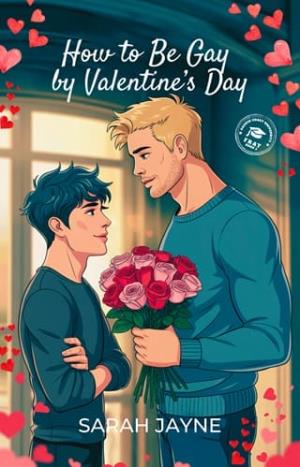
How to Be Gay By Valentines Day (PCU Frat #3)
Chapter 1
Golden Retriever Meets Feral Cat
Sebastian
Afortress of textbooks surrounds me, my laptop screen reflecting in my glasses as I attempt to memorize the entire endocrine system before my exam tomorrow. The library's quiet section is my sanctuary, at least it is until the doors swing open and in walks a group of pains in my ass; I can tell.
Football players. From their varsity jackets and the way they take up too much space. Crap, they're all huge. I sink lower behind my biochem textbook, hoping they'll migrate to the group study rooms.
No such luck.
"Dude, if I don't pass Chem this semester, Coach is gonna bench me at the start of the season," one of them whines, his voice carrying across the silent room. A librarian looks up with a frown but doesn't intervene.
"That's why we're here," says a deeper voice, belonging to the tallest of the group, a broad-shouldered blonde who looks like he could bench press me without breaking a sweat.
I roll my eyes. Great. Just what I need, testosterone-fueled distractions when I'm trying to secure my academic future.
The group shuffles toward a nearby table, chairs scraping against the floor. Someone drops a textbook with a thud. Another laughs too loudly at what I’m sure is nonsense on his phone.
I check my watch, three hours until closing. Maybe I should relocate to the house. My roommates are incredible, brilliant, funny, and… loud. I know they are hosting an engineering study group tonight, and those geeks get fired up about robotics.
"Guys," the tall blonde says, his voice unexpectedly firm. "This is the quiet section. People are studying."
"So are we, Gavin," one of them protests.
"Then act like it. Phones on silent, voices down." He's not asking. "If you can't focus here, we can move to the group rooms."
I glance up, surprised. The blonde, Gavin, is staring at his Chemistry textbook as if it’s written in Greek. When one of his friends suggests they bail, he shakes his head firmly.
"Sorry about that," he says, catching me staring. He offers an apologetic smile that crinkles the corners of his eyes.
I quickly look away, flustered at being caught.
For the next hour, I'm kind of aware they're studying nearby.
They're clearly struggling, I hear one of them confidently state that covalent bonds involve "sharing elections" instead of electrons.
The biggest of them scribbles notes furiously, but I notice him erasing as much as he writes.
At one point, he holds his pencil in a death grip, jaw clenched in frustration.
Typical. All muscle, no brain cells.
When I finally stand to get another coffee, my fourth of the day, my exhaustion betrays me. I knock into my carefully arranged study system, sending my colour-coded schedule and meticulously organized notecards cascading to the floor like confetti.
"Shit," I mutter, dropping to my knees. The schedule is everything; without it, I might as well give up on med school altogether. Okay, maybe that’s going a little far, but still. Each card represents hours of work, colour-coded by subject, importance, and testing frequency.
Before I can gather three cards, a large shadow falls over me.
"Let me help," the blonde football player suddenly kneels beside me, his hands efficiently gathering my scattered life plan.
"I've got it," I snap, more harshly than intended. The last thing I need is some jock messing up my organization system.
"You're using the Leitner method," he observes, looking at the cards in his hand. "But you've modified it with your own colour system."
I freeze, one hand outstretched for a blue-bordered card just beyond my reach. "How do you know about Leitner?"
He smiles, not the cocky grin I expect, but it’s…
different, that I have no time to figure out.
"Spaced repetition is the most efficient way to commit facts to long-term memory.
Though I've never seen anyone combine it with.
.." he glances at my schedule, "...five different highlighter colours and what looks like a time-blocking system based on ultradian rhythms."
My mouth opens, then closes. Who is this guy?
"Here," he says, handing me a stack of perfectly ordered cards. "Green for Anatomy, blue for Biochem, yellow for Pharmacology, pink for Pathology, and... purple for Psychiatry?"
"Psychology," I correct automatically.
"You're pre-med," he says, not a question.
I nod, still somewhat stunned.
"Makes sense. Your schedule has you studying sixteen hours a day. When's the last time you slept more than four hours?"
I bristle. "My sleep schedule is none of your concern."
He reaches into his bag, pulls out an energy bar, and offers it to me. "Your brain runs on glucose. That's your fourth coffee, but I haven't seen you eat anything."
"I'm fine," I say, even as my stomach betrays me with an audible growl.
He places the bar on my textbook, then stands up, unfolding to his full height. He must be at least 6'4", towering over my 5'7" frame.
"Good luck with your studies, Doc," he says with a slight smile that reaches his eyes.
"I'm not a doctor," I correct him.
"Not yet," he replies, then turns back to his friends, who are clearly watching us with interest.
As he walks away, I find myself staring at the energy bar. Reluctantly, I unwrap it and take a bite, hating that he was right. I desperately needed the calories.
If I lose one more pound, Momma is going to start showing up and force-feed me.
I glance over at his table, where he's listening to molecular structures with a wrinkle between his eyebrows. He catches my eye and winks at me.
I quickly look back at my textbook, cheeks burning.
Stupid jock, there's no heat behind it. Just confusion, and perhaps, though I'd never admit it to anyone, a tiny spark of interest.
Weeks later, I'm in my element: the Organic Chemistry lab. The sweet smell of various reagents fills my nostrils as I carefully measure 2.5 mL of a clear solution into a beaker.
"Moretti, your titration is perfect as usual," Dr. Hayes comments, peering over my shoulder at the precise colour change in my solution. "Textbook technique."
I allow myself a satisfied nod. This is where I belong, in the realm of exact measurements, predictable chemical reactions, and quantifiable results. Science makes sense. It follows rules. It's orderly.
Unlike Psychology, the current bane of my existence, I have the misfortune of needing it for my med school applications.
"When you're finished, please help Garcia with his pH calculations," Dr. Hayes adds before moving on to the next student.
I hide my sigh. Teaching isn't my strong suit. I understand the material perfectly, but explaining it to others requires patience I don't possess. I prefer my interactions with chemicals; they don't ask stupid questions.
Still, I nod. "Yes, Professor."
An hour later, I'm shoulder-to-shoulder with Russell, my closest friend among the pre-med students, walking across the mud puddles in the quad toward our Psychology 301 lecture.
"Did you finish the Myers-Briggs analysis?" Russell asks.
I scowl. "What a waste of time. Personality typing is pop Psychology garbage with no empirical validity."
"It's twenty percent of our grade," Russell reminds me gently.
"Which is why I did it. But I put my objections in the margins."
Russel laughs. "I'm sure Professor Harrington will appreciate that."
"The entire field is subjective nonsense," I keep going, getting into my favorite gripe. "You can't quantify human behaviour with any real precision. It's all just... feelings and interpretations."
"Med schools want doctors who understand people, not just diseases," Russell points out, not for the first time. "Those hearts you want to specialize in? They come with people attached.”
“Cardiology is a medical discipline. It deals with heart function and physiology, not ink blots and dream analysis," I argue back, though we both know I'm being difficult on purpose. "Psychology is a prerequisite hoop I have to jump through."
We enter the lecture hall, and I immediately feel my stomach tighten. In Chemistry, I sit front and center, hand constantly raised. Here, I slink to a middle row, trying to become invisible.
Professor Harrington enters. He is a man in his late thirties with a perpetual five-o'clock shadow and an annoying habit of pacing while he lectures.
"Today we're discussing attribution theory," he announces, writing on the whiteboard. "How we assign causes to behaviour, both others' and our own."
Russell leans in and whispers, "The silver fox is lookin' fine today." I shrug him off but secretly agree.
I take notes like I'm supposed to, but my brain won't focus. Terms like "fundamental attribution error" and "self-serving bias" feel hopelessly vague compared to the precision of my other classes.
"Mr. Moretti," Professor Harrington says suddenly, and my head snaps up. "Can you give us an example of the actor-observer bias?"
My mind goes blank. Merda. Come on, brain, think, think, think. I hate being called on in this class. In Organic Chemistry, I can recite reaction mechanisms from memory, but here? I'm lost.
"It's, um..." I fumble through my notes. "When we attribute our own actions to... external factors, but others' actions to... internal characteristics?"
It comes out as a question, and I hate how uncertain I sound.
"Close," Professor Harrington says kindly, which is worse than if he'd just told me I was wrong. "The actor-observer bias refers to our tendency to attribute our own actions to situational factors while attributing others' actions to their personal dispositions. Can anyone give an example?"
A hand shoots up from the front row. "Like if I fail an exam and say it's because the professor made it too hard, but when someone else fails, I think it's because they didn't study enough."
"Precisely, Ms. Johnson! An excellent example."
I sink lower in my seat, cheeks burning. I hate this class. I hate the imprecision, the subjective interpretations, and the lack of clear right answers. And most of all, I hate that I need to pass it to get into medical school.
When the lecture ends, I pack up quickly, eager to escape, but Professor Harrington calls out, "Mr. Moretti, a moment please."
Great. I wait as other students file out, then approach his desk.
"Sebastian," he says, using my first name now that we're alone, "I've noticed you're struggling with the material."
I stiffen. "I'm completing all the assignments."
"Completing isn't understanding," he says gently. "Your written work shows technical competence but lacks insight."
"I'm trying," I say, hating how defensive I sound.
"I know you are." He leans against his desk. "You're brilliant in your other courses. Dr. Hayes mentions your name frequently in the faculty lounge."
I wait for the "but" that inevitably follows.
"But," he continues on cue, "Psychology isn't about memorization. It's about understanding human behaviour… including your own."
"I understand behaviour," I protest. "I don't see why we need to overcomplicate it with jargon and theories when most of it is common sense."
Professor Harrington smiles. "If it were common sense, we wouldn't need psychologists. Listen, Sebastian, I'm concerned about your midterm grade. Psychology is required for med school applications, and a C won't look good on your otherwise perfect transcript."
My stomach drops. A C? I've never gotten a C in my life.
"I'm recommending tutoring," he says. "I have a student who excels in this field. I think you'd benefit from his perspective."
"His?" I ask, immediately suspicious.
"One of my best students," Professor Harrington says, not elaborating further. "He has a natural intuition for human behaviour and can explain concepts in relatable terms."
Before I can protest, he's already writing in his calendar.
"I'll email you both to set up an initial session in my office. Don't worry, Sebastian. This is a small bump in your road to med school."
I leave the lecture hall in a daze, barely noticing the rain that's started to fall. A tutor. I need a tutor. I've never needed a tutor. And I don't even know who it is.
Perfect. Just fuckin perfect.