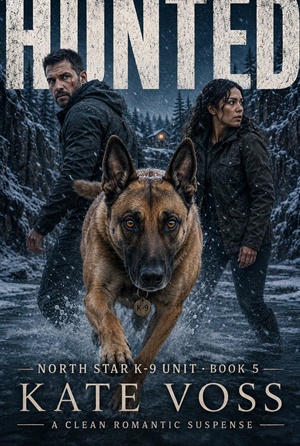
Hunted (A North Star K-9 Unit #5)
1. CHAPTER 1 — HANDOFF
The first thing they got wrong was the time.
"Twenty-one days," the man said. "You keep her breathing till the hearing. After that she's somebody else's problem."
"I get a file at the site?"
"You get what's on the sheet." The man's eyes went once around the ramp, the entrance, the stairwell, then back. "She'll be at the Hibbing lot at oh-four-hundred. Blue Cherokee. She knows the word."
"Whose name is on this? Who's she testifying against?"
"Need to know, Sandlin." A small, tired smile. "You don't."
"I've done forty of these. I've never done one where I didn't know who I was hiding her from."
"Then this is your forty-first." The man was already turning. "Twenty-one days. Keep your phone charged."
He went between two concrete pillars, and then he was a sound on the stairs, and then he was nothing.
Jacob stood with a phone in one hand that would dial one number and a sheet of paper that gave him a county road, a mile marker, and a challenge phrase.
Tamarack. That was the word. The rest of it was protocol he could have written himself, which was its own kind of insult — they trusted him with the woman's life and not with a single fact about her.
He didn't like working blind. He'd said so on the call, in the careful language a man used when he was off the books and meant to stay employable. The answer was the answer it always was now. He folded the sheet into his breast pocket and went down to the truck.
Trigger rode in the back with his chin on the console between the seats, a five-year-old Malinois the color of a deer in October.
He didn't make a sound the whole two hours north.
That was the dog's discipline and it was also Jacob's.
They'd learned each other in eleven months of this work and the learning had mostly been silence.
Trigger watched the road. Jacob watched the mirrors.
The Iron Range came up around them in the dark, the pit towns strung along the highway like beads.
The pines went from a line to a wall as the towns thinned and quit.
The Hibbing lot was a gravel apron behind a shuttered farm-supply, one light on a pole, the blue Cherokee parked nose-out, the mark of a careful person.
Good. He pulled in at an angle that put his headlights across the driver's door and kept his own face in the dark.
He let the engine run, counted to ten, and watched the Cherokee for the shape of a second person low in a seat. There wasn't one.
A figure got out of the Cherokee. Coat too big, hood down, hands visible — also good, also careful — and she came toward the truck at a walk that wasn't a civilian's walk.
Civilians hurried or they froze. This one came at an even pace with her weight balanced and her chin level and her eyes already up on his.
She stopped at the passenger window. He cracked it two inches.
"Tamarack," she said.
"Get in."
She didn't get in. She bent a little and looked through the gap at him, and the pole light caught the side of her face, and she held there one beat longer than the phrase required.
Looking. He had the strange sense of being read — taken in, sorted, filed.
It was the read he ran on everyone else.
He did not care for it aimed back at him.
"You're alone," she said.
"You were told I would be."
"I was told a lot of things." She straightened, pulled the door, slid in.
She set a single duffel between her boots and shut the door without slamming it and reached back to do her own belt before he could decide whether to mention it.
Trigger lifted his head off the console, put his nose an inch from her shoulder, and held it there, working her scent.
She went still — not the flinch of a frightened person but the deliberate hold of someone who knew exactly how much not to move.
"He won't," Jacob said.
"I know he won't." She didn't look at the dog. She looked at the windshield, at the dark past it. "Malinois don't bluff. If he wanted to he'd have already done it. He's reading my adrenaline. Tell him I'm boring."
Jacob almost smiled. He didn't. "He decides that himself."
"Smart dog." After a moment Trigger drew his head back to the console, having decided, and she let a breath out through her nose.
"What's his name?"
"Trigger."
"Somebody in the Marshals has a sense of humor."
"Somebody named him before me. I didn't change it. He answers to it." He watched her settle. "You don't flinch around a strange working dog and you don't baby-talk him. Most people do one or the other."
"Baby talk insults them. They know the difference between respect and noise." She finally glanced at the back seat, one quick read, then away. "He's carrying old scar tissue on the left flank. Somebody got a piece of him once."
Jacob's hands stayed easy on the wheel. He'd had Trigger eleven months and it had taken him three to find that scar under the coat. "You saw that in the dark," he said. "Through a window."
"I see what's wrong with a body. It's the only thing I've ever been good at." She faced forward. "Okay," she said, quieter. "Okay. Let's go."
He put the truck in reverse and held it on the brake. Most cooperators, the first thing out of them was a question or a complaint or the nervous talk that wanted reassurance. This one had handed him a fact about his own dog and a read on her own adrenaline, clean, like a colleague.
"You've been around working dogs," he said. It wasn't a question and she didn't take it as one.
"I've been around a lot of things." She turned and looked at him full-on, and there it was again, the held beat, the reading. The light was behind her now and her face was a dark shape, but her voice did the thing her face had done at the window. It waited on him. "You really don't know who I am."
"I know you're my next twenty-one days. That's the only thing about you that's my business."
She made a sound that wasn't quite a laugh. "Right," she said, soft, and faced forward, and something in the set of her shoulders settled, or closed.
He took them out of the lot and north on the county road.
For a while neither of them spoke, and the silence wasn't the silence he had with the dog.
It had weight in it. He ran the standard read on her without deciding to.
Breath rate even. Hands loose on her knees, not gripping.
No grooming gestures, no neck-touch, none of the small self-soothing a scared person leaked all over a dark vehicle.
By every measure she should have been the easiest principal he'd ever moved.
By every measure she was wrong, and he couldn't have said how.
"You took the long way out of the lot," she said. "Past the grain elevator instead of the highway ramp."
"Habit."
"It's a good habit. One road in, you can see who follows. The ramp, you can't." She said it to the window, not to him, the observation of a person thinking out loud about her own life. "How far's the cabin?"
"Far. There's coffee in the thermos. It's bad."
"I don't need steadying, Marshal." No heat in it. "But thank you. Is there water for him?" A small lift of her chin at the back seat. "Long drive for a dog that's been holding a down since Hibbing."
Jacob drove a quarter mile before he answered, because she'd noticed the dog hadn't shifted, and most people never noticed the dog at all. "Jug behind your seat," he said. "We'll stop in an hour."
"Thank you." She settled deeper into the big coat and watched the tree line slide past. The down-leaves had opened the woods, and the headlights found trunks fifty feet back, and her eyes did work — sweeping the dark, marking the gaps.
He filed it. Reads terrain. He didn't know what to do with it yet, so he set it where he set things he didn't understand, in the place that itched.
An hour up he pulled onto a logging spur and killed the lights and sat a moment, watching the road they'd come up go dark behind them.
Nothing followed. There was never anything, this early, this far from a city, and he checked anyway because the day he stopped checking was the day it would be there.
"Stretch him if you want," he said. "Stay in the wash of the truck. Don't cross the road."
She got out without being told twice and he watched her through the windshield.
She didn't reach for the dog or coo at him or do any of the things civilians did.
She let Trigger out her own side, stepped back, gave him the lead's length, and stood with her body angled so the dog could read her and the road both.
When Trigger lifted his head at something in the trees — a deer, the wind, nothing — she went still and tracked his ears before she tracked the trees.
Handler stillness. She'd learned it somewhere a person didn't learn it by accident.
He poured water into the collapsible bowl and crouched and Trigger drank and the woman crouched too, three feet off, not touching the dog, just present, her breath fogging in the cold.
"He works WitSec full-time?" she said.
"Five years. He's moved eleven principals before you. None of them lost."
"That's not a number you say to make me feel safe." She looked at him across the dog. "That's a number you say so I don't argue with the protocol."
It was exactly that. He didn't tell her so.
He took the bowl back, shook it out, and stood.
The cold came up off the gravel, and she rose with him in one motion, knees and back, no hand to the ground.
A nurse's knees, he'd think later. A nurse stood up off a floor a hundred times a shift.
He didn't have nurse yet. He had moves right and the itch of not knowing why.
"Back in," he said. "Two more hours."
Back in the truck she didn't go quiet again. He'd braced for it; it didn't come. She watched the road a while, then she said, "What's the cabin like?"
"Small. Off-grid. You'll hate it by day three and stop noticing it by day six."
"Running water?"
"A pump in the mudroom and an outhouse you'll want a flashlight for."
"And the dog sleeps where."
"The doorway. Always the doorway. Don't fight him on it."
"I wasn't going to." She turned the heat vent toward the back seat without asking, angling it at the dog, and Jacob noticed and didn't comment. "How many of these have you done?"
"Enough."
"That's not a number."
"Forty-one, counting you."
"Forty," she said. "I don't count yet. Ask me in three weeks." She let a mile go by. "You always work alone?"
"I work with him." A tip of his head at the back seat. "He's better company than most partners and he's never once leaked a location."
"High bar."
"It's the only bar that matters out here." He glanced at her. "You ask a lot of questions for somebody who's supposed to be too scared to talk."
"I'm not scared, Marshal. I told you that." She said it to the windshield. "I'm somewhere past scared. You go far enough past it, it gets quiet. You'd know."
He would know. He didn't say so. "Get some sleep if you can. It's another ninety minutes."
"I won't sleep."
"Then watch the mirror on your side and tell me if the same headlights show up twice."
She looked at him, and for the first time something almost like approval moved across her face — that he'd given her a job instead of a blanket. "Now you're talking," she said, and turned to the mirror, and watched it like she meant it.
"What happens after?" she asked, a few miles on. "Day twenty-one. The hearing."
"You testify. They put you somewhere new. New name, new town. You start over."
"And you?"
"I go back to the truck."
"That's it." She didn't look away from the mirror. "Three weeks of your life keeping a stranger breathing and then you drive off and never know how it ends."
"That's the job. The not-knowing's the job." He took a curve easy. "I keep people alive. I don't get to keep them."
"Doesn't that —" She stopped. Started again. "Doesn't that wear a groove in you? All those people you got to safe and never saw again."
"You don't do it for the thank-you. You do it because the alternative is they don't make the hearing." He glanced at her. "Why do you care what it costs me?"
She was quiet long enough that he thought she wouldn't answer. "Because somebody should," she said finally, to the dark glass. "Somebody should care what it costs the people who carry the rest of us. Mostly nobody does."
He had no answer for that. The headlights ate the road. Behind them the mirror stayed empty, and she kept watching it anyway. He found he didn't want her to stop talking — which was the first thing about the whole night that genuinely scared him.
"Clear," she said. "Same as the last ten miles. Nobody's back there."
"Good," he said. "Keep watching."
"You knew the dog wouldn't bite from one look," he said. "You knew I'd be alone before I told you. You walk like you've moved under threat, and you just clocked my exit route. Most cooperators I get can't find the door handle."
"Maybe I'm not most cooperators."
"That's what worries me."
She turned from the window and looked at him.
For the first time since the lot there was something open in her face — something that had been holding itself shut and slipped for half a second.
It wasn't fear. He'd have known fear. It was closer to grief, and it was aimed at him, and he had no idea why.
"Jacob," she said.
He hadn't told her his first name. The sheet had a last name on it if it had anything at all. His hands stayed easy on the wheel because eleven months had taught them to stay easy, but everything behind his sternum went cold and still and listening.
"How do you have my first name?"
"I'm Daniela," she said. The name was supposed to be the answer. It explained nothing he could see, and everything in her face. She faced forward and pulled the coat tighter and looked out at the open woods. "Just drive, Marshal. We've got a long way to go."
He ran the name against everything he had.
Daniela. He'd carried a thousand names in and out of that part of his memory where the job stored faces, and none of them came up to meet this one.
No file, no photo, no Daniela. And yet she'd said Jacob like she'd said it before, in some other room, years back, with weather in her voice.
He drove. The county road unspooled north into the dark. Trigger watched the road. Jacob watched the woman who knew his name. Somewhere past the headlights the Iron Range kept its own counsel, mile after black mile. All the way to a cabin he was supposed to keep her alive in for twenty-one days.
He'd been keeping people alive a long time. He had never once started one of these not knowing which of the two people in the truck was the danger.