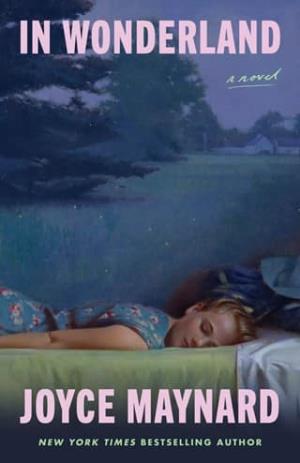
In Wonderland
Prologue
If you’ve never seen a dead person, here is one of the things you might not know.
Dead people look different from living ones.
This remains true even if they didn’t get run over by a truck or die as a result of some long illness that caused their body to waste away.
Just the fact that their heart no longer beats, their lungs don’t take in air, their brain has ceased to register any emotion—just that—is enough to transform the look of them.
For this reason, even to someone who knows the dead person well death may have rendered her almost unrecognizable.
I was not quite fifteen years old the first and only time I saw a dead person.
She had probably only been dead a few minutes.
Thin as she was—a condition that had nothing to do with lingering physical illness—she had no need to accentuate her cheekbones further, but she’d evidently applied blush.
She had changed from the outfit I’d seen her wearing an hour or two earlier into a silk nightgown.
Knowing her as I did, I imagine it was chosen with great care for its particularly flattering shade of peach and the way the folds fell over her nearly skeletal body. Every rib visible.
She was a person who cared a lot about this kind of thing. Her hair lay arranged across her silk pillowcase in a manner that made you wonder if she’d actually fanned it out that way before she set her head down that last time.
You might say she looked beautiful, as she always did. But she didn’t look like herself.
One thing about the sight surprised me, other than the fact that she was dead.
She had applied her lipstick perfectly—as always.
Her lips were slightly open, almost as if she were about to offer up one of her discourses to us on something we didn’t do that we should have, or something we did that we should not have done, or simply a way in which we might improve ourselves.
Until the moment of her death, she invariably had something to say, and it was seldom affirming.
No words came out of her now, of course.
But here came the most shocking aspect of what I saw that night: At one corner of her mouth, just barely visible—some people would have missed this, in fact—I could spot a trace of what I recognized as the smallest residual crumb of Boston cream pie.
Until that night, I doubted she had let anything of the kind touch her lips in decades, if ever.
This, more than any of the rest of it, served as indication that an event of huge and unprecedented proportions had taken place that night: A woman who counted every calorie that entered her body had eaten dessert.
I’ve pointed out already that up until the moment of her death, she was a person who liked to have the last word.
She insisted on that. In fact, it could be said that even now she was delivering a final message to those who survived her.
Dead as she was, she had somehow managed to point her long bony finger directly at the object of her greatest love and her greatest contempt.
She might as well have been aiming a gun.
I was fourteen years old the night I found her body. It took me thirty years to recognize that it wasn’t all my fault—not only her death, but everything that had happened over the three short months I think of as my Wonderland summer.