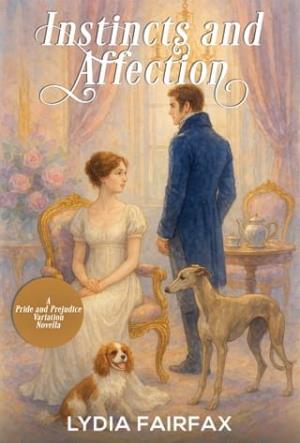
Instincts and Affection (Pride and Prejudice Variation Novella)
CHAPTER ONE
ELIZABETH BENNET HAD NEVER MUCH approved of the first week in October, at least not for the last three years.
It was ever the season of the Meryton assembly, that event which her mother, Mrs. Bennet, regarded as the summit of social consequence.
Nothing delighted that lady more than to exhibit her five daughters like a brood of hopeful chicks before any gentleman whom she considered of rank or fortune sufficient to make one of them his wife.
Perhaps, in her earlier days, Elizabeth had known some pleasure in the bustle of preparation and the novelty of new acquaintances in Hertfordshire, but this particular evening inspired in her no such animation.
She stood near the window, listening with but half an ear to her friend, Miss Charlotte Lucas, who was discoursing upon the recent arrivals in the neighbourhood and speculating with sensible curiosity on their prospects.
“Lizzy,” said Charlotte at last, her eyes narrowing with affectionate reproof, “if I did not know you better, I should think you were not attending to me at all.”
Elizabeth started slightly and turned her head. “Did you speak?”
“Exactly my point,” returned Charlotte with a laugh, giving her friend a light tap upon the arm. “You have not heard a single word. What, pray, has engaged your attention so entirely?”
“Pippin,” Elizabeth replied, her lips curving into a smile that could not be suppressed.
“Pippin?” Charlotte repeated in astonishment. “Surely you do not mean—”
“I do,” Elizabeth whispered, her eyes bright with mischief. “She is here.”
Charlotte glanced through the window into the lane.
Beneath the halted carriage, a brown spaniel, patched with white, was making free with the narrow space, her glossy coat glimmering in the lamplight as she slipped neatly beneath the axle.
Her long ears swung with every bound, and her plumed tail waved in proud satisfaction as she emerged on the other side.
She darted between the arriving horses and carriages with the confidence of a seasoned general.
The horses were far less composed: a grey sidled and tugged at his traces, while a bay tossed her head in protest. The spaniel, entirely undeterred by such a display, darted beneath another carriage, carrying herself as though the whole of the lane were her rightful domain.
“Your dog?” cried Charlotte, before recollecting herself and lowering her voice. “You have not brought your dog to the assembly?”
“Hush!” Elizabeth pressed a finger to her friend’s sleeve. “Not so loud. She followed the carriage silently from Longbourn and would not be dissuaded. I fear she has contrived to slip inside.”
Charlotte’s countenance expressed mingled amusement and alarm. “Does your mother know of it?”
“Certainly not,” Elizabeth said, laughing softly. “Had she the least suspicion, she would have stopped the carriage and ordered poor Pippin secured in chains before we had quitted the drive.”
Charlotte shook her head, though her smile betrayed her indulgence. “You will quite ruin your mother’s nerves one of these days, Lizzy.”
"Not before she quite ruins mine," Elizabeth said. The light in her eyes shifted and brightened, as if lit from within by some private joke she was only too willing to share.
The two ladies laughed heartily at their own jest, and Elizabeth cast another glance toward the window.
Her spaniel appeared to have caught sight of her through the glass, for the little creature sat wagging with self-satisfaction before returning to some fresh mischief beneath the carriage.
Elizabeth turned back to her companion with a smile.
“Now, Charlotte, I have been quite inattentive. What was it you were saying before I lost all sense of propriety?”
“I was speaking of Mr. Bingley,” Charlotte replied, folding her hands neatly before her. “He seems to be the most important of the new arrivals in Hertfordshire this year.”
Elizabeth raised a brow. “Ah, yes — Mr. Bingley. My mother has scarcely spoken of anything else for the past week. Five thousand a year, handsome, single, and newly settled at Netherfield Park — mama could not have dreamt of a more convenient miracle.”
Charlotte laughed softly. “Then your mama must be much like mine in that regard.”
“Oh, Lady Lucas is no match for my mother upon such a subject, and you know it,” Elizabeth said with a laugh.
“Mama has contrived to speak of Mr. Bingley at breakfast, dinner, and tea. We cannot eat a single dish without her wondering what he might think of it. She is already convinced that Jane will attract his notice — indeed, I believe she considers the match half made already. She even begged my father to call upon him the very day we heard that Netherfield was let. But Papa, only to amuse himself at her expense, refused to stir from his library, declaring he would wait until Mr. Bingley called first. You may imagine Mama’s distress at such obstinacy. ”
“You mean Mr. Bingley and his friend have not yet called at Longbourn?” Charlotte asked, her brows rising.
“Not yet,” Elizabeth said with a grimace. “Mama only told us he has come into the neighbourhood with his sisters, a brother-in-law, and several servants — but no mention was made of any friend.”
Charlotte drew breath to reply, but at that instant the door of the assembly room was thrown open. Conversation faltered; heads turned; and all eyes were fixed upon the party entering.
At the head of the new arrivals came a young man, perhaps six-and-twenty, whose open countenance and ready smile bespoke a cheerful and obliging temper.
“That is Mr. Bingley,” Charlotte whispered, though the name was hardly necessary. A hush had fallen over the room, and in another instant, the air was alive with murmurs concerning the newcomer and his fortune.
Behind him followed two elegantly dressed ladies, both attired in white muslin gowns trimmed with pale blue ribbons and adorned with pearl ornaments.
From their striking resemblance, Elizabeth easily perceived them to be Mr. Bingley’s sisters.
She recalled her mother’s report that one of them was married to one Mr. Hurst, which was quickly confirmed when her eyes fell upon the two gentlemen who brought up the rear.
The first was a man of comfortable girth and satisfied expression, whose good humour seemed to increase the nearer he approached the table of punch and pastries.
The other, however, was of a very different cast. He was tall, handsome, and distinguished in his bearing, yet with an air of reserve that spoke of little enjoyment in the scene before him.
His expression, grave and proud, suggested either a distaste for the company or a reluctance to be amongst it.
“That,” Charlotte whispered again, following Elizabeth’s gaze, “is Mr. Darcy.”
“Mr. Darcy?” Elizabeth repeated absently.
“Yes,” said Charlotte. “He is Mr. Bingley’s friend. He is said to have ten thousand pounds a year — twice Mr. Bingley’s fortune — and is, by all accounts, quite unmarried.”
Elizabeth turned to her friend with a spark of mischief in her eyes. “Why do I suspect you admire him already?”
“Indeed, I do,” Charlotte replied with a good-humoured smile, though a hint of wistfulness softened her tone. “At seven-and-twenty, I can hardly afford the luxury of indifference. A gentleman of fortune and proper consequence must, of course, command a measure of my admiration.”
Elizabeth sighed at this declaration. The subject was not a new one between them, for they had often spoken in this very strain.
Miss Lucas had long confessed her fear of being left upon the shelf, and had frequently avowed her resolution to marry for comfort and security wherever such might be found.
Elizabeth, on the other hand, had ever maintained that nothing short of affection could persuade her into matrimony.
Perceiving, therefore, that her friend was once more inclined to that practical line of reasoning, Elizabeth judged it prudent to decline all argument and let the matter rest.
“Mr. Bingley and Mr. Darcy waited upon my father yesterday,” Charlotte continued. “Mr. Bingley had called the very week of his arrival, but he returned yesterday with his friend to pay his respects.”
“That explains why you know so much about him—and why you admire him already,” Elizabeth said, her eyes bright with laughter.
Charlotte smiled, unoffended. “If I were not to admire such a gentleman, I fancy my mother would think me quite without ambition.”
They might have continued their playful exchange had not Lady Lucas begun signalling rather urgently to her daughter.
The Bingleys and their companions were advancing through the room, exchanging greetings with the host, and Lady Lucas was clearly determined that her daughter should not be overlooked.
Elizabeth had barely time to tease Charlotte about her mother’s strategy before she felt a sharp pinch at her own arm.
“Mama!” she whispered, giving a small start as she turned to see her mother.
Mrs. Bennet, her eyes gleaming with excitement, leaned close.
“Lizzy, do attend! Mr. Bingley and his party will soon be approaching. Compose yourself, child.” She fanned herself with brisk determination, scarcely pausing for breath.
“Your father should be here—but no, he would rather sit among his books than bestir himself to find husbands for his daughters. Sir William, now there is a man of sense! See how attentively he receives them. I daresay he means to secure Mr. Bingley for Charlotte before the evening is out.”
Elizabeth bit back a smile. “I believe Sir William’s enthusiasm may frighten poor Mr. Bingley before he reaches us.”
Her eyes drifted toward Sir William, who was now introducing Mr. Bingley to Charlotte with his customary zeal. From there, she allowed her gaze to wander about the room.
The Meryton Assembly Room was at its liveliest: the air bright with candlelight, the polished floor reflecting the shimmer of muslin gowns and scarlet coats.
The musicians were already taking up their bows, the hum of talk and laughter rising in rhythm with the tuning of violins.
Mirrors along the far wall doubled the light, while the mingled scents of beeswax, perfume, and powder hung pleasantly in the air.
The Bennet sisters were distributed much as usual.
Jane, radiant in pale blue, stood a little apart, conversing softly with a pair of neighbours, her serenity drawing glances even before the evening’s chief guests had arrived.
Kitty and Lydia had already attached themselves to a cluster of militia officers—an encampment of red coats and eager smiles near the refreshment table—while poor Mary had stationed herself beside the musicians, frowning slightly each time a note fell out of tune.
Mrs. Bennet, perceiving that the moment of importance was fast approaching, began signalling to her daughters with energy. Elizabeth had only just caught Mary’s attention and motioned for her to return when her mother’s whisper grew more urgent.
“Jane, my love, stand a little forward. Yes, that’s right. Lizzy, do smile—but not too broadly. Mary, step away from those fiddlers and come here. Kitty, Lydia, leave those officers alone this instant! I declare, if your father will not direct his daughters, then I must do it all myself!”
Elizabeth exchanged a helpless look with Jane, amusement sparkling in both pairs of eyes.
“Our general marshals her troops,” she murmured softly.
“Hush,” Jane whispered back, though her smile betrayed her laughter.
The murmur of voices deepened as Mr. Bingley and his party drew near. Mrs. Bennet straightened her posture, adjusted her shawl with all the dignity she could summon, and fixed her expression somewhere between triumph and nervous delight.
“Now, girls,” she said in a hurried whisper, “remember your manners. We must make a most pleasing impression. Oh, if your father had but an ounce of Sir William’s spirit, we should already be dining at Netherfield before the week is out.”
The sisters had only just arranged themselves before the new arrivals set off in their direction.
Mr. Bingley came forward with Sir William leading the way, his enthusiasm giving the progress all the appearance of a miniature royal procession.
He bowed and gestured with such lively zeal one might think the evening’s felicity rested entirely upon his shoulders.
“Mrs. Bennet! Miss Bennets! Allow me to present Mr. Bingley of Netherfield and his party!” he announced, his cheerful voice carrying across half the room before he moved on to the next eager listener.
Mr. Bingley’s bow was quick, his smile quicker still. Mrs. Bennet introduced her daughters one after another, each curtseying in turn. Elizabeth noticed that Jane kept her eyes upon the floor as she curtsied—a sure sign of her shyness.
“Delighted, ma’am—quite delighted,” Mr. Bingley said warmly after the introductions.
His gaze found Jane, and his expression softened at once.
“Miss Bennet, if I am not too forward, permit me to ask whether you are well acquainted with dancing, for I shall count myself fortunate indeed if I may claim the first set.”
Jane’s colour rose prettily. She looked from Mr. Bingley to Elizabeth, then to her mother, and back again. “You are very obliging, sir,” she said at last.
Elizabeth hid a smile as Mrs. Bennet’s fan fluttered like a trapped bird. Sir William had already carried the rest of the company’s attention elsewhere, yet Mr. Bingley glanced back more than once as he withdrew—his eyes clearly promising to return once the dancing began.
His sisters, having curtseyed with polished grace, wore smiles faint and perfectly measured.
They addressed Jane with particular civility, though their glances toward Elizabeth and the younger girls betrayed only polite indifference.
Mr. Hurst offered an equally brief bow before drifting away, his attention fixed, with unmistakable purpose, upon the punch table.
Mr. Darcy followed last. His bow was deep enough to satisfy propriety, yet his expression remained grave. Without more than a word of greeting, he stepped aside and moved to the edge of the room, where he stood apart, surveying the scene as though wholly detached from it.
Elizabeth’s gaze lingered a moment in spite of herself. A proud man, she thought, and one who finds little amusement in so cheerful a company.
Mrs. Bennet leaned close, her voice a breathless whisper of triumph. “Did you see, Lizzy? Mr. Bingley could scarcely take his eyes from Jane! Oh, if your father had but come tonight—what prospects we should have secured already!”
Elizabeth laughed softly. “Perhaps Papa’s absence has only improved our chances, Mama. I do not think Mr. Bingley’s spirits require encouragement.”