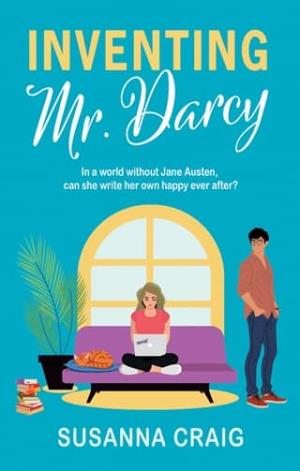
Inventing Mr Darcy
Chapter One
ONE
“‘It is a truth universally acknowledged,’” quotes Professor Pedersen, “‘that a single man in possession of a good fortune must be in want of a wife.’”
Her copy of Pride and Prejudice lies unopened on the desk in front of her, its tattered pages held together by a narrow green rubber band.
I’m not surprised she knows the first line of the novel by heart.
Heck, I’d only be a little surprised if it turned out she knew the whole book.
Julia Pedersen is, after all, the foremost scholar on Jane Austen in the United States and, arguably, the world.
Not that most of the people in the room—first-semester undergraduate students in a required seminar on the English novel—know that.
Or care. They’re mostly thinking about the fact that it’s a beautiful, warm, sunny Friday, possibly the last of the year since it’s October and also Minnesota, where the weather is as fickle as a cat that pretends to want its belly rubbed.
They would love it if Pedersen canceled class, just this once.
She won’t.
“What does it mean?” she asks, looking around at the students’ faces.
In the pause that follows, she leans forward over her desk and jiggles one foot; her slender legs are crossed at the knee, and the movement makes the gauzy fabric of her long skirt ripple.
She has this way of transmitting her enthusiasm that I hope I’ll be able to emulate when I’m an English professor—or maybe, given the abysmal academic job market in the humanities, I should say if.
It’s a testament to her ability that right away, two students gamely raise their hands to attempt an answer. Declining to call on them, she instead wags a finger. “I want you to divide into two groups, discuss your ideas, and bring them back to the class in, say, ten minutes?”
I can tell by their shifting and shuffling they think ten minutes is an absurdly long time to discuss a single sentence, even for English majors.
The last gasp of hope that class might end early sighs out the window and is swept away on the crisp autumn breeze.
“This half will work with Miss Bradshaw,” she says, dividing the room down the middle with a wave of her arm and sweeping nine of them toward me.
“The rest of you”—only eight, but who’s counting? —“are with Mr. Winkworth.”
I pointedly ignore the giggles of delight coming from the opposite side of the room.
Geoff Winkworth, Pedersen’s other graduate assistant, is—in a word—charming.
And gorgeous. His slightly crooked smile—crooked because he’s British, I’m tempted to point out to the students, and the Brits do not share America’s obsession with orthodontia—has already won the hearts of most of the class, possibly including Julia Pedersen’s.
I’m not too worried, though. It’s true both Geoff and I have a lot riding on our advisor’s opinion.
But he’s brand new and I’ve been the TA for this seminar before.
I know what she wants to hear, even if I don’t deliver my insights in a posh-sounding across-the-pond accent but rather an ordinary one from St. Paul.
“So,” I ask the students in my group, praying they’ve done the reading, “Austen doesn’t give these words to any character in particular, but if you had to pick, who do you think would be most likely to say them?”
“The mother,” says Camry, with a roll of her eyes. “Mrs. Bennet is obsessed with getting her daughters married. I am so glad it’s not like that anymore,” she finishes, unironically twisting the promise ring her high-school boyfriend gave her around her tanned, perfectly manicured finger.
I refrain from quipping that she should meet my mother sometime.
Because like Charlotte Lucas in Austen’s novel, I’m twenty-seven years old.
I’ve no money and no prospects. My roommate Cassie and I often quote that line from the movie to one another as an inside joke.
It’s famous enough to be a meme in the social media circles we frequent.
But I made the mistake of saying it to some students once and didn’t even get a polite laugh; the movie is older than they are, and most of them haven’t seen it, unless their moms made them watch it.
Camry’s comment emboldens one of her classmates.
“I think it’s society,” Rain says. They look like what you’d find if you asked ChatGPT to make an English major: short hair, some of it purple; pierced septum; black jeans and flannel shirt and combat boots, regardless of the weather. “Some people only care about money.”
“I’m so glad it’s not like that anymore,” I remark drily, which earns me a chin-jut of solidarity and maybe half a smile.
“But does everyone in the society Austen depicts feel this way about marriage? Have we been introduced to any characters who might disagree with this supposedly ‘universal truth’ about rich men wanting wives?”
“The new neighbor, Mr. Bingley,” says a pre-law major named Kate. “He’s rich and a player.” That remark produces a good-humored laugh of agreement from almost everyone in the group.
I nod encouragingly, hoping Pedersen is taking note of how well my group is engaging with the topic. Sometimes, being a graduate student is even more humbling than being a destitute Austen heroine struggling to catch the eye of a desirable suitor.
“It’s satire,” declares Samantha, a student on the creative writing track.
She speaks in a decisive tone I know will preclude further conversation—which is OK, since we must be nearing the end of our allotted time.
I see another student in the group, one who hasn’t spoken yet, write satire in her notebook, nothing else, and I wonder if she’ll remember later what it was in reference to.
“Mr. Darcy clearly doesn’t agree with that sentiment either,” Samantha adds.
“He thinks he’s too good for everyone, especially Elizabeth. ”
“Which means he’s going to be eating his words,” says Rain with a roll of their eyes.
“Spoiler,” I retort teasingly as Pedersen calls the class back together.
The truth is, I don’t have much sympathy for anyone who can’t figure out that Mr. Darcy will end up marrying Elizabeth Bennet, despite his disdain and her understandable dislike of him after he insulted her appearance in chapter three.
Actually, they all already know how the story ends, even if they don’t realize it yet; even if they claim they’ve never heard of Austen, or this book, or these characters.
It’s a narrative structure that’s been inscribed on our …
well, I was going to say hearts. But to avoid the cliché, let’s go with minds instead.
Pride and Prejudice is enemies-to-lovers at its finest and one of the most famous romances in history. It’s been adapted into every medium and inspired countless imitations and shaped every love story that followed. Without it, the world would be a different place.
But the moment when chairs and desks are scraping across the floor and students are murmuring amongst themselves about weekend plans is not the moment to share a profound philosophical insight.
I’m jotting down a note to suggest to Pedersen that the next writing assignment could be something about the novel’s impact on society when I hear Geoff speak.
“If I may, Professor? Will, here, had a brilliant observation, and I think he should kick off our discussion.” The students have rearranged themselves into an amorphous circle, with Pedersen on one end and Geoff not quite directly across from her.
She inclines her head and flashes a quick smile, and I want to imagine there’s irritation behind that expression, though I can’t be sure. The only thing that’s certain is my own annoyance.
I’m sure Geoff means well, but the classroom is full of women.
The simple fact of the matter is, most English majors are women.
Most English professors, too. The days of pipe-smoking men in tweed jackets with elbow patches are long, long gone.
And we’re talking about a book written by a woman, a book that deals not with war or politics but love and marriage, family—domestic struggles the world defines and derides as feminine.
I bristle silently at the notion that a man should get the first word.
At least, I intend my bristling to be silent.
But in the interests of holding my tongue, I’m fidgeting, mindlessly nudging the cap of my pen loose and then jamming it back into place with my thumb, when suddenly that two-inch cylinder of opaque plastic, which I’ve gnawed into a jagged point, launches directly at Geoff.
And damn if he doesn’t catch it one handed, shoot me one of his crooked grins, and say without missing a beat, “But it appears Miss Bradshaw is prepared to wage war for the privilege.”
Everyone laughs, of course, including me, because what else can I do at that point? Embarrassed, I cede the floor to Will, who says something about how Austen is offering a cogent critique of the economics of love, parroting the sophisticated phrasing he’s heard Professor Pedersen use.
Pedersen tilts her head. “So, based on the opening sentence, you’re saying that Austen disagrees with the way her society has linked marriage and money?”