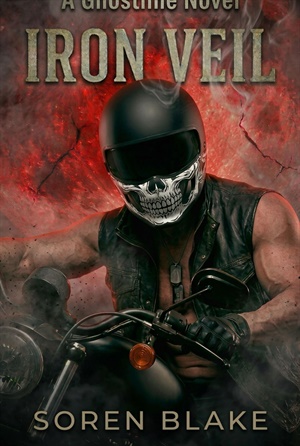
Iron Veil (GHOSTLINE MC: A Dark M/M Motorcycle Club Romance #5)
1. Eleven Seconds
ELEVEN SECONDS
Church starts at ten on Thursday, and the vote is done by ten nineteen because seventeen years of other men's wars taught every man at this table that a decision doesn't improve by being handled longer.
You gather what's true, weigh it, vote, and live inside the vote.
Warden runs church the way he ran a forward armory — nothing on the table that doesn't belong there, nothing leaving until it's signed for — and this morning the table holds a photograph and the name of one of ours.
I know every empty chair by the man who used to fill it.
Boneyard's has been empty five years, since Gideon's failed contract got him buried in a national forest nobody visits, and nobody has tried to sit there since.
The other four belonged to Gideon, Jax, Dray, and Niko—men who took a contract, looked at the target, and decided the club's word mattered less than what they were looking at.
They went off-grid one by one, alive or dead but ghosts either way, until Warden stopped letting anyone hang a road map on the wall as though geography were what kept taking them.
Ledger stands at the head of the table with a folder he doesn't open. He never opens the folder. The folder is theater; the contents are in his head to the decimal. Eleven years I've watched him stand there, and I have never once seen him get a number wrong, or forgive one.
"Shep," he says. "Gone nine days. His cut's still in his locker, which we took for a good sign for about seventy-two hours, until it stopped being one.
He crossed into Nevada from the Cal side on the fourth, on a Greyhound, paid cash.
Three nights at a weekly-rate place on Fourth Street.
And then he surfaces —" Ledger's mouth does the thing it does when arithmetic offends him — "at the Wagon Wheel east of Sparks.
In the company of a Hell's Reckoning road crew.
Eating their food. Sleeping under their roof.
Their hospitality, gentlemen. Our prospect. "
Nobody says anything for a moment. In another club there'd be noise now. In this one there's the sound of the swamp cooler and Hush turning his ring a quarter turn on his finger.
"He didn't wander into it," Ledger says.
"He was brought in. There's a prospect on that HR crew, a kid they run like a mule.
Twenty-four. Shep's age. The two of them got acquainted this spring at the Fernley swap meets, and when Shep ran, he ran to him.
The crew rolls east tomorrow, back to the mother charter in the Ozarks.
When they cross that gate, Shep is inside Hell's Reckoning's wire, holding fourteen months of our patterns, our faces, our plates, and whatever else a prospect sweeps up standing near this table. "
"What's the ask," Hush says. Six words is a speech from Hush. He got it out in four.
Warden takes the photograph off the table and holds it up so the table can see it.
A gas-station frame grab. A kid in a denim cut with a bottom rocker that says PROSPECT, laughing at something out of frame with his whole head thrown back, throat open, like laughing is a thing that could get taken away from him at any moment and he knows it.
"Extraction," Warden says. "Shep comes home breathing and answers for himself at this table.
That's the first half." He sets the photograph down and squares it to the table edge with two fingers.
"The second half is the prospect. Micah Lowe.
He turned our man, he's carried our man to a rival charter, and he goes.
On the road, before that convoy is inside the gate.
After the gate it isn't a contract anymore.
After the gate it's a war, and I have spent eleven years making sure this club never has to fight that particular one. "
He looks down the table and says, "Hands."
The vote to kill a twenty-four-year-old takes eleven seconds.
Mine is the seventh and final hand up, and I want that fact written down in whatever ledger gets kept on men like me.
I looked at the photograph of the laughing kid and voted yes because the contract is the word and the word is the club.
I have believed that since I was nineteen, when Warden found me sitting at the bar out front reading the club's mail and decided to make the habit useful instead of punishing it.
"Road Captain," Warden says. "Stay."
The room empties. Ledger goes last, and on his way out he looks at me a half second longer than he needs to, and I file it, because Ledger doesn't spend attention he doesn't intend to spend.
Then it's Warden and me and the swamp cooler.
He sits. He's fifty-one and built like the doorframe of a house that's survived weather, and he has run this club since before it had a name worth fearing.
He took me on when I was a teenager with a sealed juvenile file and a habit of watching exits.
He taught me routes, loads, fields of fire, patience.
He taught me how to fold a flag and when to lie to a cop and what a man owes the people who feed him.
Whatever I am was assembled in this building, by him, on purpose.
There's a word for what that makes him and neither of us has ever once said it out loud.
"Seventy-two hours," he says. "They ride slow. They stop loud. You'll have windows. I want Shep in a vehicle and the Lowe kid in the ground and you back at this table by Sunday church."
"Alone?"
"You work alone. That's not a criticism, it's a fact I'm using.
Bishop's on your comms. Cassidy's on standby if you need air.
Marrow's number if it gets untidy." He pauses.
"It shouldn't get untidy. It's a prospect, Rook.
He's a kid holding a wolf by the ear and he already knows it's going to turn around and eat him someday. All you are is someday."
"And if Shep won't come?"
"Shep comes. Whatever he thinks he's doing, whoever he thinks that kid is to him, he's ours.
You bring him back and church will decide what his mistake weighs.
" Warden stands. From around his neck, under the collar, he pulls the chain he's worn as long as I've known him — his tags, and the third one, the blank one.
He doesn't take it off. He just holds it a second, which is a thing he does when he's about to say something he'd rather leave in the armory.
"The day you left for basic, I gave you a blank tag," he says. "You still wear it?"
"Every day."
"You remember what I told you it was."
"The man I don't become."
"That's the one." He puts the chain away.
"Hell's Reckoning is loud, Rook. Everything they do is a performance, and the performance works, because bodies are convincing.
But loud is all it is. We are the thing they tell stories about to feel better.
Keep it that way. Quick, quiet, no witnesses, no flag on it. There is no return trip."
"There is no return trip," I say, because you say it back. That's the liturgy.
He puts his hand on my shoulder on the way out. It weighs what it has always weighed.
Eleven seconds to vote. Nineteen minutes for church. By eleven I'm rolling east with a truck, a trailered bike, four days of gear, and a photograph of a laughing kid taped inside the visor where a collector would keep a claim ticket.
The face rides at eye level for a working reason.
A man you're paid to find has to stay learned — the jaw, the gait implied by the shoulders, the way the head sits when the laugh runs out — so you tape him where the sun visor puts him six inches over your sightline and you let the miles do the memorizing.
Every man I've ever been sent for spent his last days riding in that exact spot.
None of them ever laughed like that in the frame.
The 80 east of Fernley after dark is a black corridor with the basin breathing cold through the vents, and I run it at four over the limit, which is the speed nobody remembers.
A pack of eleven bikes is the easiest surveillance target God ever made.
They can't take a side street. They can't blend.
They announce themselves a mile out and they leave witnesses smiling in every town they pass, and Hell's Reckoning wouldn't have it any other way, because being seen is their whole doctrine.
Fear is a broadcast medium. Ghostline went the other way — we're a rumor with a bank account — and the difference means I can hang two miles back on I-80 behind a horse trailer and know exactly where my work is for the next six hundred miles.
Bishop's in my ear from the hangar, dry as the basin outside the glass.
"Pack's up. Eleven and two support vehicles, rolling east out of the Wagon Wheel at fourteen twelve. Your boy Shep is in the war wagon, middle bench. Somebody's thinking about him."
"The target?"
"Crash truck. Alone. They peel him off for errands — he did two runs yesterday, smokes and ice. He's the dog they send through the fence."
"Copy."
I settle in at the pace of the interstate and I do what I do before every contract, which is build the man.
You can't take a life you haven't learned; that's not sentiment, it's tradecraft.
What you don't know is what kills you at the moment of contact — the ankle gun you didn't clock, the habit you didn't map, the friend you didn't know was watching.
So I learn him. Micah Lowe, twenty-four, born Poplar Bluff, Missouri.
Mother deceased. No father on any paper Bishop can find.
A juvenile file that's sealed, which I don't need opened, because I had one too and I know roughly what lives in there.
He's been a Hell's Reckoning prospect fourteen months, which is long.
They're either about to patch him or they're never going to, and a club like that doesn't keep a man in denim for fun.
It keeps him there because he's more useful frightened.
At the fuel stop in Lovelock I get glass on him for the first time.
He comes off the crash truck like the ground owes him money — quick, wiry, all his weight in the front of his boots.
Cheap sunglasses pushed up into brown hair that hasn't met a barber this year.
He's got a wolf inked on the left side of his neck, club support work, and under the swagger there's a thing I've seen on younger men in worse countries: he checks the lot.
Twice, casual, disguised as looking around for someone to bother.
Then he's shoulder-first into three patched members' space, talking, hands going, and I can't hear him from three hundred yards but I can see the shape of it — he's loud, he's relentless, and they're laughing, and one of them puts him in a headlock that's two pounds of pressure from being something else, and the kid laughs through it with his whole body.
He's performing. Eight hours of glass and I'd bet the truck on it.
The volume is armor. Every joke lands a half-second after his eyes have already moved on to the next threat.
He is the most frightened man in that lot and the only one dancing, and something in my chest puts its hand flat on that observation and holds it there, and I take note of the hand and file it under fatigue.
Warden's voice, seventeen years ago, teaching me to shoot at a bench outside Fallon before he put me on a bus to basic: You don't get to be interested, Rook. Interested is for targets you're not assigned.
The photograph inside my visor is a bad frame grab.
In the glass, live, laughing in a headlock, he doesn't look like the photograph.
He looks like somebody it will genuinely cost me to kill — and that costs nothing to admit, because the price has been paid seven times before, and I've never once failed to pay it.
Dusk comes down purple over the basin. The pack rides loud into it, headlight chain like a burning fuse laid along the interstate, and I follow the fuse.
Before contact — every contact, since the first one — there's a thing I do.
I put my right hand open on the console, palm up, and I watch it.
If it's steady, I go. It's a check I built after a night in another country when my hands were not steady and a man lived who shouldn't have, and three other men died who shouldn't have, over the following six weeks, because of what the living one carried.
The hand is the gauge. The hand doesn't lie to me and I don't lie to it.
Outside Wells, Bishop says, "Crash truck's peeling off. Flying J, exit 352. He's your window."
I look at my hand and find it steady as a headstone.
"Copy," I say, and take the exit.