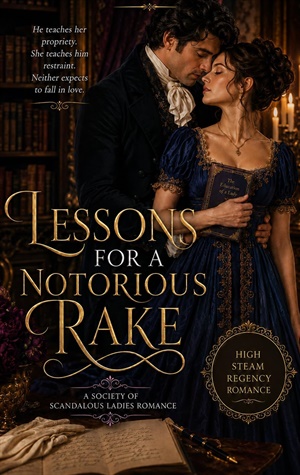
Lessons for a Notorious Rake (Society of Scandalous Ladies #2)
CHAPTER ONE THE INVISIBLE SCHOLAR
Applause sounded remarkably similar whether a man had earned it or stolen it.
Eleanor Finch sat near the rear of the Royal Antiquarian Society’s lecture hall with her gloved hands folded neatly upon her lap and listened as nearly two hundred scholars, patrons and fashionable intellectuals celebrated her father’s genius.
The sound rose beneath the painted ceiling, warm and admiring, while Dr. Edmund Finch stood behind the lectern with one hand resting upon six months of Eleanor’s labour. He received praise beautifully.
Her father lowered his silver head with just enough modesty to imply that he found public admiration faintly embarrassing, though not so embarrassing that he wished it to cease.
The candlelight caught the fine threads embroidered upon his waistcoat, and the gold frames of his spectacles flashed as he looked across the audience.
He appeared every inch the celebrated classical scholar: grave, dignified and slightly removed from ordinary concerns.
No one looking at him would have imagined that he frequently forgot where he had left his slippers.
Fewer still would have imagined that the translation for which they now applauded him had been completed almost entirely by the quiet young woman sitting beside a marble pillar at the back of the room.
Eleanor had spent half a year with the damaged fragments of the Hymn of the Western Messenger.
She had compared the surviving text against three editions in Greek, one disputed Latin copy and a set of handwritten notes made by a French scholar whose penmanship suggested that he had completed most of his work upon the back of a moving horse.
She had reconstructed missing lines, corrected errors introduced by generations of careless printers and identified a reference to an obscure cult of Hermes that her father had dismissed as domestic superstition.
He had then carried the completed manuscript into his study, altered the title page and returned it to her with three instructions. Correct the notes. Copy them neatly. Do not distract him while he prepared the lecture. Eleanor had obeyed two of the three.
She had corrected the notes and copied them neatly, but she had watched every moment of his preparation.
She had seen which passages he changed, which phrases he simplified and which of her conclusions he quietly restored after condemning them at breakfast. Most of the alterations were no more than vanity: a longer sentence where a shorter one would have been clearer, a reference to a German scholar he wished to impress, an unnecessary Latin flourish intended to remind the audience that Dr. Finch could employ three languages where one would have served perfectly well.
One alteration, however, was neither vanity nor carelessness. As the applause faded, her father adjusted his spectacles and returned to the passage projected upon a large sheet behind him.
“The final fragment,” he said, “has resisted complete interpretation for more than a century. Previous scholars assumed that Hermes carried a sealed message beyond the western gate of the city, but such a reading overlooks the financial significance of the word opheilēma. I have therefore rendered the line as follows.”
He paused before delivering the sentence with the solemnity of a judge pronouncing sentence.
“Mercury bears the silent debt beneath the evening star.”
Pens scratched across paper throughout the hall.
Eleanor did not move. The original line should have read: Hermes carries the sealed word beyond the western gate.
The word her father claimed meant debt was damaged but recognisable.
It referred to a spoken obligation or entrusted message, not money.
The western gate was equally plain, and nothing in the fragment suggested a star, evening or otherwise.
Her father knew that. Eleanor had written an entire page explaining why.
She looked down at the printed programme resting upon her lap. A decorative staff with two wings appeared at the top of the page, surrounded by a border of laurel leaves. Beneath the emblem, the Society had reproduced several lines from her father’s translation. Mercury. Silent debt. Evening star.
The same images appeared in the programmes recovered from the Mercury Club after the events surrounding Beatrice and the Duke of Calder.
Eleanor had spent several weeks studying those programmes in Arabella’s hidden library, comparing their peculiar quotations against classical sources.
She had assumed the errors were deliberate, but until now she had not understood how easily an altered translation could appear before the public without inviting suspicion.
Place a secret inside bad scholarship, and most men would defend it as genius rather than admit they did not understand it.
Her father continued speaking about ritual exchanges, merchant cults and the moral importance of secrecy in ancient society.
He quoted Eleanor’s conclusions as though they had occurred to him during a solitary walk through the British Museum.
The audience leaned forward attentively.
Eleanor studied the line again. Mercury bears the silent debt beneath the evening star.
The Mercury Club’s symbol was a winged staff.
Its blackmail letters carried an eight-pointed evening star.
Financial demands were described as debts, obligations or accounts.
The phrase might merely repeat the imagery used by the organisation, but coincidence seemed an increasingly fragile explanation. Her father turned a page.
“The fragment also suggests that the bearer could be recognised by a token,” he said. “A coin, perhaps, though the precise object remains uncertain.”
The precise object did not remain uncertain.
The Greek described a stamped disc carried beneath the tongue in funereal rites, a detail Eleanor had included in her notes because it echoed the coin given to Charon.
Her father had removed the reference: a token, a silent debt and an evening star.
Eleanor’s fingers tightened beneath her gloves.
Dr. Finch answered questions for another quarter of an hour.
He was at his most charming when discussing matters Eleanor had explained to him two days earlier.
He praised the seriousness of younger scholars, lamented declining standards of Greek instruction and accepted a florid compliment from Lord Pemberton, who declared the translation one of the most significant discoveries of the decade.
Eleanor wondered whether theft became more respectable when committed in a dead language.
When the lecture concluded, her father descended from the platform surrounded by admirers.
No one looked toward the rear of the hall.
Eleanor remained seated while the audience moved around her in a rustle of wool coats, silk skirts and scholarly enthusiasm.
She had discovered long ago that stillness could make a woman invisible.
A loud or beautiful woman attracted scrutiny.
A timid one attracted condescension. A quiet woman who kept her eyes lowered and her hands occupied became part of the furniture, and furniture heard everything.
Eleanor waited until the principal guests had entered the reception rooms before following.
The Royal Antiquarian Society occupied a substantial building near Bedford Square, filled with Greek urns, Roman busts and enough marble limbs to suggest that antiquity had been conducted almost entirely by dismembered men.
In the reception room, servants circulated with wine, tea and small savoury pastries while scholars gathered beneath portraits of deceased presidents.
Eleanor accepted a cup of tea and positioned herself near a display cabinet containing Etruscan jewellery.
Her grey gown was respectable, well fitted and entirely forgettable.
She had chosen it for precisely that reason.
Her father stood near the fireplace with Lord Pemberton and two university men. He had not yet noticed she had entered the room.
“Extraordinary work, Finch,” said Professor Alderton, a narrow gentleman whose side-whiskers seemed determined to escape his face. “The interpretation of opheilēma was particularly bold.”
Eleanor took a careful sip of tea.
Her father smiled. “Boldness is merely accuracy that has not yet received general agreement.”
It was an excellent sentence, although Eleanor wondered where he had read it. A younger scholar laughed eagerly, though Eleanor suspected he had not understood.
Professor Alderton continued. “Will the complete translation appear this summer?”
“My publisher has promised a limited edition for subscribers,” Dr. Finch replied. “There has also been interest in a private printing.”
“Ah.” Lord Pemberton lowered his voice. “For Mercury?”
Her father’s expression did not alter, but the hand holding his wineglass became still. Eleanor looked at the jewellery cabinet.
“The society has supported scholarly publication before,” Dr. Finch said.
“Not the Antiquarian Society,” Pemberton murmured. “The other one.”
Professor Alderton coughed into his fist. The younger scholar looked between them with bright curiosity.
Dr. Finch smiled. “I fear I have no talent for riddles, my lord.”
“That is not what I have heard.”
Pemberton’s amusement carried an edge Eleanor disliked.
Her father turned slightly, placing his shoulder toward her without appearing to have noticed her.
It was an unconscious movement, but one Eleanor recognised.
He often placed himself between her and conversations he did not wish her to hear.
She lowered her head and examined a pair of gold earrings behind the glass.
Lord Pemberton changed the subject, or at least pretended to.