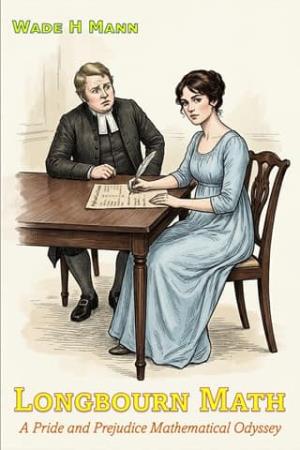
Longbourn Math (Pride and Prejudice Variations)
Chapter 6
Proposal
'Give a girl an education and introduce her properly to the world, and ten to one but she has the means of settling well.' Jane Austen
It was absolutely necessary to interrupt him now.
“You are too hasty, sir,” she cried. “You forget that I have made no answer. Let me do it without further loss of time… …
P absent a compelling reason, he would comply.
“A moment, if you please. I require supplies.”
Elizabeth went to a desk and returned with paper, ink, quill, pencil, and ruler. Resuming her original seat, she drew some faint lines, mended the pen, dipped it, and sat in contemplation for a moment.
“You make a good point regarding fortune, sir. To my chagrin, my parents have saved very little; I shall endeavour to do better. Let us begin.”
Mr Collins shook his head, having no idea what was happening.
“First things first. What, pray tell, is the income from your living?”
Mr Collins puffed out his chest and leaned forward. “It is an excellent living: £600 per annum.”
Elizabeth nodded slightly, dipped the pen, and wrote: +Living £600.
“I assume you take additional income from parish business—marrying, burying, christening—that sort of thing. How much does that bring in?”
“To what do these questions pertain?”
“I shall explain in due time. Pray, answer my questions.”
“I never thought about it. I may get £1 some months and £5 others.”
“Let us work with that. There are probably other things you might do; but let us assume an average of, say £3 per month or £36 per annum. That seems to lack ambition; let us bring it up to £55, assuming modest effort.”
He shook his head while she updated the paper: +M shall we estimate, perhaps, £1 10s total? That is, as you well know, about £1⒈/⒉, so for 40 acres your rents would be £60. You could do better by hiring labourers and managing the land yourself, but let us assume the smaller number, since it requires almost no effort, and farming it yourself is probably beyond both your skills and available time.”
She updated her page: +Farm Glebe 1.5 x 40 = £60.
Mr Collins sputtered, “But… but… but…”
Elizabeth ignored him and rolled onward. “Of course, there may be other economies to be had, but that is a good starting place for intake. See here.”
She paused a moment in satisfaction and verified the figures. “That is indeed, as you asserted, a good living, sir—very good, in fact. A grand total of £800, and that does not count the possibility of another living, nor even more ambition. Can you agree?”
Mr Collins nodded dumbly.
Elizabeth continued, “Let us examine costs. May I assume the parsonage is maintained by the estate?”
Too shocked to think coherently, he eventually nodded.
“Good, good. I assume you have two maids-of-all-work, a cook, and a footman—or at least, that is what you would need as a married man, especially if you implement the income improvements. Each requires a salary of £10-20 and upkeep, of course. I believe it reasonable to allow a total of £50 for each, making an outlay of £150-200 for household help. Let us be conservative and use the larger number.”
She added another row with: -Servants £200, then looked up to ensure his attention, or at least, his disinclination to interrupt.
“Of course, there must be a reasonable budget for food, clothing, travel, apothecaries, and the like. We must assume around £100 for those. It will vary from year to year, but that seems a good average.”
She bent and added: -Expenses £100.
Thoroughly confused and sputtering, Mr Collins fixed on the most objectionable part of the entire discussion—that he could understand anyway.
The worst, of course, was that a woman was performing arithmetic in the middle of a proposal.
The second most objectionable was that she was better at it than he was, as he could barely follow.
He doubted even Lady Catherine could manage it.
He could not tackle either of those, so he latched onto something he could object to. “I cannot farm the glebe. It is within sight of Rosings.”
Elizabeth spoke emphatically, though with every appearance of confusion. “Ah! I missed that part. That changes the entire picture. You did not tell me Lady Catherine was in trade.”
Turning red and gasping for air, Mr Collins cried, “Trade! Of course not!”
Elizabeth sighed resignedly.
“My mistake! I assumed so, since no estate owner could possibly object to farming, since that supports her grandeur. She is surrounded by 5,000 acres of farmland, not to mention the home farm and kitchen garden. I cannot imagine such a lady objecting to 40 acres, if she even noticed; and even if she could have anything to say about what you do with church land, which she does not. Nay, it is a settled thing. Lady Catherine will have no objection to farming the glebe, I can assure you. If she does, do not concern yourself. Your wife shall educate the lady properly, and all shall be well.”
As it was the longest speech Mr Collins had ever heard from the lady, he began to entertain doubts about the entire enterprise. Even so, the offer was made, and the power of answer lay within her hands. His heart squeezed, and he might well swoon on the spot.
She continued relentlessly. “My father is but 45, so according to the actuaries, he is likely to live 20-25 more years. Many things could happen in that time. For example, even 20 years hence, my mother might die, and he could take a wife young enough to bear an heir. Any offspring of your union should only count on your living for their futures, not Longbourn. If you inherit, that is all well and good, but you most definitely should not depend on it.”
Mr Collins, who thought himself practically a landed gentleman already, was near apoplexy.
“I am certain you must agree,” she continued, “any Collins children must be set up in the world; to do so, economies must be made, and money set aside, lest you repeat my parents’ mistake.”
Gasping, he could only mutter, “But… but… but—” while she carried on relentlessly.