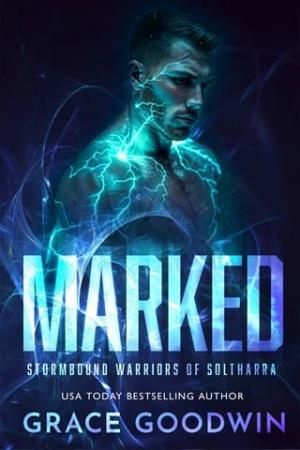
Marked (Stormbound Warriors of Soltharra #1)
Chapter 1
Planet b - HZP (Habitable Zone Probable)
The ship was dying and I was going to die with it.
I knew it the way a scientist always knows — not with panic, but with cold, awful clarity backed by data analysis. The stabilizer coil shrieked. The atmospheric sensors screamed numbers that made no sense.
The deck lurched as the storm field surged up through the hull, a brutal clawing inward. Insane as it seemed, it was like a giant planetary fist snapping shut around something fragile, squeezing tighter and tighter until my breath caught and my ribs threatened to give.
"Come on." I yanked the manual override, both hands white-knuckled on the yoke. "Come on—"
The shuttle answered with a sound like a dying animal. A roll threw me sideways against my harness, hard enough to knock the air from my lungs and leave a bruise I'd feel for days. My teeth snapped together. My vision went white at the edges.
Outside the viewport, the planet consumed everything.
This world had looked beautiful from orbit — a dark jewel striped with violet cloud systems, lightning threading through the atmosphere in patterns that had made my breath catch every time I'd watched the storm feeds.
I'd spent three days cataloguing those patterns.
Three days thinking the electrical activity was the most extraordinary thing I'd ever seen.
I wasn't thinking that anymore. I was thinking we were fucking idiots for coming here in the first place.
But NFI—Nova Frontier Initiative—our militarized corporate overlords, wanted every ‘class b’ planet in this sector of space catalogued, sampled and explored for minerals, life, genetic data.
Anything they could get their greedy hands on.
The altimeter spun. The jungle rushed up — dark canopy, jagged obsidian cliffs, a valley floor I was about to introduce my face to at a velocity that would reduce both me and the shuttle to something investigators would catalog with small, numbered flags.
I pulled up hard.
Not enough. It was never going to be enough.
The impact didn't feel like a crash. The ground surged upward with a sudden, deliberate force, closing the distance, wrapping me in its pull, and refusing to let go, almost as if the planet had decided, personally, to reach up and claim me.
Stupid thought. But I was dying, so seemed like perfect timing. Then everything went black.
I came back to myself in the ringing silence. I wasn’t sure if it was minutes or hours later.
For a moment I just breathed. Counted the breaths.
Let my nervous system run its checks — ribs aching but intact, a warm thread of blood tracking from my temple that I touched and assessed as shallow, not critical, just dramatic the way head wounds always were.
I filed it under not fatal and made myself focus before my hands could start shaking.
The cockpit had held. Barely. The viewport was spiderwebbed across the lower left corner, and half the console had gone dark. But what hit me first — what stopped the methodical inventory cold — was the smell.
Hot metal and scorched polymer, yes. The expected chemical signatures of a crash.
But underneath all of that, something clean and electric and wild.
Ozone and rain-soaked stone. The charged sweetness of air after a lightning strike.
Plant life. Soil that smelled shockingly similar to the forests back home.
The planet was alive.
I could smell life pouring in through the hull breach, and it smelled like electricity given form, like something ancient and alive, and something in my chest responded to it in a way I had absolutely no framework for.
I ran ship diagnostics with hands that were steadier than they had any right to be.
Luckily, I had managed to steer the shuttle away from the village we’d been shocked to find once we entered the atmosphere.
We thought we knew what we were getting into when we decided to land and grab some samples from the surface.
Uninhabited planet. Strong storms, but navigable.
Not dangerous. We’d thought our ship could handle the wind currents and dense atmosphere.
We’d been wrong. So damn wrong.
Every data point we had was inaccurate. Distorted by the electromagnetic fields surrounding the planet.
The energy floating in the air. We didn’t actually have a clear reading on anything.
Not the planet, the forests, not the ground formations.
Especially not the fact that this planet was inhabited by intelligent life.
They had built cities. Fucking cities. And we hadn’t been able to see them until it was too late.
The only reliable data, coming to me about the status of my ship, was not good.
The stabilizer coil — responsible for managing the power core's interaction with external electromagnetic fields — was gone.
Not damaged. Destroyed. The power core itself was currently stable, running on internal reserves, humming quietly in the belly of the ship like a heart that didn't yet know it was bleeding.
In seventy-two hours, when the next ion storm hit this valley, it would know.
Without the stabilizer to manage the electromagnetic overload, the planet’s storm field would overwhelm the ship’s core. The feedback loop would build and build until the system reached a threshold it wasn't designed to survive.
Then it would stop trying. The explosion would take out everything for miles. If that happened, the village I’d just risked my life to save would be destroyed anyway.
I sat with that for exactly three seconds. Then I picked up my field kit, exhaled through my nose. "Right. Seventy-two hours." The empty cockpit echoed the words back to me like a threat.
The survey data I'd collected from orbit had flagged crystalline formations in the cliff faces surrounding this valley.
Extraordinary conductivity. Electromagnetic properties unlike anything in the xenomineralogy database.
I'd noted them as scientifically remarkable three days ago from the comfortable distance of a stable orbit.
Now I was looking at them the way a drowning person looks at a rope.
A storm crystal with conductivity readings that high might — might — substitute for the stabilizer coil, if I could interface it correctly with the core's regulation system. It was a theory built on incomplete data and desperate need.
It was the only theory I had. The only chance I, or the other members of the crew somewhere out there in escape pods, had to get off this rock. I either stabilized the ship’s power system, or we all died right alongside the alien villagers.
I wondered what the aliens looked like. Tall? Short? Did they look like humans or were they some kind of strange creature? Reptilian? Ape-like? Insectoid?
A shudder ran through me. God, I hoped not. I could deal with a lot, but a ten-foot tall cockroach was something I could live my entire life without seeing and I’d die perfectly happy.
Didn’t matter as long as I wasn’t food.
With a thump that made my teeth rattle, I fell from the cockpit chair and shrugged out of the harness. Time to take a look at the planet that had just tried to kill me.
Breathable air. Bit warmer than I liked, but at least I wasn’t going to freeze to death outside the ship. I’d seen hundreds of distorted digital images, but reality stopped me at the edge of the ramp.
I stood there and I looked, which was not something I normally allowed myself.
Science was observation, yes, but disciplined, purposeful observation — not standing with one hand braced against the hatchway because the world in front of you had just short-circuited every professional instinct you possessed.
“Whoa.” If my dad were alive to see this? Wow. Just wow. I’d set foot on multiple alien worlds since I signed my contract with NFI, and the group of corporations it belonged to, known as The Imperium. But this world? It was… spectacular.
The trees were wrong in the most beautiful way I'd ever seen.
Their trunks were glass-smooth where lightning had repeatedly melted and rehardened the bark.
They caught the last of the dying light and threw it back in fractured violet like a hundred disco balls.
The undergrowth pulsed with faint, bluish glow that rolled along the forest floor like waves in a babbling brook of light.
Small fungi clustered at the base of every root system, breathing soft blue bioluminescence in a slow, rhythmic pattern that was almost — disturbingly, uncomfortably — like a heartbeat.
And the air hummed.
Not mechanically. Not the ambient white noise of atmospheric pressure or wind through branches.
This was a frequency. A resonance. Low and constant and alive.
I felt it less in my ears than in the cage of my chest, vibrating against my sternum like a tuning fork pressed to bone.
My body hummed along in tune, like someone had struck a giant gong the size of a bus and that long, shimmering note vibrated through my entire body.
My blood hummed. My bones resonated. Like a tree with deep roots but with every leaf and branch shaking.
My eyes buzzed. Even the air moving up and down my throat felt like it was moving. Alive.
Extraordinary.
I forced my feet to move and headed for the obsidian cliffs on the far side of the valley.
According to my calculations, I had four hours of usable light, maybe less.
The rest of my crew had ejected in escape pods.
I would find them later. First, I had to stop the ship from exploding, destroying everything.
Even if my friends survived the crash, they couldn’t cover enough ground to escape the radius of the blast. Not even if they were uninjured and knew which way to run.
I should have just enough time to assess the climb—and hopefully the crystal deposits—before darkness made the terrain impassable. I needed to move fast, think clearly, and not waste cognitive resources on—
The air changed.