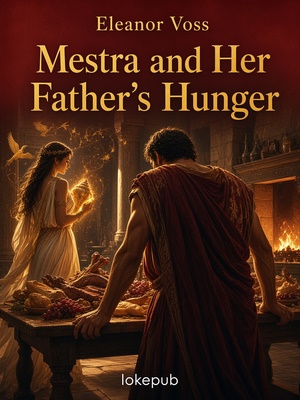
Mestra and Her Father's Hunger
Mestra
The man said he was a merchant. He had heard of my father’s affliction, and could take me off his hands, as long as I would do what I was told.
“She will,” my father said.
“She’s fifteen? A virgin?”
My father drew himself up, because he was still a king, even poor as he’d become.
“Of course.”
So my father sold me to the man for seven roasted chickens.
They’d initially agreed on ten, but the man was clever and when he came back that afternoon with the chickens, he brought them hot in a basket, and their smell filled the room.
I could hear my father tearing their joints as the man led me away in my veil.
There’d be no formal wedding because my father had no money for one.
And I was not really a wife anyway. The veil was just a piece of old dress, so sheer with use that I could look through it.
The man gripped my arm on the way out of the palace, as if he thought I would run.
But I was nearly as starved as my father, and sick with grief for both of us.
“Please Father,” I begged. “Let me stay and help you.”
He jerked his head no. “This is the best help you can be.”
The man’s cart was empty, and splintering down the back. The horse had scarred withers and a split hind hoof. The man pushed me up onto the seat. Seven chickens, he said to me. You better be worth it.
Even through the veil I could smell the fume of his breath. I’d seen at least one blackened tooth. He was the same height as my father, but thicker of course. I didn’t know where he lived, if we’d be driving for a mile or a hundred.
The cart rattled down the dusty track. We passed the grey cliffs overhanging the sea, and the path that ran down beside them to the small beach.
I had loved that place since I was a child.
After my father’s misery had begun, after all the animals had been eaten and all the treasure sold and the household fled, my comfort was to go sit and watch the water there.
The waves seemed to me the only thing in our lives that was unchanged.
Sometimes fishermen would land, and I would beg fish from them for my father.
I had gone one afternoon three months ago. It was my favorite time of day, when the sun turned the sea to gold. That was where the god had found me. He rose from the waves, and took me with both hands.
After, he’d stood above me, broad and bright, holding his trident. My lip was bitten through, and my body ached with bruises. When he’d first seized me, I had had a moment’s foolishness where I’d tried to fight. But you cannot fight a god.
“Soon you will have a child to make you happy,” he said. He was handsome, of course, hair crisp with salt, beard foaming to his chest. I wondered how many girls he had found, on how many beaches. I wondered how many of them mouthed what I did. My lord, you honor me.
He went back to his waves, and I limped home.
My skin turned purple where he’d held me, and my lip was scabbed for a month, but there was no one left to see except my father, and in his torment he did not notice.
I was grateful for that, at least he was spared this new grief.
And despite what the god had said, his briny shrimp hadn’t seemed to grow in me after all.
My courses had been gone for months by then, since the last of the stores had been eaten.
So I was not a virgin. I didn’t know what I dreaded more: how this man would find out, or what he might do to me when he did.
For the first time, I wished I did carry the god’s child, so he might help me.
We were past the beach, but on that sudden thought, I held out my palms. “Earthshaker,” I whispered.
“Poseidon. Save one who pleased you. For this man will kill me when he finds I am not as he thinks, and then my father will be alone. For his sake, help me.”
“Stop muttering,” the man said.
“I’m praying,” I told him. “Poseidon has shown me favor.”
The man laughed, a wet sound, like snapping chicken joints.
“If this is his favor you need a new patron.”
I was glad for the veil between us, sheer as it was. My chest was cold, and filled with rocks. It was true, there was no help coming. My father would die alone, and I would be swallowed by this man with his rotted mouth.
I should have cut up my face, I thought. I should have acted mad, or foolish. But that would not have changed anything. Like his cart and his horse, this man did not mind using broken things.
By then I was cold all over, shivering even in the sun. My flesh felt like a coat I wore.
The man stopped the cart to make water. The land around us was flat and dry, scrubby with rocks. I fumbled to pull the veil off. My fingers scarcely knew themselves, they felt so swollen, and my throat was clogged with dust.
“Hey! What are you doing?”
“I can’t breathe,” I said. My voice came out rough and thick. I thought I might faint from my dizziness. I pressed my hand to my face, and yelped. There was something on it, hairy and coarse. I yanked at it, and cried out again, for it stuck to my cheek and hurt.
The man was shouting, but I couldn’t hear what he said. I had caught sight of my other hand. It was twice its old size, with black hairs on the fingers. I looked down at my lap. My dress was gone. There was a tunic and large chapped knees. They were hairy too.
“What’s wrong with you? Answer me! Where’s the girl?”
The coldness was easing. I touched the beard again to be sure. I rubbed my head, which was bare skin on top. I flexed my calloused toes.
“I said, where’s the girl? She belongs to me!”
I looked up at his furious face. “I’m her,” I said, with my new voice.
“What?”
“I’m the girl,” I said. I stood up. I was taller than him now.
“It’s a trick.” But his eyes were wide. He had spoken lightly of Poseidon, he was remembering that. And he’d cheated us.
“I told you the god favored me,” I said.
The man’s eyes flicked towards the whip on the seat, as if he were thinking of seizing it. So I picked it up. It shocked me, how easy it felt, how natural in my hand.
“I’ll tell my father you changed your mind. Take your cart, and go.”
He wanted to argue. His fists were balled. He had paid seven chickens for a weak, thin girl with only virginity and obedience to recommend her. Now I was something different.
I jumped down. He climbed onto the seat and drove off.
I had never walked by myself on a road before.
The only women who traveled alone were those who were very old, and had some safety because they might be witches who would curse anyone who troubled them.
But now I was tall and broad and had a whip, even if I did not know how to use it.
I coiled it as I had seen our old groom do, and stuck it in the rope belt around my waist. I remembered the workmen who had labored for my father, how they swung their arms as they walked.
I tried to walk and swing the same. I could not tell if it was giddiness from my rescue, or the strength of my new body, but I strode along with more energy than I had felt in months.
I could not stop touching my face, my thick jaw with its springy beard.
I plucked a hair, and my eyes watered at how much it hurt.
No wonder, I thought, looking at it: the hair so thick and dense.
I liked its shining blackness. My ears were large and fleshy, my shoulders well-muscled.
I could lift a boulder, I could carry a sheep.
I peered into the darkness of my tunic. The smell of my skin was warm and sharp.
My belly was round, and I could rest a hand on it.
It was a strange feeling, to not be hungry anymore.
I examined my calves, the thick tendons behind my knees.
I had a purple toenail, and I wondered what had caused it.
At last, I lifted up my tunic to look there too.
I could feel the thing when I walked, the dangling oddness between my legs.
When I touched it, I wanted to laugh. It was softer than I had expected, and squishy.
Well, all right, I could live with that.
I passed an apple tree. A few fruits remained, high up at the top, beyond the pickers’ reach.
So I pulled myself up into the branches.
It felt just that simple—my arms moving, and my body following after.
I laughed out loud, and the sound spread over the fields around me.
I dropped the remaining fruits inside my tunic.
They pressed pleasantly against my belt as I climbed back down.
It was dark when I came to my father’s house. There were no lights to welcome me. All the porters and guards were long gone, and we had sold the lamps and tapers months ago. Still, it shocked me anew, how dull and gnawed it looked, even in shadow.
A single small fire burned in the dining room.
My father grew cold so easily now, he needed the brazier lit even in the warmest weather.
His head was on the table, but he jerked up when I came.
Beside him were the seven chicken carcasses.
They’d been eaten down to the marrow, every bone split and sucked.
He glared at me. “Who are you? Do you have something to eat?”
I held out the six apples I’d brought, three in each huge hand.
He seized them from me and bit hard into their flesh.
He had to chew to the side, because one of his teeth was broken from worrying a beef bone too long.
It was a miracle more of his teeth had not cracked.
Last month, I’d found him peeling bark from the courtyard pine when I hadn’t come home with dinner fast enough.
He swallowed the cores, and looked up. “Well? Who are you?”