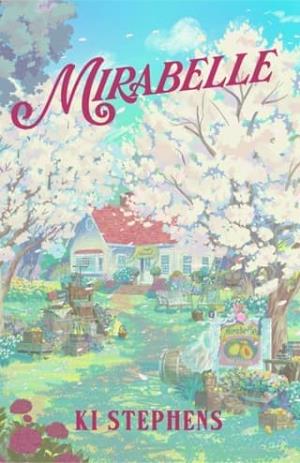
Mirabelle (Blue Willow #2)
Chapter 1
ONE
ISLA
Beau Langford slides a piece of bright yellow legal paper across the table toward me.
The windows at Juneberry—the best, and only, café in Wicklow County proper—are open to let spring in. The town green yawns beyond the glass, lush and lazy. Everything smells like butter and sugar and lilacs.
It’s the kind of morning that makes people remember how lucky they are to live here.
Though right now, I’m sitting here in one of my favorite places, marveling at how an offensively bright piece of paper can ruin an entire morning.
One number is scrawled across it in looping script. $295,000. That’s it. There’s no fancy letterhead or lengthy explanation to accompany the bald, brazen assumption that I’ll be flattered by this.
Beau, with his perfect chestnut curls and his perfectly pressed linen shirt, leans back in his chair and laces his fingers together over his stomach.
He’s the richest man in town, owner of the only operational cranberry bog in the state of Connecticut, and the kind of man who makes sure everyone remembers it.
He holds several committee seats, buys up seasonal sponsorships, and makes glossy donations that come with invisible strings.
“I added a little cushion for sentiment,” he says.
I blink once. “You think a little cushion will appease me?”
The orchard is practically pouring money down the drain at this point.
Once the trees are fruiting, we’ll have to pay the seasonal workers, too.
That will completely deplete any semblance of savings I’ve managed to drum up.
So, the offer may not be a lowball based on the current state of things, but it’s still wrong.
Wrong number, wrong man, wrong universe.
“I think you’re really tired, Winslow,” he says. “And smart enough to know when to walk away.”
I stare straight past his unbothered smile. Somewhere behind me, two mugs clink softly. Dappled sunlight spills across the tiled floor. Outside, cherry blossoms flutter against the windows.
Beau picked this place on purpose. Somewhere public. Somewhere he knows I like because he wants to soften the blow before he finishes the job.
“You know, Langford . . .” I brush the paper lightly with my fingertips. “I didn’t expect you to be so generous.”
His expression shifts slightly. A twitch near the eye. He’s hungry, he’s hopeful, and it will be my pleasure to ruin both.
“I have to admit,” I continue, “I’ve been thinking about this for a long time.”
“Of course you have. It’s a lot for one person to carry.”
I give him a mean smile. “Well,” I say, crumpling the paper slowly in my fist. “It’s impressive, really. That you managed to assign a dollar value to a fourth-generation orchard, hundreds of trees, a centuries-old well, and a house with six kinds of rot but perfect morning light.”
His jaw flexes.
“You can take this—” I say, holding the balled-up paper between two fingers. “—and fold it into something festive. Maybe a paper crane. Maybe a hat. Or, if you’re feeling especially creative, you can shove it someplace the sun doesn’t shine.”
Beau’s mouth drops open.
I toss the paper at his perfect, smug face and stand.
“Isla, just wait a minute.”
“See ya, June,” I call to the owner of the shop as the door bangs shut behind me.
Outside, the world is pretending nothing’s wrong.
The breeze in Blue Willow, Connecticut, carries that absurd early spring sweetness.
Tulips bleed open in Dr. Alma’s window boxes, bees bumbling between them like drunks.
Across the street, the chalkboard outside the hardware store reads FROST CLOTH $6.
99 in loopy pastel cursive. One of the five Carter boys darts past on a scooter, a plastic sword jammed into his backpack.
This town. This damn wonderful, oblivious town.
I swing into my mud-caked Jeep and slam the door hard enough to rattle the window. It’s still a mess from last week’s rain, full of orchard receipts I haven’t filed and one protein bar wrapper I keep meaning to throw away.
I sit for a while, hand on the wheel, heart still kicking against my ribs. It wants to fight someone, I think. Maybe Beau. Maybe myself.
Rather than scream, I drive. Ten minutes later, Mirabelle Orchard rises at the southeast edge of town.
Spring has just begun to take hold. Rows of flowering plum trees line up, green fuzz on the limbs and the soft blush of blossoms ready to break open. The house is crooked as ever. The barn door still sags. The lane needs gravel. Everything is too damn wet.
Still, it’s the most beautiful thing I’ve ever seen.
Mirabelle has always been like this, alive in a way that feels personal and deliberate. The orchard breathes. It listens. It answers when it feels like it.
And ours isn’t the only piece of living, magical land in Blue Willow. Aside from Mirabelle, there are three other legacy properties in town, four families who have managed to keep hold of what our ancestors planted. Land that reacts and remembers and somehow endures.
There’s a sentient inn up on the ridge, the cranberry bog to the northeast, and a wildflower farm with an apiary out west. There’s magic all around us. That’s what my dad used to say, anyway, back when he still cared.
My plums, in particular, are a little greedy with it.
They’re sweet and golden, with flesh that stains your fingers and juice that can ease a weary mind or coax a split wound into knitting shut.
The salves we make from them sell out fast. So do the wines and the jams when I can find the time to bottle them.
Still, it’s not enough.
Some days, I scrape by selling to the cafés and local stores.
Other weeks, I haul crates into the city for weekend markets.
But there’s always something waiting for me when I get back.
New permits, frost cloths, or broken fencing.
Fruit that spoiled too soon. Trees that want more time and care than one person can give them.
Dad’s cottage sits farther back on the property, tucked between the oldest of the plum trees. He’s aging, not quite sick, but brittle in a way that makes me nervous. Grief has worn him thin around the edges.
It all went downhill for us after Mom left, packed a suitcase nearly six years ago, and never looked back. Everything that remains belongs to me now, a twenty-eight-year-old woman going on sixty.
The orchard. The history. The debt.
And I’m worried I might lose it all unless I do something drastic to mitigate the disaster. Something desperate. Right now, it feels like I’m stepping off a ledge and praying the ground remembers how to catch me.
April in Connecticut always lies.
It looks soft and forgiving with its pale skies, early tulips, and the promise of warmth, but the wind still has teeth. Tonight, it works straight through the thickest coat I own, slicing past the collar and wrapping around my bare legs.
Being the stubborn woman I am, I hunch my shoulders and keep walking.
The back alley behind Luxe doesn’t smell like magic or fruit trees. It smells like damp concrete and metal from the storm drain. Still, the club glows faintly from inside. A pulse of low purple light throbs behind the frosted windows.
The door buzzes when I knock twice and push.
Warmth hits me instantly. It’s always overheated in here, scented with vanilla body spray, powder, and the sharp tang of Lysol. The hallway is painted a deep, glossy violet. One of the bulbs flickers overhead in a way that absolutely violates the fire code.
“Close it fast,” someone yells. “We’ll all freeze our nipples off.”
I swing the door shut behind me.
The dressing room is chaos. There are half-sequined costumes hanging from the exposed pipes overhead. Cooling curling wands sit on towels. Shoes are stacked in the corner in a glittery, dangerous avalanche.
“Look what the wind blew in,” Simone says, spinning in her chair.
She’s already halfway into costume. Silver thigh-highs, a pink velvet bodysuit, lashes so dramatic they might create their own wind tunnels. Her deep brown skin glows under the bulbs, and her cheekbones could cut fruit.
“I was about to send a search party.”
“Sorry,” I say, shucking off my coat. “Orchard stuff ran long.”
“Don’t worry.” She tosses me a mini bottle of warming lotion from her kit. “I figured you were elbow-deep in dirt somewhere.”
I hang my coat on the designated hook. Mine has a little paper tag with STARLA written across it in Sharpie, the edges curled. I step out of my boots and wiggle my toes. They’re frozen solid.
“At least I didn’t wipe out on the back steps this time.”
“Don’t jinx yourself, hon,” Simone says.
She grew up a few towns over and used to visit Blue Willow with her family. Back then, we ran around barefoot in the orchards, stealing plums and climbing trees until our knees were stained green.
We were close until she moved to the city at eighteen, kissed polite girlhood goodbye, and never looked back. Now she’s one of the best performers here. Her connections are fully the reason I’m not out dancing at the Dirty Bird, the seedy club a few blocks to the south.
“You’ve got main stage, second rotation,” she says, leaning toward the mirror. “And Roland’s here already, asking after you.”
“Thanks for the heads-up.”
Roland is trouble wrapped in cash and cufflinks. He’s here during almost every shift I have. I would consider it creepy or borderline obsessive, but he’s a big spender, and I can’t argue with cash.
I change in stages. Tights. Tape. Bodysuit. Lashes. Shimmer. Heels. My pin-straight hair gets twisted up and clipped. Gloss is swiped on. My eyes are lined until I look a little more femme fatale and less freckled orchard girl from a secret, magical town.
My set isn’t a headliner or anything, but it’s a real upgrade from serving drinks in swan pasties and kitten heels. I get twelve minutes under the lights. That’s enough time to feel fully wiped out. Enough time to pretend exhaustion isn’t woven into my bones.