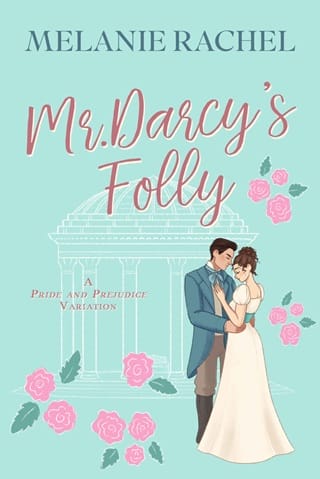
Mr. Darcy’s Folly (The Rom Com Collection #1)
Chapter One
F itzwilliam Darcy released a long breath, one he felt he had been holding since quitting London. The journey to Kent was nearing its end, and while it was barely a half-day’s travel from town, his cousin, Colonel Fitzwilliam, had slept most of the way, leaving Darcy too much time to reflect.
He glanced out the carriage window. Spring had declared itself victorious over winter at last. While it was still cool for this time of year, the hedgerows were thick and green, and beneath them clusters of primroses nodded in the gentle breeze. The late March sunshine streamed through the window, catching dust motes in its golden rays and warming the leather seats, making a mockery of Darcy’s darkening mood. Surely at Rosings he could find some peace from the relentless thoughts that had plagued him all winter—Bingley’s hollow-eyed misery over Miss Bennet, and his own . . . Well. Best not to dwell on fine eyes and impertinent smiles.
Fitz had awakened at some point, for when Darcy returned his gaze to the carriage, his cousin was wearing a knowing smirk. “Come now, Darcy,” he drawled, tapping his boot against the carriage floor in an infuriating rhythm. “You always turn surly when we come to Kent. Surely after five years, you must admit defeat in your great crusade against Aunt Catherine’s folly?”
Darcy’s jaw clenched. He had not been reflecting on his aunt’s recklessness, but it was a suitable distraction. “Seven years, for the planning began before my father died. I was still at university.”
His cousin sighed. “I am sorry to have mentioned it. Seven years, then.”
“Nature cannot be bent to Lady Catherine’s will, however much she might believe she holds authority over all things. That monstrosity weighs upwards of thirty tons, and the hill’s composition—”
“Is entirely unsuitable for such a burden, yes, yes.” Fitz waved his hand dismissively. “We have all heard your dissertations on soil composition and chalk mines. Yet there it stands, stubborn as its critic, defying your predictions of doom with every passing season.”
No one in his family ever listened to him, except for his younger sister. Everywhere else—among friends from university, Pemberley, in town—his word was taken seriously. It was a constant source of aggravation.
“Every passing season makes it more likely that it will fail,” he grumbled.
“Darcy,” his cousin said, exasperated. “Let us focus on other things.”
“Such as?”
Here his cousin smiled mischievously. “Such as why you were in such a hurry to remove from London this year.”
Fitz’s words struck close to Darcy’s heart, and he batted them away. “I have no idea what you mean.”
“No?” Fitz’s tone was innocent, but his eyes sparkled with mischief. “I could have sworn you said something about protecting Bingley from a fearsome lady. Has her father come after you?”
“Do not be ridiculous,” Darcy cut in, perhaps too sharply. Fitz raised an eyebrow at his vehemence, and Darcy moderated his tone. “The lady was not fearsome at all; she was pleasant and quiet. But she did not care for him in the way he did for her. I simply persuaded Bingley to end an unfortunate situation before it progressed too far.”
“Ah yes, so you said. Tell me, did you consult the lady in question about her feelings, or merely make the decision for everyone involved?”
Darcy frowned. “Clearly, I could not ask her such a thing. I observed her carefully, and she showed no particular preference for him.”
“You observed her?” Fitz inquired disbelievingly, straightening in his seat. “Darcy, you know nothing about a woman’s heart.”
“And you do, I suppose?”
“No, I will grant you that. Complete mystery. But I do not pretend otherwise, as you do.”
He attempted not to take affront but was unsuccessful. “I beg your pardon?”
“Darcy,” Fitz replied, “you and Lady Catherine have one thing in common. You both believe you can order the world around you to your liking, and you are both wrong. Allow Bingley to make up his own mind. He is a man full grown.”
“He is barely past his majority, Fitz.” Darcy shook his head. “And I know exactly what he is going through, losing his father so young with an inheritance thrust upon him before he is ready.”
“I would not mind having an inheritance thrust upon me,” his cousin muttered.
Everyone always said that, but they were thinking of the luxuries they could purchase and not the responsibility it required. “Say that you do—what do you do next?”
His cousin tipped his head to one side. “I invest it in the funds and live off the interest.”
“Ah, but prices go up over time, and the amount of interest your money produces remains the same.”
“I invest it in some other project, then.” Fitz did not appear to be enjoying this game, but Darcy pushed through.
“Higher rewards require higher risks. What if you lose everything?”
“I would not risk it all.”
“What if the bank fails?”
His cousin grunted. “I should like to have the opportunity, that is all I am saying.”
“Given all I have just related, if you did come into an inheritance, would you come to me for advice?”
Fitz glared at him. “I do not know. Would you be this top-lofty about it?”
Fitz would have asked for assistance, just as Bingley had—and Bingley, at least, had listened to him. His point made, Darcy leaned back against the squabs. “Bingley has his inheritance young, as I do. He has a sister in his charge until she marries—as I do. I have managed to make a success of it, though I made many mistakes at first, mistakes that I can teach him to avoid. Why is it so surprising that I offer advice or that he listens to it? It would not be a disaster for him to marry a woman whose father is a country squire. But she would not advance his place in society. If Bingley is to give up the possibility of a splendid match, his wife ought at least to love him, do not you think?”
His cousin was quiet for a moment before saying, in an unyielding voice, “But how do you know she does not?”
“Because I observed her, as I have said.”
“And you are never wrong?” Fitz asked, motioning out the window in the general direction of the folly. “I think we know that is not true.”
This again. “I have just said I make mistakes. I am human. But I am not wrong about that folly, and I am not wrong about Bingley’s latest angel.”
Fitz raised his eyes skyward, as if seeking patience. “My dear cousin, do you never tire of being so very certain about everything?”
“I am not certain about everything ,” Darcy said, tugging at his cravat with uncharacteristic agitation. The carriage wheels struck a rut in the road, jostling them both.
“No?” Fitz leaned forward, his expression sharpening with interest. “Name one thing about which you harbour doubt.”
Darcy’s thoughts flew unbidden to a pair of fine eyes sparkling with challenge, to a raised chin and a question about why he had denied George Wickham his due. He pushed the memory aside with savage force. “I am not certain I have done right by Georgiana.”
His cousin’s expression softened. “You have done everything possible to protect her.”
“Have I?” Darcy’s fingers drummed against his thigh. “Perhaps if I had not been so occupied with estate matters after Father’s death, if I had spent more time with her, she would not have been willing to . . .” He broke off, unwilling to complete the thought.
“She was at school until last summer, Darcy. You cannot watch over her every moment,” Fitz said quietly.
“No?” Darcy’s voice held an edge. “When society harbours such individuals as—” He caught himself. “At least I did spare her Lady Catherine’s particular brand of society.” His aunt had demanded that Georgiana live with her after leaving school. His sister had been terrified that he would acquiesce, but he never would. It would have broken his gentle sister forever, to live day in and day out with Lady Catherine.
“She will have to grow stronger, Darcy, before we allow her to come out.”
“Georgiana would be pleased not to come out at all. I think we must wait until she is eighteen.”
Fitz nodded. “The additional year will help her—but if she cannot perform well in Lady Catherine’s company, she will not be able to withstand the gossips of the ton. Of course, if you married, she might gain courage from your wife.” He waggled his eyebrows in a suggestive manner.
“I know what you are thinking. Do not say it.” He would not marry simply to please his family. Fitz’s parents, the earl and the countess, humoured him enough to privately agree that he and Anne should not marry, but Lady Catherine always tried to push Anne forward as a marriage partner for him. Not that she ever said so aloud.
“Ah yes, my aunt’s cherished vision of you and my cousin.” Fitz teased. “Though neither you nor Anne have ever shown the slightest inclination in that direction.”
“Because there is nothing to show inclination toward,” Darcy said flatly. “Anne and I agreed years ago that we should not suit, and we have hardly exchanged two words this past year because she does not want her mother to harangue her about it. We are cousins, nothing more.”
“And yet you allow Lady Catherine her fantasies,” Fitz observed.
“You will note that she has never come out and directly stated that Anne and I should marry. It is all pushing us together and vague innuendo. She is perfectly aware that any clear declaration would be put down immediately. It is no different than London in that way.” Darcy sighed. “I am already at war with her over the folly and have no desire to provoke more endless arguments.”
Fitz studied him with some scepticism. “And yet, none of this is the reason.”
He had forgotten where this conversation had started. “Reason?”
“There is something else that has been irritating you like a thorn in your paw since you returned from your sojourn with Bingley. I will discover it, you know.” Fitz broke off as the carriage crested a hill and Rosings Park came into view, its windows gleaming in the spring sunshine. And there, perched on the top of the hill, stood Lady Catherine’s folly, as unmoved by the passing seasons as by Darcy’s objections to its existence.
“I suppose,” Fitz continued, either oblivious to or deliberately ignoring Darcy’s glower, “you intend to resume hostilities the moment we arrive? It would be a shame to break with tradition, after all.”
“I merely state facts as they are,” Darcy replied. “If my aunt chooses to take offence at reality, that is hardly my concern.”
Fitz laughed outright. “Oh, but it is your concern, cousin. You make it your concern with remarkable consistency. One might almost think you enjoy these battles of will, for you two are remarkably the same in stubbornness.”
Darcy’s fingers drummed against his thigh as he considered the comparison. Perhaps there was some truth to that, though his reasons for arguing were genuine. And if she would just listen . . . “I simply cannot stand by while—” he began, but Fitz cut him off with a tired laugh.
“While my aunt commits sins against architecture and engineering? While she tempts fate with her stone folly? No one uses it, and it is up on a hill no one traverses. Really, Darcy, there must be better windmills at which to tilt.”
As a footman hurried to open the door, Darcy waved for Fitz to precede him. He would have to try again to convince his aunt, of course, to make her at last understand the danger she had created. But he knew, with a sinking certainty, that Lady Catherine de Bourgh would sooner dance a jig with a chimney sweep than ever admit that she had been wrong.
Darcy straightened his cuffs, already silently composing his arguments.
Elizabeth Bennet stepped out of the Hunsford parsonage, her father’s volume of Robert Burns’s poetry tucked securely beneath her arm. The morning had dawned with such profound beauty that she could not bear to remain indoors a moment longer.
The hedgerows blazed with life, primroses and cowslips dotting the verges like scattered gold. A pair of linnets darted past, their wings catching the sunlight. After spending a fortnight in the home of a man who still resented her rejection of his hand in marriage although he clearly had married the better woman, Elizabeth savoured the burgeoning of spring and the moments of pure, uncomplicated peace that came with it.
Elizabeth’s steps were light as she crossed the stone bridge and walked up to the top of the hill towards Lady Catherine’s folly. She took note of the bluebells as they nodded in the gentle breeze, their violet-blue blossoms clustered together in dense drifts. Their sweet, honey-like fragrance mingled with the rich, earthy scent of damp soil. It had been cold and wet for her first fortnight in Kent, which only made this sudden warmth more welcome. She could not help but think how perfectly nature had arranged this vista, without any need for man’s interference.
The folly itself stood as testament to that interference—a model of classical pretension that Elizabeth thought rather absurd. On her second walk she had recognized it as a poor copy of the Temple de l’Amour at Versailles, of which she had seen colour plates in one of her father’s books. The ill-fated Marie Antoinette’s folly had, extravagance aside, been a triumph of symmetry and grandeur. Lady Catherine’s, in contrast, was a mockery of the original’s majesty. Yet even with its reduced scale and questionable proportions, the structure loomed large, a limestone testament to ambition unchecked by taste. Folly indeed.
“Lady Catherine laments that I had no governess,” she told the butterflies as they fluttered past, “yet she has done her own no credit.” Still, she had to admit that the folly’s elevation offered an excellent vantage point for reading, and the stone benches within provided different perspectives of the landscape. The back side of the structure, the one nearest the bluebell grove, was nearly hidden in a grove of trees, and while the seats were stone, they were under the slightly domed roof and therefore dry. It was a comfortable enough place to sit for an hour’s occupation. And of course, when she was inside the folly, she was spared the need to look at the outside of it.
As she stepped inside and turned back toward the parsonage, a movement on the road caught her eye. A fine carriage was making its way towards Rosings. Elizabeth’s spirits dampened slightly as she recalled Charlotte’s news. Lady Catherine’s nephews, Mr. Darcy and his cousin Colonel Fitzwilliam, were expected to arrive today.
She could not claim to be surprised. Lady Catherine had spoken of her nephew with such frequency that one might believe he had already been present at every gathering. But after Mr. Collins had expounded at length upon the honour of sharing tea with such august personages who, despite their wealth and connections, still understood their duty to their exalted aunt, Charlotte had eased Elizabeth’s concern. After encouraging her husband to return to his garden, she had picked up her sewing and said, “We are unlikely to see much of Rosings while the gentlemen are here, Elizabeth. We are good enough company when there is none other to be had, but she will wish to keep her nephews engaged in entertaining her and Miss de Bourgh.”
This was a disappointment to Maria, who had been recording every invitation to Rosings and interaction with Lady Catherine in her journal, the better to share with her family when she returned home. To Elizabeth, however, it was a relief. Mr. Darcy had never enjoyed her presence, and she certainly did not desire his. And he reminded her of his friend Mr. Bingley, a man who had shown her eldest sister a great deal of attention in the autumn and raised everyone’s expectations of a marriage proposal. But he had left for London without a word and never returned.
Truthfully, it was not only that which had inspired Elizabeth’s dislike. From nearly the very first moment she had seen him at the assembly in Meryton, his proud gaze sweeping over the room with scarcely concealed disdain, he had demonstrated his arrogance. Even now, she could recall the slight lift of his brow when he had first beheld her, the utter indifference with which he had dismissed her as not handsome enough to tempt him even to dance . How foolish she had been to care, even for an instant, what such a man thought of her.
Yet in the weeks that followed, she had watched him carefully—not because she admired him, but because his manner perplexed her. At Netherfield, when Jane had been ill, she had glimpsed something in him beyond conceit, though at the time she had not much cared. Thinking on it now, he had seemed uncomfortable with Miss Bingley and the Hursts, though whether this was due to the company or his own nature, she could not tell. More than once, she had caught him looking at her with an expression she could not decipher. And then, just as swiftly, his features would harden, and he would turn away.
The reason for his bewildering behaviour had not mattered. He had left Hertfordshire without a word, before she ever discovered what she might have done to earn such derision from him, and then she had put it out of her mind when neither he nor his friend had returned. Her thoughts then were all for Jane.
Alas, he was again nearby, and despite Charlotte’s assurances, she knew they would be in company again, even if briefly. If he had found her presence distasteful in Hertfordshire, what would he think of her now, residing at the parsonage? She imagined his disapproving gaze sweeping over her surroundings, his lips pressed into that firm, humourless line. He would not need to say a word. His distaste would be clear enough.
Elizabeth settled herself upon the bench and opened her book with determined satisfaction. The spring breeze ruffled the pages, and she tilted her face towards the sun. Not even the prospect of Mr. Darcy’s presence across the lane at the great house could diminish the perfect tranquillity of this moment. Let him arrive with all his pride and disapprobation—she had poetry and sunshine for company.
A skylark burst into song overhead, as if in agreement with her thoughts, and Elizabeth smiled. No, not even Mr. Darcy could spoil such a day as this.