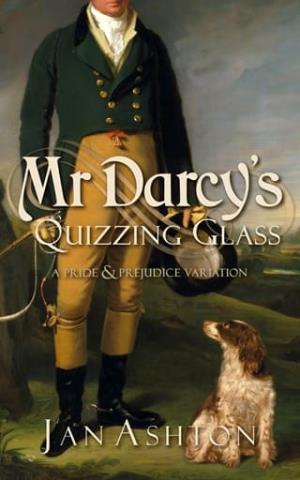
Mr Darcy’s Quizzing Glass (Pride, Prejudice and Romance)
Prologue
George Darcy was a man who understood his place—within his family and society, amongst his friends, and even amongst his enemies. Of the latter, he had very few, the fact of which he credited to an unremarkable object: the quizzing glass he carried round his neck.
To be sure, it was a fine specimen, ornate and bejewelled.
The glass’s true value, however, was in the insight it gave to him, and to his father and grandfathers before him.
Was a new acquaintance clothed in the refinements of a gentleman, but a gull in the cardroom?
Could he trust that a man bringing him an investment scheme did not possess nefarious motives?
What of those prone to sudden extravagance or rapid penury?
Had they built their fortunes on lies? The glass revealed all.
It was not ‘magical’ per se; it did not pronounce judgment or whisper secrets.
However, it sharpened the perceptions of those peering through it to expose the ‘rougher edges’ of whoever was caught within its sight.
It was not flawless, of course; a good man might have faulty ideas or a blemished past, which Darcy must use his own intelligence to discover.
But it bestowed just enough discernment to instil resolution and spirit, to provide evidence of one’s perceptions, to recommend to the world a man with a steel edge of confidence.
Thus George Darcy’s reputation for good judgment, for good sense, for goodness in general, was unmatched by anyone.
He held a great deal of pride in his impeccable standing, yet he did not fear his Maker; his sole aim was to bring honour to the Darcy name, as had his father before him.
Nevertheless, his temper, long schooled to perfect composure, stirred beneath the surface as he looked across the crowded drawing room at his wife, deep in conversation with an elegant gentleman.
The fellow stood too close to Anne, and even from a dozen yards away, he clearly was too easy in his address, too keen in his smile, and far too familiar for a husband’s liking.
Darcy had hardly known Hugh Vaughan when they were at school together; the heir to a baronetcy in Lancashire, he was a sharp wit and uninterested scholar, and even then, had been rumoured to keep at least one mistress.
Anne smiled, and Darcy could see the amusement in her usually cool countenance.
She was enjoying Vaughan’s glib flattery!
Beyond the affectionate smiles she gave to him and young Fitzwilliam, she had not looked so delighted in years.
Was she taken in by Vaughan’s shallow wit and smooth looks?
Was she so easily swayed from the constancy of their attachment?
Fury, biting and cold, unfurled in his chest. How dare she enjoy the company of this worthless lackwit!
Needing to know with certainty whether Vaughan was the scoundrel he suspected, ideas of what could be done to ruin his opportunities to manipulate any other lady of the ton seizing his mind, Darcy reached towards his waistcoat and withdrew his quizzing glass, its gold rim glinting faintly in the candlelight.
With deliberate calm, he raised it as though to inspect the precision of the brushstrokes in a painting hanging nearby.
But when he brought the lens to his eye, he did not see Vaughan. He gazed at another face entirely—his own, mirrored back from a looking glass behind the offender. Swirling within and around his reflection was a pale grey shadow.
For an instant, the air surrounding him seemed to still; the sounds of conversation dimmed. Through that small, circular lens, Darcy saw not Vaughan’s faults but his own failings of pride and jealousy laid bare. This cannot be! I am not a man of malicious intent or amorality!
Darcy lowered the glass, blood rising to his temples as he glimpsed his shocked expression in the mirror.
After closing his eyes briefly to regain his sensibilities, he saw that across the room, the objects of his ire had separated, seemingly unaware of his scrutiny.
Vaughan was speaking with another gentleman and Anne was occupied with her aunt.
She looked over to him and smiled warmly, eyebrow raised, as though welcoming his company.
Shaken, he stared at the quizzing glass he had relied upon so willingly and so often these past years, using it to easily place others into neat little categories of good and bad, right and wrong.
With trembling hands, he slipped it into his pocket, a warning echoing unbidden in his mind, the weight of it like a blade against his heart.
Has it enabled the darkness I fear in others to grow without restraint in me?