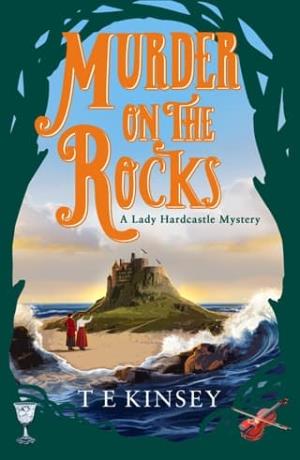
Murder on the Rocks (A Lady Hardcastle Mystery #13)
Chapter One
Lady Hardcastle was looking out of the train window as we clickety-clacked through the Somerset countryside. ‘Don’t you just adore a train journey?’
‘We’ve had some fun ones, that’s for certain,’ I said. ‘And some terrifying ones. Do you remember the night train from Bucharest?’
‘Oh yes. Or that tiny line in Dubrovnik when the local gang leader thought we must be British spies.’
‘We were British spies.’
‘I suppose so. But we weren’t spying on him.’
‘No, that’s true.’ I contemplated the view across the fields for a few moments. It really was rather beautiful in the winter sunshine. ‘But yes, apart from those two – and at least a dozen other hairy trips – I do, indeed, adore a train journey.’
There was a knock at the compartment door, and a white-jacketed steward slid it open and poked his head inside.
‘Please excuse the interruption, ladies, but I see you’ve reserved a table in the restaurant car. Lunch will be served in fifteen minutes.’
Lady Hardcastle turned towards him with a smile. ‘Thank you . . . ?’
‘Pearson, madam.’
‘Thank you, Pearson. We shall be there presently.’ She pointed towards the front of the train. ‘That way?’
He shook his head and pointed in the other direction. ‘That way, madam. You can’t miss it – just follow the sound of spilling soup.’
And with that, he was gone.
‘Say what you like about the convenience of the motor car, young Flossie, but until you can serve me a three-course luncheon as we drive along the King’s highway, the Great Western Railway has much to offer.’
I gave a small shrug. ‘I can’t argue with you there. You’d be wearing most of your meal by the time we arrived at our destination.’
‘Just so.’ She stood and hefted her Gladstone bag from the luggage rack. ‘Shove your book in here for now, dear. We’ll sort everything out when we change trains at Plymouth.’
‘Shove?’ I said.
‘Yes, dear. Shove it in.’
I placed my book carefully in the bag, nestling it among magazines, a newspaper, a hairbrush, a box of powder, a leather case containing a manicure set, and goodness knows what other unnecessary tat she was hauling about with her.
She snapped the bag shut. ‘Come then, tiny one. Let us adjourn to the restaurant car to see what they have to offer.’
We made our way along the corridor and through the doors joining the carriages.
I wondered, as I so often did, whether it would be possible to uncouple the carriages while the train was in motion.
How useful that would have been on some of our journeys, leaving our pursuers impotently shaking their fists in the doorway of their rapidly slowing car as we sped off into the distance.
‘No,’ said Lady Hardcastle.
‘No what?’
‘No, you can’t uncouple the carriages while the train is in motion.’
I frowned. ‘How did you—?’
‘You wonder about it every time we move along a train.’
She wasn’t wrong.
We soon found the restaurant car and I smiled to myself with satisfaction at its clinking glasses and jingling cutlery on starched white linen.
Pearson the steward ushered us to a table set for four. ‘We’re quite busy for lunch today so we have no more twos, but I thought you’d be more comfortable at a larger table anyway, so I took the liberty.’
We thanked him and sat down.
As we perused the menu, a gentleman entered the car and beckoned the steward. A murmured conversation followed, which ended with Pearson shrugging apologetically and gesturing down the carriage at the already-full tables.
‘It’s a good thing you booked a table,’ I said. ‘There doesn’t seem to be room for the more spontaneous diners on board.’
Lady Hardcastle turned in her seat to look at the dismayed man near the door. He was smartly dressed and had a decorated cardboard box under his arm.
She turned back towards me. ‘He seems like a nice enough fellow. Would you object to some company?’
‘Not at all,’ I said. ‘It’s a long journey and you’ve heard all my sparkling anecdotes dozens of times before.’
‘I was present for most of the adventures recounted in them.’
‘You were. So we need someone else to talk to, I think.’
She beckoned the steward, who moved along the swaying carriage with a grace I was sure neither Lady Hardcastle nor I could manage. The forlorn would-be diner hovered near the door with his package, seemingly unsure what to do.
‘Yes, madam?’ said Pearson. ‘Some water, perhaps?’
‘Thank you, no. Actually, yes, that would be splendid. But that’s not why I called you over. Is that gentleman looking for a table?’ She tilted her head backwards to indicate Forlorn Man.
‘He is. But I’ve had to turn him away – we’re fully booked, as you can see.’
‘Ah, but we have plenty of room at our table. If he wouldn’t be uncomfortable dining with strangers, we’d be more than happy to have him join us.’
‘That’s very kind of you, madam. If you’re sure you don’t mind . . .’
‘Not at all. It’s not that we’re weary of our own company, you understand, but a fresh view of the world would make our journey much more enjoyable. Bring him over if he’ll come.’
Pearson glided off and returned moments later with the now grateful and relieved passenger. ‘Ladies, this is . . .’
‘Dymond,’ said the man, putting down his box on the floor next to the chair Pearson was holding out for him. ‘Paul Dymond at your service. Like the precious stone, but with a Y.’ He paused. ‘But there are no Ys in Paul, obviously.’
Pearson smiled. ‘This is Mr Dymond with a Y. I shall be back in a few moments to take your orders.’ He left to attend to other diners.
Lady Hardcastle gestured for our guest to sit. ‘Welcome, Mr Dymond. I am Emily, Lady Hardcastle . . .’ She paused.
‘And I’m Florence Armstrong,’ I said. ‘Miss.’
‘How do you do,’ said Dymond. ‘It really is most kind of you to allow me to share your table. Thank you.’
‘Think nothing of it,’ said Lady Hardcastle. ‘We were just saying to Pearson—’
‘To . . . ?’
‘Pearson,’ repeated Lady Hardcastle. ‘The steward.’
Dymond nodded. ‘Aha. Sorry, do go on.’
‘We were just saying how welcome company would be. An engaging conversation can make a long journey seem so much shorter, don’t you think?’
‘I suppose so, yes. Though give me a good book and a comfortable place to sit and I can be quite content with my own company.’
‘I know exactly what you mean,’ I said. ‘With a warm fire at this time of year.’
‘Oh, most definitely,’ said Dymond with a nod. ‘London has been exceptionally cold.’
‘You’ve come all the way from London?’ said Lady Hardcastle. ‘Good heavens. You must have been travelling for ever. We only joined at Bristol and I already feel as though we’ve been on the train since the dawn of time.’
‘It’s not so bad. I have a book and a comfortable place to sit, so the time is passing quite pleasantly. It was only unexpected hunger that forced me from my compartment. That and the loud snoring of the gentleman I’ve been sharing it with.’
He caught sight of me trying to get a better look at the box at his feet. Not my finest hour – I always imagined myself more subtle than that.
‘It’s a bear,’ he said. ‘I collect them.’
I smiled. ‘A bear?’
‘The Americans call them teddy bears, but this one is German.’
He picked up the box and opened it. Inside was not, as I expected, a brown toy bear, but a black one.
‘It’s a Titanic Bear,’ said Dymond. ‘Steiff – do you know Steiff? They make bears. Steiff made the Titanic Bears to commemorate the victims of the disaster. He’s a sad bear, but he has pride of place in my collection.
I didn’t like the idea of leaving him unguarded with only my snoring compartment companion to see off potential thieves, so I brought him with me. ’
‘He’s magnificent,’ I said. ‘I had no idea there were collectors of bears.’
‘There are collectors of everything,’ he said with a smile of his own. ‘Not many collect bears, mind you, but there are a few of us. They appeal to me for some reason.’
‘And are you on your way home to Devon?’ asked Lady Hardcastle.
‘No, I’m visiting a friend at Exeter. He has managed to acquire a couple of bears from America and he’s said I can have one. I’m taking the Titanic Bear to show him. Do you live in Bristol or are you travelling home to Devon yourselves?’
‘We live near Bristol,’ I said.
‘And we’re off on something of an adventure,’ said Lady Hardcastle.
‘An acquaintance of ours – another American, as it happens . . . I wonder if he has any teddy bears. I shall ask him. But bears or not, he has invited us to spend the weekend with him at his . . . I’d ordinarily say “country house”, but it’s not quite a house and it’s not really in the country. ’
Dymond laughed. ‘That’s intriguing. So what is it?’
‘Well, it used to be a fort, but he’s renovated it and turned it into a .
. . a retreat, I suppose one might say. And it’s not in the country because it’s on a little island a mile or so off the coast. He plans to open it as a resort where the well-heeled can get away from it all for a few days in unashamed luxury. ’
‘I say. That does sound exciting. I take it he’s a wealthy chap.’
‘Rich as Croesus. His father’s company made a fortune in munitions during the Civil War.
During the Reconstruction they diversified into .
. . well, into everything as far as I can make out.
Railways – or “railroads”, I should say – oil, mining, factories.
By the time he inherited the company in the eighties, you name it, they had a hand in it.
For nearly twenty years he ran the many businesses with great success, but around the turn of the century he had some manner of Damascene moment and decided that the rapacious acquisition of wealth didn’t sit well with his conscience.
He divested himself of his many holdings and retired to England, where he potters about indulging his love of antiquities. ’
‘But he’s still rich, you say?’