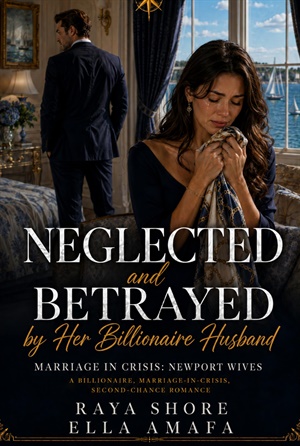
Neglected and Betrayed by Her Billionaire Husband (Her Marriage in Crisis #118)
1. Elizabeth
— ? —
Elizabeth
The machines breathe for him now.
I sit in the plastic chair beside my father’s bed, holding his hand the way I used to when I was small and afraid of thunderstorms. Back then, his grip could anchor me through anything.
Now his fingers feel like paper wrapped around kindling, and I’m terrified that if I squeeze too hard, something essential will break.
The hospital room smells like antiseptic and lilies someone brought three days ago, already starting to wilt in their plastic vase.
The fluorescent lights hum a constant, tuneless note that burrows into my skull and stays there.
I’ve memorized every crack in the ceiling tiles, every beep and whir of the monitors, every shift change and hushed conversation in the hallway.
“Elizabeth.” His voice is smoke now, thin and drifting. “There’s something I need to tell you.”
I lean closer, my chair scraping against the linoleum. “I’m here.”
“Something I should have told you years ago.” His eyes, still sharp despite the morphine, find mine with an intensity that makes my chest tight. “Twenty years ago, I saved a man’s life.”
I wait. The heart monitor marks time in steady green peaks.
“Pulled him from a car wreck on the coast road. Bad one. The car was on fire, and everyone else just stood there watching, but I couldn’t-” He stops, coughs, the sound wet and hollow.
I reach for the water cup, but he waves it away.
“Stayed with him through three surgeries. Testified for him when the other driver’s family tried to twist the story, claim he was at fault.
I was the only witness willing to stand up in court.
Exposed their lies. Saved his reputation when a scandal would have destroyed everything. ”
“I didn’t know.”
“I never wanted you to know. Never wanted you to think-” Another cough. “That man was Edward Fairweather.”
The name lands like a stone in still water. Everyone in Rhode Island knows that name. Old money, older influence, the kind of family whose history is woven into the coastline itself.
“He died owing me a debt he could never repay.” My father’s grip tightens with surprising strength. “But his son knows. Jarec knows.”
Something cold unfurls in my stomach.
“I asked him to marry you. To protect you when I’m gone.”
“You asked him to marry me.” I pull my hand from his grip.
“Like I’m a - a debt to be settled. A transaction.”
The words don’t make sense. They’re shapes without meaning, sounds that my brain refuses to assemble into anything coherent. Marriage. Arranged. Protection.
“You can’t be serious,” I say.
“Elizabeth-”
“I’m not property, Father. I’m not something you can trade because a man saved your life twenty years ago.”
His eyes fill with tears.
“You think I don’t know that? You think this is what I wanted for you?”
“Then why-”
“Because I’m dying.” The word lands like a stone. “And you’ll be alone. No family left. You don’t have your mother. No money - the medical bills have taken everything. No connections, no safety net, nothing to protect you from a world that doesn’t care about people like us.”
“I can take care of myself.”
“I know you can. But you shouldn’t have to.” He grips my hand again, urgent. “Jarec isn’t buying you, Elizabeth.
“He’s promising to make sure you’re never one bad month away from the street. Never one illness away from bankruptcy. Never alone the way I’ve been alone since your mother left.”
“And if I hate him? If we make each other miserable?”
“Then you divorce him and keep the settlement. It’s in the contract.
You can leave anytime, take enough money to start over somewhere safe, and never see him again.
” He coughs, wet and rattling. “I’m not selling you, sweetheart.
I’m giving you options. Options I never had.
I know it’s not what you dreamed.” His thumb strokes across my knuckles, that old familiar gesture that used to mean everything’s going to be all right.
“But you’ll be safe. You’ll be provided for. And maybe…”
“Maybe what?”
His eyes drift toward the window, toward the gray Rhode Island sky. “Maybe he’ll learn to see what I see. What everyone who truly looks at you sees.”
I want to argue. Want to tell him this is insane, that you can’t trade your daughter like a debt marker in a card game, that I’m a grown woman with my own life and my own plans even if those plans have always been small and uncertain.
I want to tell him that I don’t need protecting, that I’ll be fine on my own, that I’ve been taking care of myself since Mom left when I was twelve and I can keep doing it.
But he’s dying. He’s dying and he’s afraid, and this is the last thing he has to give me.
So I squeeze his hand, and I don’t argue, and I wonder what kind of man agrees to marry a stranger out of duty.
***
The law office smells like old leather and older money.
Three days have passed since the hospital.
The funeral was yesterday, a small affair, poorly attended.
My father had outlived most of his friends, and the few who remained were too old or too ill to travel.
I stood alone at the graveside in a black dress I’d bought at a thrift store two years ago, watching them lower the only person who ever truly loved me into the cold ground.
Now I’m standing in a room full of mahogany furniture and framed credentials, watching a stranger sign his name to a contract that will bind us together.
Jarec Fairweather is devastating in person.
I’ve seen him in society pages, of course - grainy photographs at charity galas, blurry shots getting into town cars, the occasional profile piece that painted him as brilliant, ruthless, unreachable. None of it prepared me for the reality.
He’s tall, broad-shouldered, with dark hair that looks like he runs his hands through it when he’s thinking. His eyes are the color of winter storms, gray with something colder underneath. He moves like someone who has never been denied anything in his life, every gesture economical and precise.
He barely looks at me.
“The terms are straightforward,” the lawyer drones, shuffling papers. “Separate accounts, separate social obligations where preferred, joint residence at the Fairweather estate in Rhode Island.”
I study Jarec’s profile while the lawyer talks. The hard line of his jaw. The slight tension around his mouth. He’s not happy about this. That much is obvious.
Good. That makes two of us.
“And the marriage itself?” I hear myself ask, surprised by the steadiness of my own voice.
Jarec finally meets my eyes. His expression is polite, distant, carved from marble. Whatever he sees when he looks at me doesn’t register on his face.
“In name only.” His voice is low, controlled. “I made a promise to a dying man. I intend to honor it. But I won’t pretend this is something it isn’t.”
Something small and hopeful in my chest - something I didn’t even know was there - curls up and goes quiet.
“I understand.”
We sign. Page after page, initials and signatures, my maiden name becoming something else with each stroke of the pen. When we’re finished, we shake hands. His palm is warm and dry against mine, the contact lasting exactly two seconds before he pulls away.
I notice he doesn’t wear a ring.
I notice his hands are larger than I expected.
I notice that even with his perfect composure, there’s something guarded in his eyes, something held carefully in check.
Then I stop noticing, because what does it matter? This isn’t a marriage. It’s a transaction.
***
The ceremony is small, efficient, ruthless in its brevity.
A judge, two lawyers as witnesses, and Jarec’s mother Esther, who watches me throughout with eyes like chips of ice. She’s elegant in the way expensive things are elegant, all sharp angles and deliberate grace, and she doesn’t bother to hide her disdain.
I wear a cream dress I found at the back of my closet. It’s not a wedding dress, but then again, this isn’t a wedding. It’s a formality. A checkmark on a list of obligations.
The vows are perfunctory. I do. I do. You may kiss the bride.
Jarec brushes his lips against my cheek so briefly I might have imagined it. His skin is warm. He smells like cedar and something darker, something that makes me want to lean closer even as everything else in me screams to pull away.
Then it’s over.
“Your room is the third door on the left,” he says as we drive toward the estate, his eyes fixed on the road. “Mine is over there. If you need anything, the staff will assist you.”
“Thank you.”
He nods once, and we don’t speak again for the rest of the drive.
The house rises from the coastal cliffs like something out of a Gothic novel. Gray stone, tall windows, the sound of waves crashing below. It’s beautiful in the way that tombs are beautiful - impressive, cold, designed to outlast the people who built it.
Inside, a butler takes my single suitcase with an expression carefully blank. I follow Jarec through a maze of corridors until he stops in front of a door.
“This is you,” he says. “Good night, Elizabeth.”
Then he’s gone, swallowed by the shadows of the hallway, and I’m standing alone in a stranger’s house with a ring on my finger and a husband who doesn’t want me.
***
The room is beautiful, cold, impersonal.
A four-poster bed with crisp white linens. A vanity with a mirror that reflects nothing but emptiness. A window that looks out over the cliffs and the churning sea below.
I unpack my suitcase, which doesn’t take long. Three dresses, two pairs of jeans, underwear, toiletries, my paints and brushes wrapped carefully in an old t-shirt. My whole life fits into a few thousand cubic inches of borrowed space.
Changing into a nightgown, I brush my hair and sit on the edge of the bed.
I should sleep. Tomorrow will be difficult enough without exhaustion weighing me down.
But my mind won’t quiet.
I think about my father. About the way he looked at the end, skin like parchment, eyes bright with fear and hope and desperate love. About the way he squeezed my hand when I said yes to this arrangement, relief flooding his features like sunrise.
I think about the promise I made. Not to Jarec - I made no promises to Jarec - but to my father. To honor his final wish. To let myself be protected even if it feels like a cage.
I think about the stranger down the hall. My husband. The word tastes foreign in my mouth, like a language I never learned to speak.
The clock on the mantle ticks past ten. Past eleven. Past midnight.
Some foolish part of me keeps listening for footsteps. For a knock on the door. For anything that might suggest this marriage is more than paper and ink and old debts.
I imagine what it would be like if he came.
If the door opened and he stood there looking at me the way husbands are supposed to look at their wives on a wedding night.
Would he kiss me? Would he want to… stay?
My stomach flips at the thought - half dread, half something hotter and more terrifying.
I’ve never been in bed with anyone. Never been undressed by someone else’s hands.
Never even been kissed properly, not really.
The idea of him seeing me like that makes my pulse hammer in places I try not to name.
He doesn’t come.
Of course he doesn’t.
I turn off the lamp and lie in the dark, staring at the ceiling of my gilded cage, and I think about what my father said in the hospital.
I only wanted her time.
That’s what he told me once, about my mother. She’d been beautiful and careless and cruel, and when she left, he didn’t miss her money or her cooking or her body in his bed. He missed her time. Her attention. The simple gift of being seen.
I pull the covers up to my chin and close my eyes.
I don’t want to be here.
I don’t want this house, this husband, this hollow arrangement that my father thought was a gift but feels more like a punishment.
But I made a promise to a dying man.
And I have nowhere else to go.